
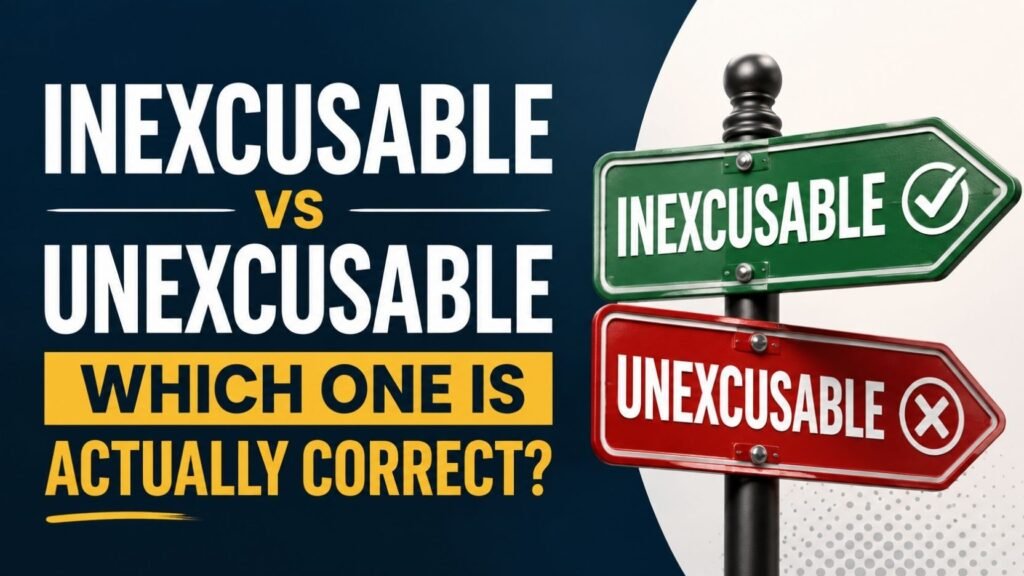
If you have ever paused mid-sentence wondering whether to write “inexcusable” or “unexcusable,” you are not alone. Both words look reasonable. Both seem to follow normal English patterns. But only one of them is considered correct in modern, standard English.
The short answer: inexcusable is the correct word. It means something that cannot be justified, forgiven, or defended. “Unexcusable” shows up here and there online, but major dictionaries do not recognize it as standard, and careful writers avoid it.
This guide walks through what inexcusable actually means, why “unexcusable” keeps showing up anyway, how the word behaves in a sentence, and how to use it with confidence in everyday writing.
What Does Inexcusable Mean?
Inexcusable is an adjective. It describes an action, behavior, mistake, or decision that is so wrong it cannot be excused, forgiven, or reasonably explained away.
At its core, the word answers one simple question: can this be justified? If the answer is no, inexcusable is the right word.
- His comment during the meeting was inexcusable.
- Ignoring a direct safety warning is inexcusable.
- The company’s delay in responding to the recall was inexcusable.
Notice that inexcusable almost always describes conduct, not objects. You would not call a broken chair inexcusable. You would call a person’s behavior, decision, silence, or delay inexcusable, because those are things a person is responsible for.
See More: Hypothesis Or Hypotheses
Why Does “Unexcusable” Exist at All?
English builds negative adjectives with a small handful of prefixes: un-, in-, im-, il-, and ir-. Which prefix attaches to which word is not always predictable, and that inconsistency is exactly why mix-ups like this one happen.
Compare these pairs:
| Base Word | Correct Negative Form | Incorrect Form |
| excusable | inexcusable | unexcusable |
| happy | unhappy | inhappy |
| possible | impossible | unpossible |
| legal | illegal | unlegal |
“Un-” is the most common negative prefix in English, so it feels like a safe default. When a word like excusable takes in- instead, it goes against that instinct, and “unexcusable” slips out as a natural-sounding but nonstandard guess.
Some older or regional sources do list “unexcusable” as a rare variant, and it was used more freely a few centuries ago. But in modern English, style guides and dictionaries treat it as nonstandard. If you are writing anything formal, professional, or public-facing, unexcusable is not the safer choice.
Inexcusable Vs Unexcusable: Quick Comparison
| Inexcusable | Unexcusable | |
| Standard in modern English | Yes | No |
| Found in major dictionaries as the primary entry | Yes | Rarely, if at all |
| Safe for formal or professional writing | Yes | No |
| Common in everyday, informal use | Yes | Occasionally, by mistake |
If you remember nothing else from this article, remember this: when in doubt, choose inexcusable.
Where Does The Word Come From?
Inexcusable traces back to the Latin word excusare, meaning “to free from blame” or “to make an excuse for.” That root passed into English through excuse and excusable.
Adding the prefix in- (meaning “not”) to excusable gives you inexcusable: literally, “not excusable,” or something that cannot be freed from blame. This pattern is consistent with other Latin-derived English adjectives that also take in-, such as inevitable and inconceivable.
Because excusable came into English through Latin rather than through native Old English roots, it followed the Latin-style negative prefix in- rather than the native English un-. That single detail explains most of the confusion people have today.
How To Pronounce Inexcusable
Inexcusable is pronounced: in-ik-SKYOO-zuh-buhl
- Stress falls on the third syllable: SKYOO.
- It has five syllables total: in / ex / cus / a / ble.
- The “s” in the middle sounds like a “z,” similar to the “s” in excuse when used as a verb (“to excuse someone”).
There is no difference in pronunciation between American and British English for this word.
Inexcusable In A Sentence
Here are a few natural examples showing how the word works across different situations:
- Missing three deadlines in a row is inexcusable for a project manager.
- The referee’s decision to ignore the foul was inexcusable.
- Speaking to a customer that way was completely inexcusable.
- Her lateness might be understandable once, but doing it every single day is inexcusable.
You will also often see inexcusable paired with intensifiers, since the word already carries strong disapproval:
- Absolutely inexcusable
- Completely inexcusable
- Utterly inexcusable
These pairings are common in speech and writing because inexcusable is rarely used for small, minor issues. It is reserved for behavior that genuinely crosses a line.
See More: Mines Vs Mine
Is Inexcusable A Strong Word?
Yes. Inexcusable is a strong, emotionally loaded word. It does more than say something is wrong; it says the wrongdoing has no valid defense at all.
Compare it to milder alternatives:
- Unfortunate: regrettable, but not necessarily anyone’s fault.
- Understandable, but wrong: there is at least some context that softens the blame.
- Inexcusable: there is no context that makes this acceptable.
Because of that weight, inexcusable is commonly used in situations involving serious mistakes, ethical failures, safety violations, or repeated bad behavior, rather than everyday slip-ups.
Common Mistakes With Inexcusable
Mistake 1: Spelling it “unexcusable.”
❌ His mistake was unexcusable.
✅ His mistake was inexcusable.
Mistake 2: Using it for things instead of actions. Inexcusable describes behavior, not broken objects or bad luck.
❌ The cracked phone screen was inexcusable.
✅ Dropping the phone after being warned twice was inexcusable.
Mistake 3: Confusing it with “excusable.” Excusable means something can be forgiven or justified. Inexcusable means the opposite.
- Being five minutes late due to traffic is usually excusable.
- Being three hours late with no explanation is inexcusable.
Mistake 4: Assuming British and American English differ here. They do not. Both varieties of English use inexcusable as the standard spelling, and both treat unexcusable as nonstandard.
Synonyms And Related Words
Several words share ground with inexcusable, though each carries a slightly different shade of meaning.
| Word | Meaning | How It Differs From Inexcusable |
| Unforgivable | Cannot be forgiven | Focuses on forgiveness rather than justification |
| Unjustifiable | Cannot be justified | Very close in meaning; often interchangeable |
| Unacceptable | Not allowed or tolerated | Broader; can apply to minor rule-breaking too |
| Indefensible | Cannot be defended | Common in arguments, decisions, or policies |
| Reprehensible | Deserving strong condemnation | Focuses more on moral judgment than justification |
Inexcusable sits closest to unjustifiable and indefensible in everyday use, though inexcusable is generally the more common, more conversational choice.
Antonym: Excusable
The direct opposite of inexcusable is excusable. Something excusable can reasonably be forgiven or explained.
- Forgetting someone’s name after meeting them once is excusable.
- Forgetting your own manager’s name after five years is inexcusable.
Seeing the two words side by side makes the meaning of each much clearer, since they sit on opposite ends of the same idea: whether an action deserves forgiveness or not.
Is Unexcusable Ever Acceptable to Use?
In casual conversation, most people will understand what you mean if you say “unexcusable.” It will not cause confusion. But it will likely read as a small error to anyone paying close attention, especially in:
- Emails to clients or supervisors
- Academic writing
- Published articles or reports
- Resumes, cover letters, and professional documents
If you want your writing to sound polished and correct, inexcusable is the safer and more accepted choice in every one of these situations.
See More: Occurring Or Occuring
Frequently Asked Questions
Is it inexcusable or unexcusable?
Inexcusable is correct. Unexcusable is considered nonstandard in modern English and is not the preferred form in dictionaries or formal writing.
Is “unexcusable” a real word?
It appears occasionally, mostly as a mistake, and a few dictionaries note it as a rare or archaic variant. It is not the standard or recommended form today.
What does inexcusable mean?
It describes behavior, action, or a mistake that cannot be justified, forgiven, or reasonably defended.
What part of speech is inexcusable?
It is an adjective. It describes a noun, usually an action, behavior, or decision.
Is inexcusable a strong word?
Yes. It expresses strong disapproval and is generally reserved for serious wrongdoing rather than minor issues.
What is a synonym for inexcusable?
Common synonyms include unjustifiable, indefensible, unforgivable, and unacceptable.
What is the opposite of inexcusable?
The opposite is excusable, meaning something that can be forgiven or reasonably explained.
Where does the word inexcusable come from?
It comes from the Latin word excusare (“to free from blame”), through the English words excuse and excusable, with the negative prefix in- added.
Is there a difference between British and American English here?
No. Both use inexcusable as the standard spelling and treat unexcusable as incorrect or nonstandard.
How do you use inexcusable in a sentence?
Use it to describe behavior with no valid excuse, such as: “Ignoring the warning signs was inexcusable.”
Final Thoughts
The difference between inexcusable and unexcusable comes down to one simple fact: only one of them is considered standard English today. Inexcusable is the word recognized by dictionaries, style guides, and careful writers everywhere, while unexcusable remains a rare, nonstandard variant that is best avoided.
Once you understand why the confusion happens, the choice becomes easy to remember. English usually reaches for un- as its default negative prefix, but excusable is one of the exceptions that took in- instead, because of its Latin roots. Keep that in mind, and you will never have to second-guess this word again.

Abdul Rehman Jutt is the author behind Grammar Wordz, with 4 years of experience researching and writing about English grammar, words, meanings, and language rules. Their goal is to make grammar simple, clear, and easy to understand through accurate and useful explanations.