
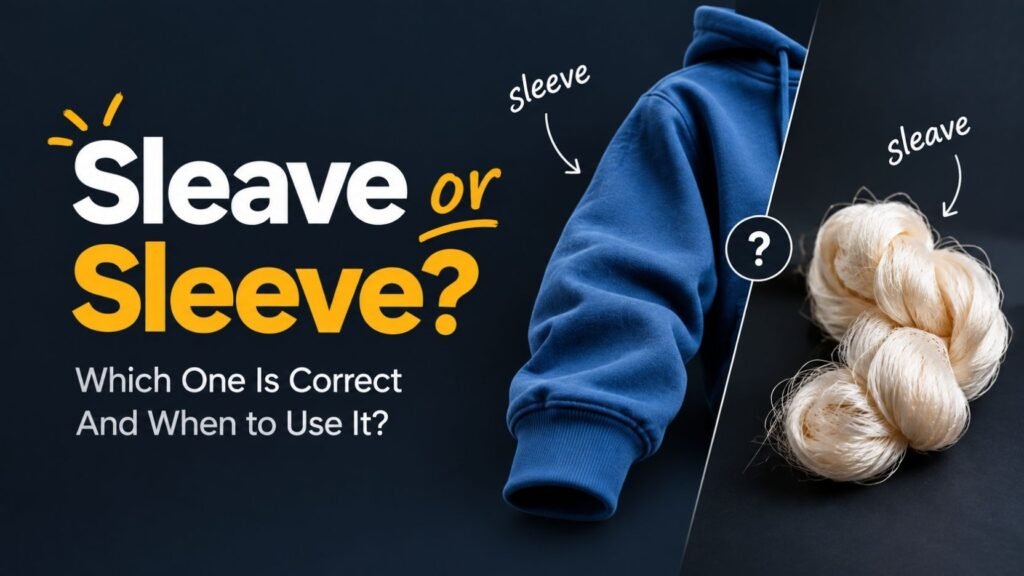
If you are typing a sentence about a shirt, a tattoo, a laptop cover, or a surgery, and you pause because “sleeve” suddenly looks wrong, you are not alone. The confusion is common, and it has a simple answer.
Sleeve is the word you want almost every time. It means the part of a garment that covers the arm, or, more broadly, a tube-shaped cover that protects or holds something, such as a laptop sleeve or a card sleeve. Sleave is a real but very rare word. It refers to a tangled or unseparated strand of silk thread, and today it survives mainly in old poetry, in Shakespeare, and in specialist textile writing.
For a clothing question, a tattoo question, a laptop case question, or a medical question, “sleeve” is always correct. Reserve “sleave” for the narrow, old-fashioned meaning tied to silk and thread, where it still has a proper, if uncommon, place.
Quick Answer
| Question | Answer |
| Is it “sleave” or “sleeve” for a shirt arm? | Sleeve |
| Is it “sleave” or “sleeve” for a tattoo? | Sleeve |
| Is it “sleave” or “sleeve” for a laptop case? | Sleeve |
| Is it “sleave” or “sleeve” for gastric surgery? | Sleeve |
| Is “sleave” a real word? | Yes, but it means tangled silk thread, not a garment part |
| Do they sound the same? | Yes, both are pronounced “sleev” |
See More: Height Vs Hight
Sleave or Sleeve: The Simple Rule
Here is the rule in one sentence: if you can picture an arm, a tube, or something being covered, write sleeve. If you are quoting old English poetry about silk, or discussing raw, untwisted thread, you may be looking at sleave.
These two words are not simply a “right spelling” and a “wrong spelling” of the same idea. They are two separate English words that happen to sound identical and look almost identical on the page. That is exactly why people mix them up. English has plenty of these near-twin pairs, and “sleave or sleeve” is one of the more obscure ones, because most readers have never met “sleave” at all.
For everyday writing, in emails, product descriptions, school essays, or social posts, you will use “sleeve” in almost every situation. “Sleave” only becomes relevant if you are working with older texts, studying Shakespeare, or writing about historical silk production.
What Does Sleeve Mean?
Sleeve (noun) has two closely related core meanings.
Meaning 1: The part of a garment that covers the arm. This is the everyday meaning almost everyone knows. A shirt sleeve, a jacket sleeve, or a dress sleeve is the fabric tube that the arm goes through.
- Example: She rolled up her sleeve before washing the dishes.
- Example: The jacket has a torn sleeve on the left side.
Meaning 2: A tube-shaped covering that protects or holds an object. Outside of clothing, “sleeve” describes anything shaped like a tube or a sheath that slides over something else to protect it.
- Example: He kept the record in its original cardboard sleeve.
- Example: The knife came with a leather sleeve for safe storage.
Sleeve can also work as a verb, meaning to fit something with a sleeve or to enclose it in a sleeve-like cover, as in “sleeve the trading card before storing it in the box.”
Table: Common Types of “Sleeve”
| Term | What It Means | Typical Context |
| Long sleeve | A sleeve that covers the whole arm to the wrist | Shirts, dresses, sweaters |
| Short sleeve | A sleeve that ends above the elbow | Button-up shirts, t-shirts |
| Puff sleeve | A sleeve gathered to stand out from the arm | Formal or vintage-style dresses |
| Raglan sleeve | A sleeve that extends in one piece to the collar | Baseball tees, sportswear |
| Tattoo sleeve | Tattoo work that covers most or all of an arm | Body art |
| Laptop sleeve | A padded case shaped to fit a laptop | Bags, tech accessories |
| Knee sleeve | A compression band worn around the knee | Workouts, joint support |
| Leg sleeve or arm sleeve | A fitted fabric tube worn on the leg or arm | Sports, sun protection, recovery |
| Card sleeve | A thin plastic cover for a trading or playing card | Card games, collecting |
| Gastric sleeve | A surgical procedure that removes part of the stomach | Weight loss surgery |
Every single one of these uses the word “sleeve,” never “sleave,” because each one describes a covering, a tube, or a garment part.
What Does Sleave Mean?
Sleave is a noun, and in older usage also a verb, tied to raw silk and unseparated thread. It is not a misspelling of “sleeve.” It is its own word, just a much rarer one.
Meaning 1 (noun): A tangled or knotted strand of silk or thread. Merriam-Webster defines sleave simply as a skein, and older dictionaries describe it as the knotted or entangled part of silk or thread, or silk that has not yet been twisted.
Meaning 2 (noun, historical): Sleave silk. “Sleave silk” was floss silk, a soft, loosely twisted silk that separates easily into thin filaments, once used for embroidery. Merriam-Webster records its first known use in English back to 1588 and marks the term as obsolete today.
Meaning 3 (verb, archaic): To separate or divide threads. Older dictionaries, including Webster’s 1828 Dictionary, list “sleave” as a verb used by weavers, meaning to separate threads or to divide a bundle of thread into single strands. This sense is sometimes spelled “sley” as well.
You will not run into “sleave” in ordinary modern writing. It shows up almost exclusively in three places: literary criticism, historical or poetic texts, and detailed discussions of textile history.
The Famous Shakespeare Line
The best-known appearance of “sleave” is in Shakespeare’s Macbeth. After murdering King Duncan, Macbeth describes sleep as something that “knits up the ravelled sleave of care.” Here, “sleave” refers to a tangled, unravelled strand of silk. The image is that troubled thoughts are like knotted, messy silk thread, and sleep is what smooths and reknits that tangle back into order.
This line is frequently misquoted or misprinted as “the ravelled sleeve of care,” swapping in the everyday word “sleeve.” That version sounds natural to modern readers because “sleeve” is the word we actually use, but it changes the image Shakespeare intended. A sleeve on a shirt is not something that gets “ravelled” the way a strand of loose silk does. The original word is “sleave,” and it fits the metaphor of untangling far better than a garment part would.
Sleave vs Sleeve: Side-by-Side Comparison
| Feature | Sleeve | Sleave |
| Common today | Yes, very common | No, rare and mostly literary |
| Core meaning | Garment arm covering; tube-shaped cover | Tangled or unseparated silk thread |
| Part of speech | Noun, also used as a verb | Noun, and historically a verb |
| Pronunciation | Sleev | Sleev (same sound) |
| Typical use | Clothing, tech accessories, medical terms, gaming, sports | Poetry, Shakespeare, textile history |
| Example sentence | She wore a long sleeve dress to the interview. | The old text describes sleave silk used in embroidery. |
Grammar: Part of Speech
Sleeve functions mainly as a noun: “the sleeve of the coat.” It can also function as a verb, especially in card-collecting and record-collecting communities, meaning to place something inside a protective sleeve: “Always sleeve your cards before shipping them.”
Sleave functions as a noun in its standard dictionary sense, referring to the tangled thread itself. Historically it also worked as a verb, meaning to separate or untwist thread, a usage tied specifically to weaving and silk work and now considered archaic.
Neither word changes form in unusual ways. Sleeve becomes “sleeves” in the plural and “sleeved” or “sleeving” as a verb. Sleave becomes “sleaves” in the rare cases it is pluralized, and historically “sleaved” or “sleaving” as a verb.
How to Pronounce Sleave and Sleeve
This is part of why the two words get confused so easily: they are pronounced the same way. Both rhyme with “leave” and are said as “sleev,” with a long E sound. Older dictionary entries transcribe “sleave” phonetically as “slēv,” identical to how “sleeve” is said.
Because the words sound alike and are spelled almost the same, the difference only shows up in writing. There is no pronunciation trick that will tell you which one to use. You have to rely on meaning and context instead.
Origin of Sleeve
“Sleeve” comes from Old English slīef or slēfe, related to a Germanic root meaning to slide or to put on, connected to the idea of the arm sliding into the garment. Over centuries the spelling settled into “sleeve,” and the meaning expanded from clothing to any tube-shaped covering, which is why we now also talk about a laptop sleeve or a record sleeve.
Origin of Sleave
“Sleave” traces back to Middle English sleve or sleven, connected to a root meaning to split or to disentangle. Some etymological sources connect it further to Old English slǣfan, tied to the idea of cutting or splitting. This origin fits the meaning well: sleave is thread that has been split apart or left in a loose, tangled state, rather than twisted into a smooth strand.
Although “sleeve” and “sleave” likely share very distant linguistic roots connected to splitting, cutting, or sliding, they developed into two separate words with two separate meanings by the time modern English took shape.
See More: Fillet Vs Chamfer
Is Sleave A Real Word?
Yes. “Sleave” is a legitimate, dictionary-recognized English word, confirmed by Merriam-Webster, Collins, and multiple historical dictionaries. It is valid in Scrabble and other word games.
It is simply rare, specialized, and largely restricted to literary and historical contexts today. If you search for “sleave” in a general-purpose dictionary, you will find it, but you will also usually see a label such as “archaic,” “obsolete,” or “literary,” marking it as uncommon in everyday speech.
Common Mistakes With Sleave And Sleeve
Because the words are homophones, the most frequent error is using “sleave” when “sleeve” is meant, almost always in the context of clothing, accessories, or medical terms.
❌ Incorrect: I need a long sleave shirt for the winter.
✅ Correct: I need a long sleeve shirt for the winter.
❌ Incorrect: He got a full tattoo sleave on his right arm.
✅ Correct: He got a full tattoo sleeve on his right arm.
❌ Incorrect: She is scheduled for gastric sleave surgery next month.
✅ Correct: She is scheduled for gastric sleeve surgery next month.
❌ Incorrect: Put your laptop in its protective sleave before packing it.
✅ Correct: Put your laptop in its protective sleeve before packing it.
❌ Incorrect: He wore a knee sleave during the workout.
✅ Correct: He wore a knee sleeve during the workout.
The reverse mistake, writing “sleeve” when the older meaning of “sleave” is intended, is less common in everyday writing, but it happens often in reprints and casual quotations of the Macbeth line, where “the ravelled sleeve of care” appears instead of the original “ravelled sleave of care.”
💡 Tip: If you are not discussing silk thread, old poetry, or Shakespeare, you almost certainly want “sleeve.”
Sleeve In Clothing And Fashion
Clothing is where “sleeve” appears most often, and it comes with its own set of describing words.
- Long sleeve: covers the arm down to the wrist, common in long sleeve shirts, long sleeve dresses, and long sleeve maxi dresses.
- Short sleeve: ends above the elbow, as in a short sleeve button up shirt.
- Sleeveless: a garment with no sleeve at all.
- Puff sleeve: gathered fabric that puffs out at the shoulder or upper arm, often seen on formal or vintage-inspired dresses.
- Half sleeve: a sleeve that ends partway down the arm, between short and long.
- Cap sleeve: a very short sleeve that barely covers the shoulder.
A long sleeve wedding dress, a black long sleeve dress, or a white long sleeve shirt are all everyday examples of the word doing its main job: describing how much of the arm a garment covers.
Sleeve Beyond Clothing
The word “sleeve” stretches naturally into other fields, always keeping the core idea of a covering or a tube.
Tattoo sleeve: a large tattoo, or a connected set of tattoos, that covers most or all of the arm, often described as a half sleeve or a full sleeve depending on coverage.
Laptop sleeve: a padded, form-fitting case that slides over a laptop to protect it from scratches and light impact, distinct from a bag because it has no straps or extra compartments.
Gastric sleeve: short for sleeve gastrectomy, a weight-loss surgery in which a large portion of the stomach is removed, leaving a narrower, sleeve-shaped stomach. This is a medical term, and if you are researching the procedure, always confirm details with a licensed medical professional rather than general definitions.
Knee sleeve, leg sleeve, arm sleeve: fitted fabric or neoprene tubes worn during exercise, sports, or recovery, offering light compression, warmth, or support around a joint or limb.
Card sleeve and record sleeve: a thin protective cover, plastic for trading cards and playing cards, paper or cardboard for vinyl records, used to prevent scratches, bending, and wear.
Table: Sleeve Across Different Fields
| Field | Meaning of “Sleeve” |
| Clothing | The part of a garment covering the arm |
| Tattoo art | A large tattoo design covering the arm |
| Technology | A padded case for a laptop or tablet |
| Medicine | Short for sleeve gastrectomy, a stomach-reduction surgery |
| Sports and fitness | A compression band for the knee, leg, or arm |
| Card and record collecting | A thin protective cover to prevent damage |
| Weaving and machinery | A tube-shaped part that fits over a rod, pipe, or shaft |
Sleeve As A Verb
Outside its main use as a noun, “sleeve” also works as a verb in a few specific communities. Card collectors “sleeve” their cards, meaning they place each card inside a thin plastic protector. This might involve a single sleeve, or “double sleeving,” which means placing a card in two layers of protection, one snug inner sleeve and one looser outer sleeve, for extra durability during regular handling or shipping.
- Example: Always sleeve your rare cards before putting them in a binder.
- Example: For tournament play, many players prefer double sleeving over a single sleeve.
See More: Spicy Vs Hot
Synonyms And Related Words
| Word | Meaning | How It Differs From Sleeve |
| Cuff | The end part of a sleeve, near the wrist | A cuff is part of a sleeve, not the whole sleeve |
| Casing | A protective outer covering | Broader term, not limited to arm-shaped or tube-shaped items |
| Sheath | A close-fitting cover, often for a blade | More common for tools and weapons than clothing |
| Jacket (of a record) | The outer cover of a vinyl record | Regional alternative to “sleeve” in some contexts |
| Sleave | Tangled silk thread | Unrelated in meaning; related only by spelling and sound |
Frequently Asked Questions
Is it “sleave” or “sleeve” for a shirt?
It is “sleeve.” A shirt sleeve is the part that covers the arm. “Sleave” refers to tangled silk thread and has nothing to do with garments.
What does “sleave” mean?
“Sleave” is a noun meaning a tangled or unseparated strand of silk or thread. It was historically also used as a verb meaning to separate thread. Today it appears mainly in literature and textile history.
Is “sleave” a word in Scrabble?
Yes, “sleave” is a valid Scrabble word, since it is a recognized dictionary entry, though it is rarely useful because it does not commonly appear in everyday text.
Why does the Macbeth quote say “sleave” instead of “sleeve”?
Shakespeare’s original line describes sleep as something that “knits up the ravelled sleave of care,” comparing troubled thoughts to tangled silk thread that sleep smooths out. Many modern reprints and quotations mistakenly change it to “sleeve,” which changes the intended image.
Do “sleave” and “sleeve” sound the same?
Yes. Both words are pronounced “sleev,” rhyming with “leave.” The identical pronunciation is a major reason the two get confused in writing.
Is “gastric sleeve” spelled with an “e” or an “a”?
It is spelled “gastric sleeve,” referring to the sleeve-shaped stomach created during the procedure. “Gastric sleave” is incorrect.
What is the difference between a sleeve and a half sleeve?
A sleeve, in tattoo or clothing contexts, generally refers to full coverage of the arm, while a half sleeve covers roughly the upper or lower half of the arm rather than the entire length.
What does it mean to “sleeve a card”?
It means placing a trading card or playing card inside a thin plastic protective cover to prevent scratches, bending, and general wear from handling.
Is “sleeve” a noun or a verb?
“Sleeve” is primarily a noun, referring to a garment part or a protective covering. It also functions as a verb, especially in card collecting, meaning to place an item into a protective sleeve.
Can “sleave” ever correctly describe clothing?
No. Even though “sleave” and “sleeve” look and sound alike, “sleave” never refers to a part of a garment. Its meaning is limited to tangled or unseparated thread, mainly silk.
Conclusion
The choice between “sleave or sleeve” comes down to meaning, not just spelling. “Sleeve” is the everyday word for the part of a garment that covers the arm, and it extends naturally to tattoos, laptop cases, knee supports, gastric surgery, and card protectors. “Sleave” is a genuine but rare English word for tangled or unseparated silk thread, best known from its appearance in Shakespeare’s Macbeth, where sleep is described as untangling the “ravelled sleave of care.”
For nearly every sentence you will ever write, “sleeve” is the correct choice. Keep “sleave” in reserve for the rare moments you are discussing old silk work, quoting Shakespeare accurately, or exploring the history of English thread and weaving vocabulary. Knowing the difference will keep your writing accurate, and it also means you will recognize one of English’s more interesting and overlooked word pairs the next time you come across it.

Abdul Rehman Jutt is the author behind Grammar Wordz, with 4 years of experience researching and writing about English grammar, words, meanings, and language rules. Their goal is to make grammar simple, clear, and easy to understand through accurate and useful explanations.