
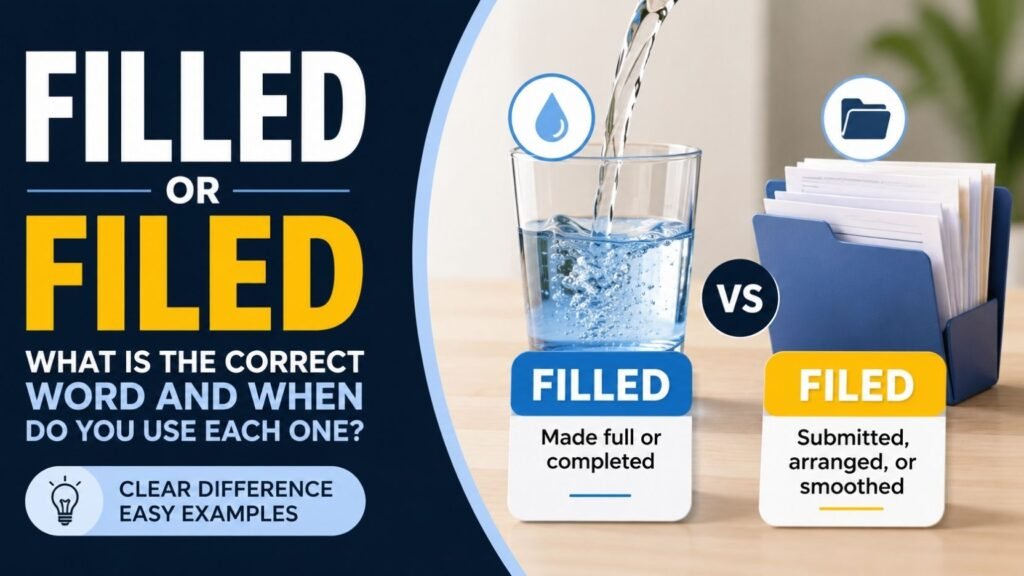
“Filled” and “filed” are two different words with two different meanings. Filled means made full, completed, or occupied with something. Filed means submitted officially, arranged in order, or smoothed down with a tool. They are not spelling variations of the same word, so choosing between them depends entirely on what you are trying to say.
Many people search for “filled or filed” because the words look similar and sound almost alike when spoken quickly. This mix-up is common with forms, tax returns, applications, and legal documents, where both words can seem to fit at first glance. Understanding the small but important difference will help you write and speak with confidence in emails, paperwork, and everyday conversation.
Filled Or Filed: The Quick Answer
If something became full or was completed with contents, use filled. If something was submitted, registered, or officially recorded, use filed. A cup is filled with water. A tax return is filed with the government. A form is usually filled out and then filed once it reaches the office that processes it.
Here is the simplest way to remember it:
| Word | Core Meaning | Comes From |
| Filled | Made full or complete | The verb “fill” |
| Filed | Submitted, arranged, or smoothed | The verb “file” |
These two verbs are unrelated in origin, even though they sound alike. Knowing that they come from completely different root words is the fastest way to stop confusing them.
See More: Inexcusable Vs Unexcusable
What Does “Filled” Mean?
Filled is the past tense and past participle of the verb “fill.” It describes something that has become full, or something that now contains a substance, object, or feeling that it did not have before.
Meaning 1: Made full with a substance
This is the most common meaning. A container, space, or object is filled when it holds as much of something as it can, or simply holds a noticeable amount of it.
- The glass was filled with orange juice.
- Her eyes filled with tears during the movie.
- The balloon was filled with helium.
Meaning 2: Completed or occupied
“Filled” can also describe a role, position, or space that has been taken or completed.
- The job vacancy has been filled.
- Every seat in the theater was filled before the show started.
Meaning 3: Supplied a prescription
In everyday American English, a pharmacy “fills” a prescription, meaning it prepares and provides the medication.
- I need to get my prescription filled today.
In each case, the core idea stays the same: something moves from empty, open, or incomplete to full, occupied, or complete.
What Does “Filed” Mean?
Filed is the past tense and past participle of the verb “file.” Unlike “filled,” the verb “file” has two distinct meanings, and both are common in everyday English.
Meaning 1: Submitted or officially recorded
This is the meaning most people search for. When a document, form, claim, or legal request is filed, it has been formally submitted to an office, court, or government body, usually so it becomes part of an official record.
- She filed her tax return before the deadline.
- The company filed for bankruptcy last year.
- His lawyer filed a lawsuit against the manufacturer.
Meaning 2: Arranged or stored in order
“File” also means to place documents, papers, or records into a system so they can be found later, such as a folder, cabinet, or digital storage system.
- The receipts were filed alphabetically.
- Please file these invoices under the client’s name.
Meaning 3: Smoothed or shaped with a tool
A separate but common use of “file” involves a physical tool called a file, used to smooth or shape a hard surface such as a fingernail or a piece of metal.
- She filed her nails before the interview.
- He filed down the rough edge of the metal bracket.
Even though these three meanings look different, they share one theme: something is being placed, shaped, or recorded through a deliberate, organized action.
Filled Or Filed: Side-By-Side Comparison
Seeing both words next to each other, in similar sentence patterns, makes the difference easier to remember.
| Sentence With Filled | Sentence With Filed |
| I filled the form with my personal details. | I filed the form with the passport office. |
| The tank was filled with gasoline. | The complaint was filed with the police station. |
| Her schedule was completely filled for the week. | Her tax documents were filed a week early. |
| The bottle is filled to the top. | The paperwork is filed in the top drawer. |
Notice the pattern: filled describes the inside of something becoming full, while filed describes an outward action of submitting, recording, or shaping something.
The Most Confused Case: Filled Out A Form, Then Filed It
This is where most of the confusion happens, especially with taxes, job applications, immigration forms, and legal paperwork. The confusion makes sense, because both actions usually happen with the same document, one right after the other.
Here is the correct order of events:
- You fill out a form. This means writing information into the blank spaces.
- Once it is complete, you file it. This means submitting it to the correct office, agency, or system.
So the accurate phrasing depends on which stage you are describing.
- “I filled out the application” describes the act of writing the answers.
- “I filed the application” describes the act of submitting it once it was ready.
A sentence like “I filled the tax return” is grammatically understandable, but it is not the natural or standard phrasing. Native English speakers say “I filed my tax return” or “I filled out my tax return,” not “I filled my tax return.”
Quick Reference Table
| Stage | Correct Verb | Example |
| Writing information into blanks | Filled out | She filled out the job application. |
| Submitting the completed document | Filed | She filed the job application with HR. |
Filled Or Filed: Tax Returns And Legal Filings
Tax season and legal news are two of the biggest reasons people search for the correct word, since headlines and government instructions use “filed” constantly.
Tax returns are always described as being filed, never filled, once they reach the tax authority.
- “When do taxes have to be filed” is asking about the submission deadline, not about writing numbers into boxes.
- “Married filing jointly” describes a tax status chosen when a couple files one combined tax return together.
- A return is considered filed once it has been submitted to the tax authority, whether electronically or by mail.
Legal documents follow the same pattern. Lawsuits, claims, motions, and official complaints are filed with a court or agency.
- A class action lawsuit is filed when a law firm submits it to a court on behalf of a group of people.
- Articles of impeachment are filed when they are formally submitted to a legislative body for consideration.
- Bankruptcy is filed when a person or company submits a formal request to a bankruptcy court.
- H1B visa applications are filed with immigration authorities during a specific filing period each year.
- A company’s financial statements may be filed with a regulatory body, such as a companies registrar, as part of routine compliance.
In every one of these cases, “filed” refers to the formal act of submission, not to any process of making something full.
A Note On Repeated Bankruptcy Or Lawsuit Filings
News stories sometimes discuss how many times a public figure or company has filed for bankruptcy, or how many lawsuits someone has filed. In grammar terms, this is simply the plural use of the same core meaning: each bankruptcy case or lawsuit is one act of filing, and the count adds up the number of separate filings over time. This is a factual, case-by-case matter rather than a language question, so exact numbers should always be checked against current, reliable news sources rather than assumed.
Filled Or Filed: Everyday Object Examples
Away from paperwork, “filled” and “filed” show up constantly in daily conversation, shopping, and product descriptions.
Filled: Food, Drinks, And Objects
- Jelly filled donuts and cream filled donuts describe pastries with a soft filling injected inside them.
- An oil filled radiator heater, sometimes called an oil filled heater or oil filled space heater, is a heater that uses sealed oil inside its panels to store and release heat.
- A down filled jacket, such as a girls’ freestyle down filled caviar jacket, uses down feathers as insulation inside the fabric layers.
- Balloons filled with helium float because helium is lighter than the surrounding air.
- A fun filled board game set or a fun filled weekend describes an experience that felt full of enjoyable activity.
See More: Hypothesis Or Hypotheses
Filed: Tools, Beauty And Organization
- Filed nails means nails that have been shaped and smoothed using a nail file.
- Filed paperwork means documents placed into a folder, cabinet, or digital system for storage and retrieval.
A Special Case: Gold Filled Jewelry
“Gold filled” is a specific jewelry term, and it is genuinely spelled with “filled,” not “filed.” Gold filled jewelry is made by mechanically bonding a solid layer of gold to a base metal core, using heat and pressure, so the gold layer is thicker and more durable than a plated layer.
Gold plated jewelry, by comparison, has only an extremely thin layer of gold applied through an electroplating process, which tends to wear off faster than gold filled jewelry.
| Feature | Gold Filled | Gold Plated |
| Gold layer thickness | Thicker, bonded layer | Very thin, electroplated layer |
| Durability | More durable over time | Wears down faster |
| Typical price | Higher than plated | Lower than filled |
This term uses “filled” because the gold layer is treated as if it fills or coats the base metal in a substantial way, unlike the thin, quick coating used in plating.
Medical And Physical Descriptions Using “Filled”
“Filled” is also common in everyday descriptions of the body, since it naturally describes something containing fluid or substance.
- A blood filled pimple describes a raised bump under the skin containing blood rather than the usual pus, often caused by irritation or picking at the skin.
- A soft fluid filled lump on a baby’s head may describe a swelling that contains fluid rather than solid tissue.
These are descriptive, everyday phrases rather than formal medical terms. If you notice a lump or unusual swelling, especially on a baby, it is best to have it checked by a doctor rather than relying on general descriptions found online.
Grammar Breakdown: Filled
Part of speech: Past tense and past participle of the verb “fill”; also used as an adjective.
Base form: Fill Past tense: Filled Past participle: Filled Present participle: Filling
As a verb:
- Present: I fill the bottle every morning.
- Past: I filled the bottle yesterday.
- Perfect: I have filled the bottle already.
As an adjective:
- A filled water bottle sat on the desk.
- The filled seats stretched across the entire stadium.
“Filled” follows the regular pattern of adding “-ed” to form both the past tense and the past participle, so there is no irregular spelling to memorize.
Grammar Breakdown: Filed
Part of speech: Past tense and past participle of the verb “file”; also used as an adjective.
Base form: File Past tense: Filed Past participle: Filed Present participle: Filing
As a verb:
- Present: She files the reports every Friday.
- Past: She filed the reports last Friday.
- Perfect: She has filed the reports already.
As an adjective:
- The filed documents sat neatly in the cabinet.
- Her filed nails looked smooth and rounded.
Because the base verb ends in a silent “e,” it simply drops the “e” before adding “-ed,” which gives “filed” rather than “fileed.”
How To Pronounce Filled And Filed
The pronunciation difference is small but important, and it is one reason the two words get confused in speech.
- Filled is pronounced “fild,” rhyming with “build” and “billed.” It has a short “i” sound.
- Filed is pronounced “fyld,” rhyming with “mild” and “styled.” It has a long “i” sound, close to the word “eye.”
If you say the two words slowly side by side, “filled” sounds flatter and shorter, while “filed” has a slightly stretched, gliding vowel sound. In fast, casual speech, this difference can blur, which is part of why writers sometimes type the wrong one by mistake.
Origin Of Filled And Filed
Filled comes from the Old English word “fyllan,” which meant to make full. This word is related to the adjective “full,” and the connection between “fill” and “full” has stayed consistent through centuries of English.
Filed, in the sense of submitting or organizing documents, comes from the Old French word “filer,” meaning to string documents together on a thread or wire, which was once a literal method of organizing papers. Over time, this evolved into the modern meaning of formally submitting or storing records.
Filed, in the sense of smoothing a surface, comes from a separate but older root, the Old English word “feol,” referring to the physical tool used for smoothing metal or other hard materials.
So while “filled” traces back to one consistent root about fullness, “filed” actually blends two different historical paths, one about paperwork and one about a physical tool, that happen to share the same modern spelling.
Common Mistakes With Filled Or Filed
❌ Incorrect: I filled my taxes yesterday.
✅ Correct: I filed my taxes yesterday.
Taxes are submitted to a tax authority, so “filed” is the correct word here, not “filled.”
❌ Incorrect: Please filed out this form before submitting.
✅ Correct: Please fill out this form before submitting.
“Filed” is a past tense verb, so it cannot follow “please” in an instruction. The base form “fill” is needed here.
❌ Incorrect: The lawsuit was filled against the company.
✅ Correct: The lawsuit was filed against the company.
Legal documents are filed with a court, so “filled” does not fit this context.
❌ Incorrect: She filed her water bottle before the hike.
✅ Correct: She filled her water bottle before the hike.
A water bottle becomes full of liquid, so “filled” is correct, not “filed.”
❌ Incorrect: He filed his nails until they were smooth, then he filled the paperwork.
✅ Correct: He filed his nails until they were smooth, then he filed the paperwork.
Both actions here use “filed,” since shaping nails and submitting paperwork are both meanings of “file,” while “filled” would incorrectly suggest something became full.
Filled Or Filed: Which One Is The Correct Spelling?
Neither word is a misspelling of the other. Both are correctly spelled, standard English words, but they come from different root verbs and carry different meanings. The confusion is not really about spelling at all. It is about choosing the word that matches what you are actually trying to describe: something becoming full, or something being submitted, organized, or shaped.
If you are ever unsure which one fits, ask yourself a simple question: Am I describing something becoming full, or something being submitted, arranged, or smoothed? The answer will point you to the right word almost every time.
Synonyms And Related Words
Synonyms for filled:
| Word | Meaning | Example Use |
| Full | Containing the maximum amount | The tank is full. |
| Packed | Tightly filled | The train was packed with commuters. |
| Loaded | Filled with a heavy load | The truck was loaded with boxes. |
| Stuffed | Filled tightly, often with soft material | The pillow was stuffed with feathers. |
Synonyms for filed (submission sense):
| Word | Meaning | Example Use |
| Submitted | Formally sent in | She submitted the report on time. |
| Registered | Officially recorded | The trademark was registered last year. |
| Lodged | Formally submitted, often legal | The appeal was lodged with the court. |
| Recorded | Entered into an official record | The deed was recorded at the county office. |
While these words overlap in meaning, “filed” remains the most natural and expected term in tax, legal, and administrative contexts in American English.
See More: Mines Vs Mine
Frequently Asked Questions
Is it “filled” or “filed” for taxes?
It is “filed.” You file a tax return with the tax authority once it is complete.
Is it “filled” or “filed” for a form?
Both can apply, but at different stages. You fill out a form by writing information into it, and then you file it once it is submitted to the correct office.
What is the correct spelling, filled or filed?
Both spellings are correct English words. The right choice depends entirely on the meaning you intend, not on spelling accuracy.
Is “filled” a noun or a verb?
“Filled” is primarily a verb, specifically the past tense and past participle of “fill.” It can also work as an adjective, as in “a filled container.”
How do you pronounce “filed” correctly?
“Filed” is pronounced with a long “i” sound, like “fyld,” rhyming with “mild” and “styled.”
What is the difference between “filled” and “filed” in a sentence?
“Filled” describes something becoming full or complete, such as a cup filled with coffee. “Filed” describes something being submitted, arranged, or smoothed, such as a document filed with an office.
Why do “gold filled” and “gold plated” both use different spellings than “filed”?
“Gold filled” genuinely uses the word “filled,” describing a thick, bonded layer of gold applied to a base metal. It has no connection to the word “filed,” despite the similar sound.
Can “filed” ever mean the same as “filled”?
No. Even though they sound similar, “filed” and “filled” come from different root verbs and never share the same meaning in standard English.
Is it correct to say “duly filled or filed”?
This phrase usually appears in formal or legal writing to describe a document that has both been completed correctly (filled out properly) and submitted correctly (filed with the right office). The two words are doing two separate jobs in that phrase, not repeating the same idea.
Is “filled up” the same as “filled”?
“Filled up” is a common informal phrasing that adds emphasis, often used for tanks, containers, or schedules, such as “I filled up the car with gas.” The core meaning stays the same as “filled.”
Conclusion
“Filled” and “filed” may sound alike, but they describe two completely different actions. “Filled” means something became full, complete, or occupied, whether that is a glass of water, a job vacancy, or a jacket lined with down. “Filed” means something was formally submitted, organized, or smoothed, whether that is a tax return, a lawsuit, a stack of paperwork, or a set of nails. Once you separate the idea of fullness from the idea of submission or arrangement, the choice between filled or filed becomes far easier to make.
The safest way to check your own writing is to picture the action clearly before choosing your word. If something is becoming full, reach for “filled.” If something is being sent in, recorded, or shaped, reach for “filed.” With that simple mental check, you will be able to use both words correctly, whether you are writing a tax document, describing a product, or simply telling a friend how your day went.

Abdul Rehman Jutt is the author behind Grammar Wordz, with 4 years of experience researching and writing about English grammar, words, meanings, and language rules. Their goal is to make grammar simple, clear, and easy to understand through accurate and useful explanations.