
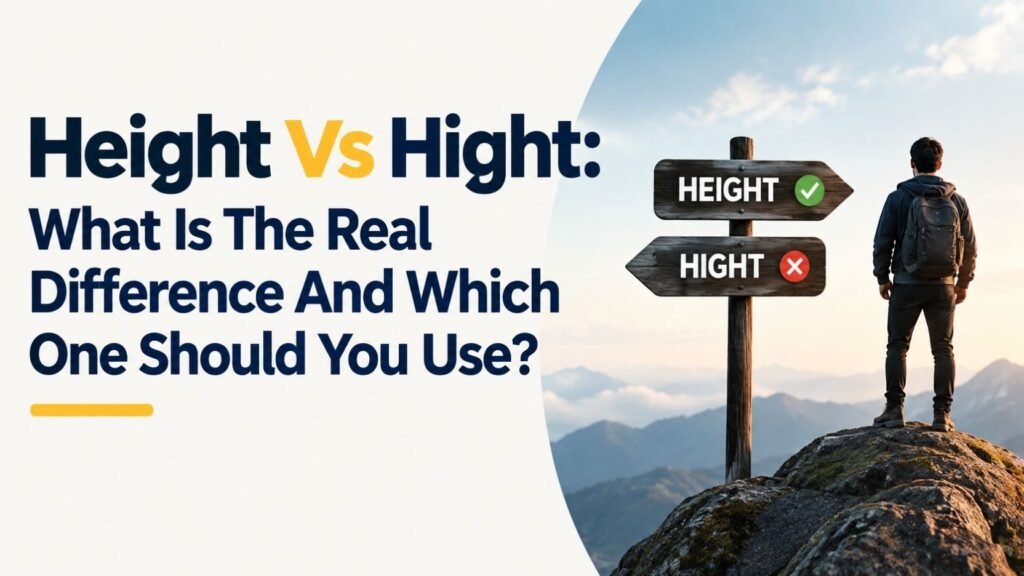
If you have ever paused while typing and wondered whether it is “height” or “hight,” you are not alone. The two words look almost identical, sound similar in some accents, and cause confusion for writers at every level. The short answer is simple: height is the correct modern word for how tall something is, and hight is an old, mostly obsolete word that once meant “called” or “named.” In everyday writing, height is almost always what you want.
Understanding why these two words get mixed up takes a little more explaining. One is a measurement term you use every day. The other is a piece of archaic English that survives mostly in old poetry, fantasy writing, and dictionaries. Knowing the difference will help you avoid an easy but noticeable spelling mistake.
What Does Height Mean?
Height is a noun. It refers to how tall a person, object, or place is, measured from the base to the top. It also refers to a high point or degree of something, as in “the height of summer” or “the height of fashion.”
Here are the core meanings:
- The measurement of how tall someone or something is (his height is six feet).
- A high point or position above ground or sea level (the plane reached a great height).
- The most intense or extreme point of a situation (the height of the pandemic).
- A high place, especially in the plural form (they built a fort on the heights above the river).
Height comes from the adjective “high,” and this is one clue for remembering the spelling. High becomes height, the same way wide becomes width and long becomes length.
See more: Fillet Vs Chamfer
What Does Hight Mean?
Hight is an archaic word. In older English, particularly Middle English and early Modern English, hight was a form of the verb “hote” or “hight,” meaning “to be called” or “to be named.” You will find it in older poetry and literature, where a character might be introduced as “a knight hight Gawain,” meaning a knight named Gawain.
Hight is not used in ordinary modern writing. It survives mainly in:
- Historical or classic literature
- Poetry written in an old-fashioned or archaic style
- Fantasy fiction that borrows old English style for tone or atmosphere
- Dictionaries, where it is labeled as archaic or obsolete
Outside of these specific contexts, hight is essentially a fossil word. Most native English speakers today have never seen it used correctly and only encounter it as a misspelling of height.
Height Vs Hight: The Core Difference
| Word | Part of Speech | Meaning | Modern Usage |
| Height | Noun | How tall something is; a high point or degree | Common, used every day |
| Hight | Archaic verb form | Called, named | Rare, found mainly in old texts |
The simplest way to remember the difference:
- Height measures how tall something is.
- Hight means “named” and is essentially retired from everyday English.
If you are writing anything modern, from an email to a school essay to a business report, height is almost certainly the word you need.
Why Do People Confuse Height And Hight?
There are a few clear reasons this mix-up happens so often.
They look nearly identical. The two words differ by a single letter, e and t swapped in placement, and that is enough to trip up even careful writers, especially when typing quickly.
Autocorrect and muscle memory. Some people learn the word “height” imperfectly and internalize an incorrect spelling pattern, especially since English spelling does not always match pronunciation in a predictable way.
Hight still appears in some names, brands, and dialects. Real surnames like Hight exist, and hight also shows up in specific products or usernames, so people sometimes see the spelling “hight” in the wild and assume it is simply a variant of height. It is not.
Regional or informal speech patterns. In casual or dialectal speech, some speakers pronounce “height” in a way that sounds closer to “hight,” reinforcing the misspelling when they write it down.
Correct Vs Incorrect Usage
Understanding real examples makes the rule easy to apply.
❌ Incorrect: What is your hight?
✅ Correct: What is your height?
❌ Incorrect: The building reached an impressive hight.
✅ Correct: The building reached an impressive height.
❌ Incorrect: Use this hight calculator to check your growth.
✅ Correct: Use this height calculator to check your growth.
✅ Correct: (archaic use only): “There dwelt a maiden hight Elaine.”
That last example shows the only situation where “hight” is grammatically legitimate: old-style or intentionally archaic writing, where it functions as a verb meaning “was named.”
How To Pronounce Height
Height is pronounced “hyte,” rhyming with “kite” or “bite.” The IPA pronunciation is /haɪt/.
A common mistake, especially among some English learners and in a few regional dialects, is pronouncing it as “heighth,” adding an extra “th” sound at the end, similar to “width” or “length.” This pronunciation is considered nonstandard in most formal English and is not reflected in the correct spelling, which has no “th.”
If hight is pronounced at all in its archaic sense, it also rhymes with “kite,” since the two words share the same vowel sound and root spelling pattern.
Height As A Grammar Point
Height is always a noun in modern English. It does not function as a verb, adjective, or adverb.
Singular and plural forms:
- Singular: height (the height of the wall)
- Plural: heights (used for multiple measurements, high places, or degrees, as in “the heights of human achievement”)
Common sentence patterns:
- Subject + verb + height: “Her height surprised everyone.”
- At + article + noun + of + height: “He stood at a height of six feet.”
- The height of + noun: used idiomatically to mean the peak or extreme, as in “the height of rudeness” or “the height of luxury.”
Related word forms:
- Heighten (verb): to increase or intensify something, as in “the music heightened the tension.”
- Heightened (adjective): increased or intensified, as in “heightened security.”
Hight, by contrast, has no modern grammatical family. It does not form standard derivatives in contemporary English, since it belongs to an older verb system that has fallen out of use.
Origin And Etymology
Height traces back to Old English “hēahþu” or “hīehþu,” related to “hēah,” meaning “high.” Over centuries, the spelling and pronunciation evolved through Middle English forms like “heighte” before settling into the modern “height.” This is consistent with many English words where an adjective (high) produces a related noun through a similar transformation pattern (wide to width, deep to depth).
Hight has a completely separate history. It comes from Old English “hātan,” meaning “to call, name, or command.” Over time, this verb produced forms like “hight” or “hoten,” used in the sense of “was called” or “was named.” This verb largely disappeared from standard English by the early modern period, surviving mainly as a literary or poetic device used by writers who wanted an old-fashioned tone.
Despite the similar spelling today, height and hight come from two unrelated word families. Their resemblance is coincidental rather than historical.
See More: Spicy Vs Hot
Height In Different Contexts
Physical measurement: The most common use, referring to a person’s or object’s vertical size. “Height calculator” tools, medical charts, and clothing size guides all use this sense of the word.
Geography and altitude: Height can describe elevation, such as the height of a mountain above sea level, or “the heights” as a place name for elevated land, as seen in many town and neighborhood names.
Figurative or idiomatic use: Height often describes the peak of an experience or quality, such as “the height of the storm” or “the height of embarrassment.” These phrases use height to mean the most extreme or intense point, not a literal measurement.
Comparative contexts: People frequently compare height between individuals, objects, or categories. This is why height comparison charts and height calculators are popular tools, especially for tracking growth, sizing products, or comparing measurements across groups such as average height for men and average height for women.
Common Mistakes To Avoid
⚠️ Writing “hight” when you mean height in any everyday sentence.
⚠️ Adding an extra “th” sound and writing “heighth,” which is not standard English.
⚠️ Assuming “hight” is simply an alternate or informal spelling of height. It is a different, archaic word with a different meaning.
⚠️ Using “highth,” an older nonstandard variant that occasionally still appears in some dialects but is not accepted in standard writing.
💡 Tip: If you are ever unsure, say the word out loud. Height rhymes with “kite,” has no “th” sound, and always refers to tallness or a peak, never to being named or called.
Similar And Related Words
| Word | Meaning | How It Differs from Height |
| Width | Measurement of side-to-side distance | Measures horizontal size, not vertical |
| Length | Measurement of how long something is | Measures longest dimension, not verticality |
| Depth | Measurement of how deep something is | Measures downward or inward distance |
| Elevation | Height above sea level | More specific to geography and altitude |
| Stature | A person’s height, often used figuratively for importance | Can describe reputation as well as physical height |
Each of these words follows a similar noun pattern formed from an adjective, which is a helpful pattern to recognize when learning English measurement vocabulary.
See More: Traveling vs Travelling
Frequently Asked Questions
What does hight mean?
Hight is an archaic English word meaning “called” or “named.” It is not a modern spelling variant of height.
Is hight a real word?
Yes, but it is considered archaic or obsolete. It appears in old literature and poetry, not in everyday modern writing.
Is height vs hight the same word with two spellings?
No. They are two separate words with different meanings and different origins. Height refers to tallness, while hight historically meant “named.”
How do you spell the measurement word correctly, height or hight?
The correct spelling for the measurement of tallness is height, spelled h-e-i-g-h-t.
Why do some people write hight by mistake?
It usually happens because the two words look similar, and some speakers are unfamiliar with the archaic word hight, so they assume it is a shorter or alternate spelling of height.
Is heighth a correct word?
No. Heighth is a nonstandard variant sometimes heard in casual speech, but it is not accepted in standard written English. The correct form is height, without the extra “th” sound.
What part of speech is height?
Height is a noun. It does not function as a verb or adjective in modern English.
Can hight ever be correct in modern writing?
Only in specific literary or stylistic contexts, such as writing that intentionally imitates old English for poetic or fantasy effect. In practical, everyday writing, height is always the correct choice.
Are Hight and Height ever used as surnames?
Hight does exist as a surname for some individuals and families, separate from its archaic meaning as a word. This is simply a proper noun and does not affect the spelling rules for the common noun height.
Does British English spell height differently from American English?
No. Height is spelled the same way in both British and American English, and the meaning does not change between the two.
Conclusion
Height and hight may look almost the same on the page, but they belong to entirely different parts of the English language. Height is the everyday word for measuring tallness, describing elevation, or expressing a peak moment, and it is the word you should use in virtually every modern sentence. Hight, on the other hand, is a piece of archaic vocabulary that once meant “called” or “named,” and it now survives mainly in old literature rather than daily conversation.
The next time you find yourself pausing over this spelling, remember the simple rule: if you are talking about how tall something is, you want height, not hight. Keeping this distinction clear will make your writing more accurate and more polished, whether you are filling out a form, comparing measurements, or simply making sure your sentence looks right.

Abdul Rehman Jutt is the author behind Grammar Wordz, with 4 years of experience researching and writing about English grammar, words, meanings, and language rules. Their goal is to make grammar simple, clear, and easy to understand through accurate and useful explanations.