
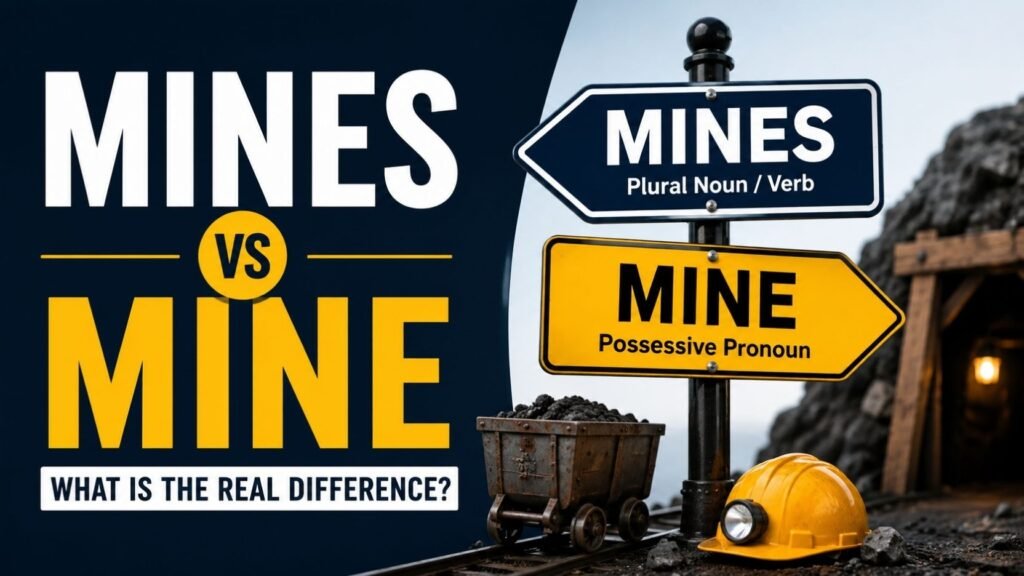
“Mine” is a possessive pronoun that means something belongs to you, as in “This book is mine.” “Mines” is a different word entirely. It is the plural of the noun “mine,” meaning underground sites where people dig for coal, gold, or other minerals, and it is also the verb form used with he, she, or it, as in “The company mines copper.” Standard English never uses “mines” to show possession.
Confusion happens because so many other possessive pronouns end in “s,” like yours, his, hers, ours, and theirs. That pattern makes “mines” feel like it should follow the same rule, especially in casual speech or certain dialects. But “mine” is the one exception in that group. Understanding why helps clear up one of the most common small grammar mix-ups in English.
Quick Answer
| Word | Part of Speech | Meaning | Example |
| Mine | Possessive pronoun | Belongs to me | That phone is mine. |
| Mine | Noun | A site dug for minerals or ore | They worked in a coal mine. |
| Mine | Verb | To dig for resources, or to plant an explosive device | Miners mine for gold. |
| Mines | Noun (plural) | More than one mining site, or explosive devices | The region has several salt mines. |
| Mines | Verb (present tense, he/she/it) | Digs for resources | The crew mines the tunnel daily. |
| Mines | Nonstandard possessive | Used informally in some dialects instead of “mine” | “That’s mines,” she said (nonstandard). |
See More: Occurring Or Occuring
What Does “Mine” Mean?
“Mine” carries more than one meaning, and the correct one depends entirely on context.
Mine as a Possessive Pronoun
This is the meaning most people search for. “Mine” replaces a noun and shows ownership.
- The red jacket is mine.
- Is this seat mine or yours?
- A friend of mine called earlier.
Notice that “mine” stands completely on its own. It replaces the noun instead of sitting next to it, which is different from “my,” a possessive adjective that always needs a noun beside it.
- Correct: This is my car. This car is mine.
- Incorrect: This is mines car.
Mine As A Noun
“Mine” also refers to a place where people dig into the earth to remove coal, metal, salt, gemstones, or other materials.
- The miners descended into the mine before sunrise.
- An old silver mine still sits outside the town.
Mine As A Verb
As a verb, “mine” means to dig up resources from the ground, or, in a very different sense, to place an explosive device.
- Companies mine lithium for batteries.
- Soldiers were ordered to mine the bridge before retreating.
What Does “Mines” Mean?
“Mines” is almost always one of two things: a plural noun or a verb conjugated for he, she, or it.
Mines As A Plural Noun
When more than one mining site or explosive device is involved, “mine” becomes “mines.”
- The region is known for its diamond mines.
- The soldiers avoided the field because of buried mines.
Mines As A Verb
Add an “s” to the verb “mine” when the subject is singular in the third person.
- The company mines coal in three states.
- She mines data for a living, sorting patterns from huge spreadsheets.
Is “Mines” A Word For Possession?
This is one of the most searched questions related to this topic, so it deserves a direct answer.
⚠️ In standard, formal English, “mines” is not a correct possessive pronoun. The only correct possessive form is “mine.”
That said, “mines” does appear as a possessive in some informal and dialectal speech, most notably in African American Vernacular English (AAVE) and in the early speech of young children learning English. Linguists explain this as a natural pattern: since yours, his, hers, ours, and theirs all end in “s,” some speakers extend that same pattern to “mine,” producing “mines.” This is a documented and systematic feature of certain dialects, not simply an error made at random.
For everyday formal writing, school assignments, professional emails, and most published content, “mine” remains the standard and expected form. “Mines” as a possessive is best reserved for casual, dialectal, or quoted speech where that voice is intentional.
Mines Vs Mine: Grammar At A Glance
| Feature | Mine | Mines |
| Function | Possessive pronoun, noun, verb | Plural noun, verb (he/she/it form) |
| Shows ownership? | Yes, in standard English | Only in informal or dialectal speech |
| Needs a noun after it? | No, it replaces the noun | Depends on use, usually stands alone as a noun |
| Common in formal writing? | Yes | Only for the noun or verb meanings |
| Example of ownership | The choice is mine. | Nonstandard: The choice is mines. |
How To Pronounce Mine And Mines
Both words are simple to pronounce and follow the same core sound.
- Mine: sounds like “myn,” rhyming with “line” or “wine.” IPA: /maɪn/
- Mines: sounds like “myns,” adding a soft “z” sound at the end, similar to “lines.” IPA: /maɪnz/
There is no difference in stress or syllables. Each word has just one syllable, and American and British pronunciation match closely here, unlike many other English words.
Origin Of “Mine” And “Mines”
The possessive pronoun “mine” comes from Old English “mīn,” which already meant “belonging to me.” That root goes back further to Proto-Germanic, and it is related to similar possessive forms in other Germanic languages, such as German “mein.” Over centuries, English speakers used “mine” both before consonants and vowels (“mine eyes,” for example), though today “my” is used before nouns and “mine” stands alone.
The noun and verb “mine,” referring to digging for minerals, comes from a completely separate root. It traces back to Old French “mine” and Medieval Latin “mina,” both connected to mining and extracting ore. This is why “mine” the possessive and “mine” the excavation site look identical today even though they developed from unrelated origins. English simply ended up with two different words that happen to share the same spelling and sound, a situation linguists call a homograph or homophone pair depending on context.
Mines Vs Mine In Real Sentences
A few clear, natural examples make the difference easy to remember.
Possessive pronoun “mine”:
- That decision was mine to make.
- The blue umbrella by the door is mine.
- We compared notes, and mine were more detailed.
Noun “mine” (singular) and “mines” (plural):
- The abandoned mine still attracts curious hikers.
- Several old mines dot the hillside outside town.
Verb “mine” and “mines”:
- Workers mine cobalt in that region.
- The machine mines through rock at a steady pace.
See More: Heros vs Heroes
Common Mistakes With Mines and Mine
❌ Incorrect: This laptop is mines.
✅ Correct: This laptop is mine.
❌ Incorrect: Is that book yours or mines?
✅ Correct: Is that book yours or mine?
❌ Incorrect: The gold mine were closed last year. (subject-verb mismatch)
✅ Correct: The gold mines were closed last year.
The most common mistake is using “mines” as a possessive pronoun in formal writing. Since the noun and verb “mines” are perfectly correct, the error only appears when someone uses “mines” to mean “belongs to me.” Reading a sentence back and asking “does this describe ownership, or does it describe a mining site or action?” usually settles the confusion right away.
Mines And Mine In Names, Places And Pop Culture
Both words show up often as part of proper nouns, titles, and brand names, which is a separate situation from grammar rules. These are fixed names, so they are spelled exactly as the institution or work chose, regardless of standard usage patterns.
Schools Named “Mines”
Several respected schools use “Mines” directly in their name because they were founded to train engineers in mining and related sciences.
- Colorado School of Mines is a public research university in Golden, Colorado, known for engineering, geology, and applied science programs. It is often simply called “Mines” by students and alumni.
- South Dakota School of Mines and Technology, located in Rapid City, is a similar engineering-focused institution with its own strong reputation in mining and geological engineering.
People sometimes compare the two schools directly, since both specialize in mining, engineering, and technical fields, though they are separate institutions in different states with their own admissions standards, campus cultures, and athletics programs.
Places Called “Mines” or “Mine”
- Paint Mines Interpretive Park in Colorado is a striking natural area known for colorful rock formations, not an active mining site. The word “mines” here reflects the area’s history and appearance rather than current mining activity.
- Kingston Mines is a well-known blues club in Chicago, named after a historic town, not an active mine.
- Nevada Gold Mines is one of the largest gold mining operations in the world, a joint venture between two major mining companies.
- Salt mines and pink salt mines, such as those associated with Himalayan pink salt, refer to real underground deposits where salt is extracted, often centuries old.
- The Mines Golf Course and similar venues sometimes take their name from land once used for mining, even after the mining itself has ended.
“Mine” And “Mines” In Games, Books And Entertainment
- Lost Mines of Phandelver is a well-known introductory adventure module for the tabletop role-playing game Dungeons & Dragons, widely searched along with terms like its PDF availability for players preparing a campaign.
- King Solomon’s Mines is a classic adventure novel, later adapted into films, including one connected to The Librarian: Return to King Solomon’s Mines.
- Seven Dwarfs Mine Train is a well-known roller coaster attraction themed around a mining story.
- Minesweeper is a classic computer puzzle game where players avoid hidden “mines” on a grid, distinct from a naval minesweeper, which is a ship designed to clear underwater mines.
- Color Me Mine is a paint-your-own-pottery studio brand, using “mine” in its possessive sense as a name, not related to mining at all.
“Mine” In Song And Film Titles
Because “mine” so naturally expresses ownership and emotion, it appears often in music and film titles.
- “Sweet Child o’ Mine” by Guns N’ Roses is one of the best-known rock songs to use this possessive form stylistically.
- “The Boy Is Mine,” including its well-known tour, and “She Used to Be Mine” are additional examples where “mine” expresses a strong personal claim or emotional attachment.
- “My Love, Mine All Mine” and “This Little Light of Mine” both use the older, poetic pattern of placing “mine” after a noun for emphasis, a style more common in older or lyrical English.
- “Enemy Mine” is a science fiction film whose title plays on the double meaning of “mine” as both a possessive pronoun and a nod to conflict.
- “Your Place or Mine” uses the possessive form in its most familiar, everyday sense.
These titles are stylistic and intentional. They do not represent a grammar rule to copy in ordinary writing, but they show how naturally “mine” fits into expressive, emotional language.
Military And Gaming Use Of “Mines”
In a military or gaming context, “mines” refers to explosive devices placed to detonate on contact or by remote trigger.
- Anti-personnel mines and anti-tank mines, sometimes shortened to AP mines and AT mines, are used and discussed in military and historical contexts.
- In video games such as Helldivers 2, players compare tools like gas mines, incendiary mines, and pressure-triggered mines, each with different tactical uses.
- A minesweeper, in this sense, refers to a ship built to detect and clear naval mines from the water, distinct from the puzzle game of the same name.
Related And Confusing Words
| Word | Meaning | How It Differs From Mine or Mines |
| My | Possessive adjective, always followed by a noun | “My car,” never stands alone like “mine” does |
| Miner | A person who works in a mine | Refers to a person, not an object or possession |
| Minor | Something less significant, or a person under legal age | Sounds different from “miner” only in some accents; unrelated in meaning |
| Ours | Possessive pronoun for a group including the speaker | Follows the same pattern as “mine” but for “we” |
| Yours | Possessive pronoun for the person spoken to | Correctly ends in “s,” unlike “mine” |
“Miner” and “minor” are worth a quick note since they sound alike in many American accents and are often confused in writing, even though they have nothing to do with “mine” or “mines” grammatically.
See More: Cosy Or Cozy
Frequently Asked Questions
What does “mines” mean?
“Mines” usually means more than one mining site, or it describes explosive devices. It can also be the verb “mine” used with he, she, or it, as in “he mines gold.”
Is “mines” a word for possession?
Not in standard English. The correct possessive pronoun is “mine.” “Mines” appears as a possessive only in certain informal dialects, most notably African American Vernacular English and early child speech, where it follows the pattern of yours, his, hers, and theirs.
What is the difference between “mine” and “mines”?
“Mine” shows ownership, refers to a single excavation site, or works as a verb meaning to dig for resources. “Mines” is the plural noun form, or the verb form used with he, she, or it. Formal English never uses “mines” to mean “belongs to me.”
How do you use “mine” in a sentence?
Use “mine” alone to show something belongs to you, without a noun directly after it. Example: “The green backpack is mine.”
Is “mine” a noun or a pronoun?
It can be both. As a pronoun, “mine” shows possession. As a noun, “mine” refers to an underground site for extracting minerals. As a verb, it means to dig for resources or plant an explosive.
How do you pronounce “mine” and “mines”?
“Mine” rhymes with “line” and “wine,” pronounced /maɪn/. “Mines” adds a soft “z” sound at the end, pronounced /maɪnz/.
Why do some people say “mines” instead of “mine”?
Because most other possessive pronouns, like yours, his, hers, ours, and theirs, end in “s.” Some speakers, especially in certain dialects or during early childhood language development, apply that same pattern to “mine,” producing “mines” as a possessive form.
Is “Mines” always a school named Colorado School of Mines?
No. “Mines” is a common nickname for Colorado School of Mines, but it is also used in other institution names like South Dakota School of Mines and Technology, in place names like Kingston Mines, and as an ordinary plural noun in everyday writing.
Is “the boy is mine” grammatically correct?
Yes. This uses “mine” correctly as a possessive pronoun meaning “belongs to me,” in this case referring to a person rather than an object, which is a common and accepted figurative use.
Conclusion
The core difference between mines and mine comes down to function. “Mine” shows possession, names a single excavation site, or acts as a verb meaning to extract resources. “Mines” is the plural noun for excavation sites or explosive devices, and it is also the verb form used with he, she, or it. In standard, formal English, “mines” is never the correct way to show ownership, even though it appears that way in some informal dialects and in children’s early speech patterns.
Whenever a sentence feels uncertain, ask a simple question: does this word need to show that something belongs to someone, or does it describe a place, an object, or an action related to digging? If it is about ownership, “mine” is always the safe, standard choice. If it involves an actual excavation site, an explosive device, or the act of extracting resources, “mines” is the correct plural or verb form to reach for.

Abdul Rehman Jutt is the author behind Grammar Wordz, with 4 years of experience researching and writing about English grammar, words, meanings, and language rules. Their goal is to make grammar simple, clear, and easy to understand through accurate and useful explanations.