
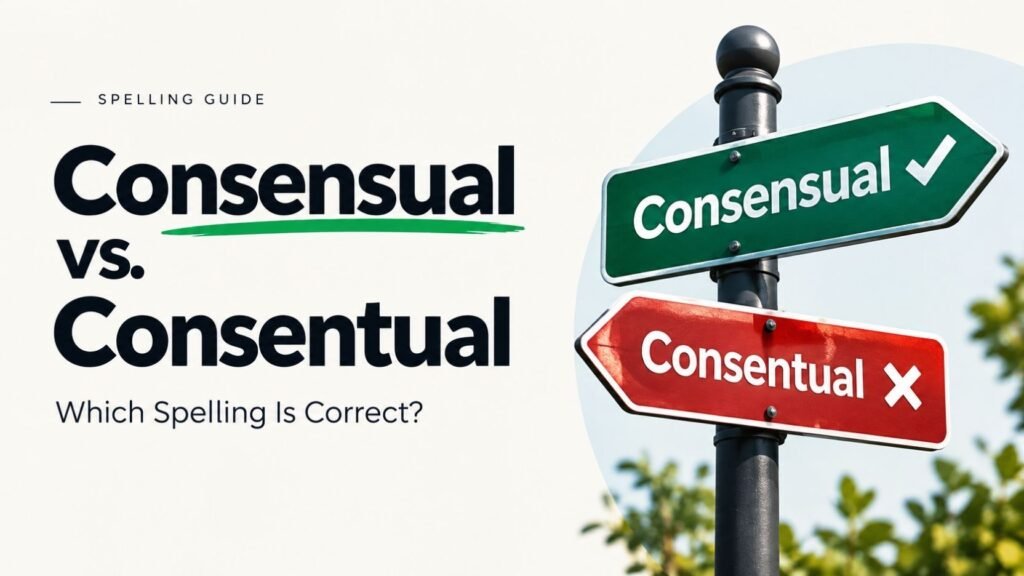
If you have ever paused mid-sentence wondering whether to write consensual or consentual, you are not alone. The two words look almost identical, and they even sound the same when spoken aloud. Only one of them is correct in standard English, and this guide explains exactly which one, why the confusion happens, and how to use the real word with confidence.
In short: consensual is the correct, dictionary-recognized word, and consentual is a common misspelling. Understanding why this mix-up happens will help you remember the right spelling for good. It also helps to know how consensual is used in everyday language, in legal writing, and in a few specific phrases that show up often in search, such as non consensual and consensual non-consent.
Quick Answer
| Question | Answer |
| Which spelling is correct? | Consensual |
| Is consentual a real word? | No, it is a nonstandard misspelling |
| Part of speech | Adjective |
| Simple meaning | Based on mutual agreement or consent |
| Pronunciation | kuhn-SEN-shoo-uhl |
| Word it comes from | Consensus (Latin), not consent directly |
See More: Inexcusable Vs Unexcusable
Consensual Meaning
Consensual is an adjective. It describes something that happens because everyone involved agrees to it.
- A consensual decision is one both sides accepted.
- A consensual relationship is one both people freely chose to be in.
- A consensual agreement is one nobody was forced into.
The core idea behind consensual is mutual, willing agreement. Nobody was pressured, tricked, or forced. Everyone said yes.
Example sentences:
- The two companies reached a consensual settlement instead of going to court.
- Their breakup was consensual, and both of them agreed it was the right choice.
- The therapist explained that healthy relationships depend on consensual choices, not obligation.
Is Consentual A Real Word?
No. Consentual is not a recognized word in standard English dictionaries. It is a misspelling of consensual.
The mix-up is easy to understand. The noun consent ends in “-ent,” and English has plenty of adjectives formed by adding “-ual” to a root, so it feels natural to guess consentual. But that is not how this particular word developed. The real adjective form traces back to consensus, not directly to consent, which is why the correct spelling keeps the “s” instead of a “t” in the middle: con-sen-sual, not con-sen-tual.
You may also see a third variant, consential, in casual writing. That form is incorrect too.
💡 Tip: If you remember that consensual is connected to consensus, meaning general agreement, the correct spelling becomes much easier to recall.
Why the Mistake Is So Common
A few things make consentual an easy typo or guess to make:
- Consent and consensual look and sound closely related, so people assume a direct spelling link.
- Autocorrect does not always catch it, since consentual can resemble a plausible English word pattern.
- The words sound identical when spoken, so the mistake usually only shows up in writing.
- It appears often enough online, in comments and casual posts, that some readers assume it must be an accepted variant.
None of that changes the fact that dictionaries, editors, and style guides only recognize consensual.
Grammar: Part Of Speech And Word Forms
Consensual is an adjective, which means it describes a noun. It does not have its own verb form. To talk about the action of agreeing, English uses related words instead, such as consent (verb) or agree.
| Form | Word | Example |
| Adjective | consensual | a consensual decision |
| Adverb | consensually | they consensually agreed to end the contract |
| Noun (related) | consent | she gave her consent |
| Verb (related) | consent | he consented to the interview |
Consensual itself stays the same whether it describes one thing or several things, since adjectives in English do not change for plural nouns. You can say a consensual choice or several consensual choices, and the spelling of consensual never changes.
How to Pronounce Consensual
Consensual is pronounced kuhn-SEN-shoo-uhl, with the stress on the second syllable.
In IPA, it is written roughly as /kənˈsɛnʃuəl/.
This pronunciation is the same in American English and British English. The spelling is also identical in both, so there is no US versus UK version of this word to worry about.
Where Consensual Comes From
Consensual traces back to the Latin word consensus, meaning agreement or general accord. Latin combined the idea of “feeling together” (from sentire, to feel, plus the prefix con-, together) into consensus. English later formed the adjective consensual from that root, using the common adjective-forming ending “-al.”
This history matters for spelling, because it shows the adjective was never built directly from the English word consent. It grew from consensus instead. That single fact explains the entire spelling difference between the correct consensual and the incorrect consentual.
See More: Hypothesis Or Hypotheses
Consensual Vs Consent: What Is The Difference?
Consent and consensual are closely related but grammatically different.
- Consent is usually a noun or a verb. It means permission, or the act of giving permission.
- Consensual is an adjective. It describes something that was done with everyone’s agreement.
Example:
- She gave her consent for the procedure. (noun)
- He consented to the search. (verb)
- The procedure was consensual. (adjective describing the noun “procedure”)
You would not say “the procedure was consent,” just as you would not say “she gave her consensual.” Each word plays a different grammatical role in the sentence.
Consensual In Different Contexts
The word consensual shows up in several specific settings. Each context keeps the same core meaning, mutual agreement, but the details matter.
Legal Context
In law, consensual describes an act, agreement, or relationship where all parties freely agreed, without force, fraud, or undue pressure. Calling something consensual is not automatically the same as saying it was legally valid consent.
Legal consent can also depend on factors such as a person’s legal capacity to agree, whether the agreement was truly voluntary, whether required disclosures were made, and what the specific law in that jurisdiction requires. A contract, for instance, can be described as consensual in a general sense while still being challenged in court over one of those specific legal requirements.
Non Consensual
Non consensual (sometimes written nonconsensual) is the opposite of consensual. It describes something that happened without the agreement of everyone involved. In everyday and legal use, non consensual usually signals that consent was missing, refused, or impossible to give, which can carry serious legal weight depending on the situation.
Consensual Non-Consent (CNC)
Consensual non-consent, sometimes written consensual nonconsent, is a specific term used mainly within discussions of intimate relationships and role play. It describes a pre-agreed scenario where participants consent in advance to a scene that simulates a lack of consent, with clear boundaries, safety practices, and the ability to stop at any time set up beforehand.
The word “consensual” in this phrase is doing important work: everything about the arrangement is agreed to ahead of time, even though the scenario is designed to look or feel otherwise. This is a distinct concept from non consensual acts, which involve no prior agreement at all.
Consensual Non-Monogamy
Consensual non-monogamy refers to a relationship structure where partners openly agree that one or more of them may have romantic or sexual connections outside the primary relationship. The defining feature is that everyone involved knows about and agrees to the arrangement, as opposed to infidelity, which happens without that agreement.
Business And Everyday Use
Outside legal and relationship contexts, consensual simply describes any decision, agreement, or process everyone accepted willingly. A consensual merger, a consensual schedule change, or a consensual house rule all describe the same basic idea: nobody was overruled or forced.
Common Mistakes
| ❌ Incorrect | ✅ Correct | Why |
| The agreement was consentual. | The agreement was consensual. | Consentual is not a standard word. |
| We reached a consential decision. | We reached a consensual decision. | Consential is also a nonstandard spelling. |
| Is this consentual or not? | Is this consensual or not? | Same correction applies in questions. |
| A non consentual act | A non consensual act | The prefix “non” does not change the base spelling rule. |
⚠️ Common mistake: Writers often add consentual because they are thinking of the word consent. Remember that the correct adjective grew from consensus, not from consent, so the “s” stays in the middle of the word.
Similar And Related Words
These words overlap with consensual in meaning but are not interchangeable in every sentence. Mutual, for example, describes something shared between two sides, such as mutual respect, while consensual specifically points to agreement or permission being given.
See More: Mines Vs Mine
| Word | Meaning | Difference from Consensual |
| Consent | Permission, or to give permission | Noun or verb, not an adjective |
| Agreed | Reached a shared decision | More general, not limited to consent situations |
| Mutual | Shared by both sides | Describes a relationship between two things, not agreement specifically |
| Voluntary | Done by choice, without being forced | Focuses on free choice rather than shared agreement |
| Unanimous | Agreed on by absolutely everyone in a group | Stronger, implies no dissent at all in a group decision |
Frequently Asked Questions
What does consensual mean?
Consensual means based on the willing agreement of everyone involved. It describes decisions, relationships, or actions that nobody was pressured or forced into.
Is consentual a word?
No. Consentual is a common misspelling of consensual and is not recognized in standard dictionaries.
How do you pronounce consensual?
It is pronounced kuhn-SEN-shoo-uhl, with the stress on the second syllable, the same way in American and British English.
Is consensual a noun or an adjective?
Consensual is an adjective. It describes a noun, such as a consensual agreement or a consensual relationship.
What is the difference between consensual and consent?
Consent is a noun or a verb meaning permission or the act of giving permission. Consensual is the adjective form used to describe something done with everyone’s agreement.
What does non consensual mean?
Non consensual describes something that happened without the agreement of everyone involved, meaning consent was missing or absent.
What is consensual non-consent?
It is a term used to describe a pre-agreed role-play scenario in which participants consent in advance to a scene that simulates a lack of consent, with clear limits and safety measures set beforehand.
What is consensual non-monogamy?
It describes a relationship where partners openly and mutually agree that one or more of them can have outside romantic or sexual connections.
Is consential also incorrect?
Yes. Consential is another nonstandard variant that should be avoided in place of consensual.
Conclusion
Consensual is the only correct spelling for describing something based on mutual, willing agreement, whether that is a relationship, a contract, or a simple decision between two people. Consentual, along with the rarer consential, is a misspelling that comes from mistakenly linking the word to consent instead of its real root, consensus. Once you connect consensual with consensus in your mind, the correct spelling becomes far easier to remember.
Whether you are writing a legal document, a casual message, or an article about relationships, sticking with consensual keeps your writing accurate and credible. The related terms covered here, from non consensual to consensual non-consent and consensual non-monogamy, all build on the same root meaning: agreement that is real, informed, and freely given.

Abdul Rehman Jutt is the author behind Grammar Wordz, with 4 years of experience researching and writing about English grammar, words, meanings, and language rules. Their goal is to make grammar simple, clear, and easy to understand through accurate and useful explanations.