
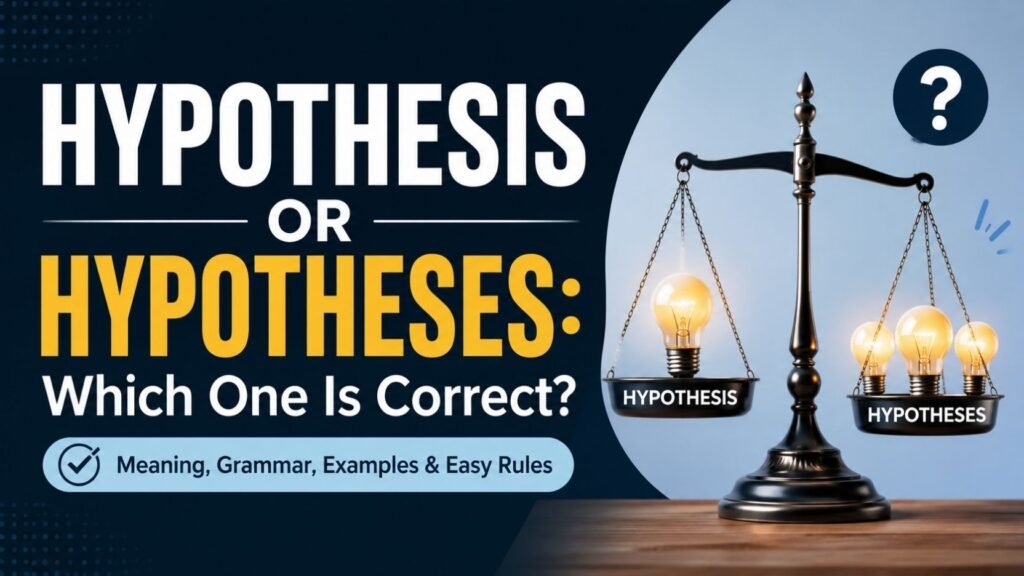
Hypothesis is the singular form, and hypotheses is the plural form of the same word. If you are talking about one proposed explanation, you use hypothesis. If you are talking about two or more, you use hypotheses. Both spellings are correct English, but they are correct in different situations, not interchangeable in the same sentence.
This small spelling shift trips up a lot of writers because the word does not follow the usual English rule of adding an “s” to make a plural. It follows an older Greek pattern instead. Understanding this pattern makes the choice automatic, whether you are writing a lab report, a thesis chapter, a business proposal, or a school assignment that asks for your hypothesis or hypotheses.
Hypothesis Meaning: What Does Hypothesis Mean?
A hypothesis is an educated guess or a proposed explanation for something, made before it has been tested. It is a starting point for investigation, not a proven fact.
In everyday language, a hypothesis is simply your best guess about why something happens, based on what you already know. In science and research, it becomes more formal: a testable statement that predicts a relationship between two or more things.
See More: Mines Vs Mine
Hypothesis Definition
- Simple definition: An idea or explanation that you propose and then test to see if it is true.
- Formal definition: A tentative, testable statement that predicts the outcome or relationship of a study, experiment, or investigation.
- Part of speech: Noun.
- Plural form: Hypotheses.
A hypothesis is not a random guess. It is usually built on existing knowledge, observation, or a pattern the researcher has already noticed. That is what separates a hypothesis from a wild guess: it comes with a reason behind it, and it can be checked against evidence.
Hypothesis Or Hypotheses: The Grammar Rule
Here is the core grammar rule in one sentence: hypothesis is singular, hypotheses is plural, and the word changes because of its Greek origin rather than the usual English “add an s” rule.
Most English nouns become plural by adding “s” or “es.” Hypothesis does not follow that pattern. Instead, it follows a Greek plural pattern where “-is” changes to “-es.” You can see this same pattern in several other English words borrowed from Greek.
| Singular | Plural |
| Hypothesis | Hypotheses |
| Analysis | Analyses |
| Thesis | Theses |
| Crisis | Crises |
| Basis | Bases |
| Diagnosis | Diagnoses |
Notice the shared pattern: every singular form ends in “-is,” and every plural form ends in “-es,” with the final “s” of the singular disappearing. “Hypothesises” is not a word, and neither is “hypothesi.” If you remember one thing from this section, remember this: change the ending, don’t just add a letter.
Quick Reference Table
| Form | Example Sentence | Number |
| Hypothesis | The researcher tested one hypothesis about sleep and memory. | Singular |
| Hypotheses | The team tested three separate hypotheses about sleep and memory. | Plural |
Is It Hypothesis Or Hypotheses? A Simple Test
If you are unsure which form to use, ask yourself one question: am I talking about one proposed explanation, or more than one?
- One idea, one guess, one prediction → hypothesis
- Two or more ideas, guesses, or predictions → hypotheses
This works the same way as choosing between “child” and “children,” even though the spelling change looks different. The logic is identical: singular subject, singular verb form of the noun; plural subject, plural form of the noun.
Example:
- Incorrect: “The scientist proposed two hypothesis before running the trial.”
- Correct: “The scientist proposed two hypotheses before running the trial.”
- Incorrect: “My hypotheses is that plants grow faster in sunlight.”
- Correct: “My hypothesis is that plants grow faster in sunlight.”
A useful trick: hypotheses sounds like it has an extra syllable compared to hypothesis, and that extra sound often lines up with “more than one” in your sentence. It is not a perfect rule, but it can help you catch a mistake before you hit submit.
How To Pronounce Hypothesis And Hypotheses
Pronunciation is where the two words diverge the most, and it is one of the most searched parts of this topic.
- Hypothesis is pronounced: hy-POTH-uh-sis (IPA: /haɪˈpɒθəsɪs/ in British English, /haɪˈpɑːθəsɪs/ in American English)
- Hypotheses is pronounced: hy-POTH-uh-seez (IPA: /haɪˈpɒθəsiːz/ in British English, /haɪˈpɑːθəsiːz/ in American English)
The stress falls on the second syllable in both words: po-THESIS and po-THESES. The main difference a listener will hear is the ending: “sis,” with a short “i” sound, versus “seez,” with a long “e” sound. If you remember that the plural ends the same way as “cheese” without the ch, you will rarely mix up the two out loud.
💡 Tip: Say the singular and plural out loud together a few times: “hypothesis, hypotheses.” The rhythm difference becomes easy to hear once you notice it.
Origin Of The Word Hypothesis
The word hypothesis comes from the Greek word hupothesis, formed from hupo- meaning “under” and thesis meaning “a placing” or “a proposition.” Put together, it originally meant something like “a foundation” or “a basis put under something,” which evolved into the modern sense of a proposed explanation that supports further investigation.
The word entered English in the late 1500s through Latin, which had already borrowed it from Greek. Because it kept its Greek plural form instead of adopting a regular English “-es” ending, hypothesis still behaves like a Greek word today, centuries after it was absorbed into English.
This same “under” and “thesis” structure explains why hypothesis and thesis are close relatives. A thesis is a statement or proposition; a hypothesis is literally something placed underneath it, a foundation for an argument that still needs testing.
Hypothesis Or Hypotheses In Research
In academic and scientific writing, the choice between hypothesis and hypotheses depends entirely on how many predictions your study makes.
- A study testing a single relationship, such as whether sleep duration affects test scores, has one hypothesis.
- A study testing several relationships, such as whether sleep duration, screen time, and diet all affect test scores, has multiple hypotheses.
Research papers often use both forms in the same document. The introduction might say, “This study proposes the following hypotheses,” and then list them individually, each one introduced as “Hypothesis 1,” “Hypothesis 2,” and so on. Notice that even inside a list of hypotheses, each individual item is still called a hypothesis, because you are referring to it on its own.
How To Write A Hypothesis
A strong hypothesis usually has three qualities: it is testable, it is specific, and it states a clear relationship between variables. Many hypotheses in formal research follow an “if, then” structure.
- Start with a question. What are you trying to find out?
- Identify your variables. What are you changing (independent variable), and what are you measuring (dependent variable)?
- State the predicted relationship. Use a clear “if, then” or “greater than, less than” structure.
- Make it testable. You must be able to collect evidence that could prove it right or wrong.
Example of a well-written hypothesis: “If students sleep at least eight hours per night, then their test scores will be higher than students who sleep less than six hours.”
This example works because it names both variables clearly, predicts a direction, and can be tested with real data.
How To Write Hypotheses In Quantitative Research
In quantitative research, hypotheses are usually written in pairs: a null hypothesis and an alternative hypothesis, sometimes numbered as H1, H2, and so on when a study has more than one. Each hypothesis should:
- Focus on one relationship at a time
- Use precise, measurable language
- Match the statistical test that will be used to evaluate it
- Avoid vague words like “affects” without specifying direction, when direction matters to the study
When a study has several research questions, it typically produces several hypotheses, one per question, each written and tested separately.
Null Hypothesis And Alternative Hypothesis
Two terms come up constantly alongside this topic: the null hypothesis and the alternative hypothesis. These are not different words for hypothesis and hypotheses. They describe two competing explanations within a single study.
- Null hypothesis (H0): The assumption that there is no relationship or no effect between the variables being studied. It is the default position that a researcher tries to disprove.
- Alternative hypothesis (H1 or Ha): The statement that there is a relationship or effect. It is what the researcher often expects, or hopes, to support with evidence.
| Term | What It Claims | Example |
| Null hypothesis | No effect or no difference exists | There is no difference in plant growth between the two fertilizers. |
| Alternative hypothesis | An effect or difference exists | Plant growth differs between the two fertilizers. |
Null Hypothesis Example
Suppose a researcher is studying whether a new study method improves exam scores.
- Null hypothesis: The new study method has no effect on exam scores.
- Alternative hypothesis: The new study method improves exam scores.
The researcher then collects data and uses statistical testing to decide whether there is enough evidence to reject the null hypothesis in favor of the alternative. Note that both of these are still individually called a hypothesis. When you refer to them together, you would say “the null and alternative hypotheses,” using the plural because you are naming two.
See More: Pokey Or Poky
Examples Of Hypotheses
Seeing the word used correctly in different contexts often makes the rule click faster than any explanation.
Singular examples:
- “Her hypothesis was that caffeine improves short-term memory.”
- “The team could not confirm the hypothesis after three trials.”
- “What is your hypothesis for this experiment?”
Plural examples:
- “The report compared five competing hypotheses about the extinction event.”
- “Both hypotheses were rejected after the data came in.”
- “You have too many hypotheses for a single short study; consider narrowing your focus.”
A/B testing, common in marketing and product design, also relies on this same structure. A single test usually has one hypothesis, such as “changing the button color will increase clicks,” while a broader testing roadmap might involve several hypotheses tested one at a time across different experiments.
Hypothesis Testing
Hypothesis testing is the formal statistical process used to decide whether there is enough evidence to support or reject a hypothesis. Researchers collect data, apply a statistical test, and compare the result against a threshold (commonly called a p-value) to judge whether the observed pattern is likely due to chance or reflects a real effect.
The basic steps of hypothesis testing are:
- State the null and alternative hypotheses.
- Choose a significance level, most commonly 0.05.
- Collect and analyze data using an appropriate statistical test.
- Compare the result to the significance level.
- Decide whether to reject or fail to reject the null hypothesis.
Note the careful wording in that last step: researchers say they “fail to reject” the null hypothesis rather than “prove it true.” A hypothesis test can show that evidence supports an idea, but it does not offer absolute proof, which is part of why the word hypothesis remains attached to the idea even after testing.
How Do Hypotheses Differ From Theories?
This is one of the most common points of confusion in both everyday and scientific language, and it is a completely different distinction from singular versus plural.
| Term | Definition | Status |
| Hypothesis | A proposed, testable explanation for a specific observation | Not yet tested, or tested only in limited studies |
| Theory | A well-supported explanation for a broad range of observations, backed by repeated testing and evidence | Extensively tested and widely accepted within a field |
A hypothesis is a starting point. A theory, in the scientific sense, is a much stronger and more established explanation, built up from many hypotheses that have been tested repeatedly over time and have consistently held up. In casual speech, people often use “theory” to mean “guess,” which is the opposite of how scientists use the word. In careful writing, especially academic or scientific writing, it helps to keep this distinction clear: hypothesis comes first, theory comes after extensive, repeated confirmation.
Famous Uses Of The Word Hypothesis
Certain named hypotheses appear often in search results and general knowledge. Two of the most recognized are the Riemann Hypothesis and the Sapir-Whorf Hypothesis.
The Riemann Hypothesis
The Riemann Hypothesis, proposed by mathematician Bernhard Riemann in 1859, is one of the most famous unsolved problems in mathematics. It makes a specific claim about the pattern of prime numbers, related to the zeros of what is known as the Riemann zeta function.
It remains unproven, despite over 160 years of effort by mathematicians, and it is one of the seven Millennium Prize Problems, each carrying a one-million-dollar reward for a verified solution. Because it is still unproven, it is correctly called a hypothesis, not a theory or a law.
The Sapir-Whorf Hypothesis
The Sapir-Whorf Hypothesis, named after linguists Edward Sapir and Benjamin Lee Whorf, proposes that the structure of a person’s language influences how they think and perceive the world. It exists in a stronger form, sometimes called linguistic determinism, which claims language strictly limits thought, and a weaker form, called linguistic relativity, which claims language merely influences thought patterns.
The stronger version is widely rejected by linguists today, while the weaker version still receives ongoing research attention. Like the Riemann Hypothesis, its name reflects that it remains a proposed explanation rather than a settled fact.
Both of these examples are useful for understanding the word itself: even famous, long-studied ideas stay labeled as a hypothesis until they are proven and broadly confirmed, at which point the field may eventually treat them differently.
“The Love Hypothesis” In Popular Culture
The word hypothesis has also crossed into popular fiction through The Love Hypothesis, a romance novel by Ali Hazelwood, first published in 2021. The book follows Olive Smith, a PhD candidate, who fake-dates a professor to help a friend, only for the arrangement to develop into real feelings. It became a major bestseller and a favorite in the “STEM romance” genre.
The novel is being adapted into a film, also titled The Love Hypothesis, starring Lili Reinhart as Olive Smith and Tom Bateman as Adam Carlsen, directed by Claire Scanlon. The adaptation is set to premiere on Prime Video on September 23, 2026. This is a good example of how the word hypothesis, normally at home in a lab or a research paper, can also carry a playful, romantic meaning in a title: the “hypothesis” being tested is not about chemistry in the scientific sense, but about a fake relationship becoming real.
Medical Hypotheses And Academic Usage
The word also appears as the title of an academic publication, Medical Hypotheses, a journal that publishes speculative and exploratory ideas in medicine, often before they have full experimental backing.
The plural title reflects its purpose: the journal is a space for multiple proposed explanations and early-stage ideas across many areas of medicine, rather than a single confirmed finding. This is a natural, correct use of the plural form, since the publication covers many different hypotheses across many different articles and authors.
Common Mistakes With Hypothesis Or Hypotheses
Even confident writers slip up on this pair. Here are the mistakes that show up most often.
❌ Incorrect: “I have two hypothesis for this project.”
✅ Correct: “I have two hypotheses for this project.”
Why: Two items require the plural form, hypotheses.
❌ Incorrect: “This hypotheses was not supported by the data.”
✅ Correct: “This hypothesis was not supported by the data.”
Why: “This” signals a single item, so the singular form, hypothesis, is required.
❌ Incorrect: “The scientists tested several hypothesises.”
✅ Correct: “The scientists tested several hypotheses.”
Why: “Hypothesises” is not a word in standard English; the correct plural follows the Greek pattern.
❌ Incorrect: “What is your hypothesis’s for the experiment?”
✅ Correct: “What is your hypothesis for the experiment?” or “What are your hypotheses for the experiment?”
Why: Adding an apostrophe-s turns the word into a possessive, not a plural; possessive and plural are different grammatical functions.
⚠️ A quick self-check before submitting any paper: search your document for “hypothesis” and “hypotheses,” then confirm each instance matches how many explanations you are actually discussing at that point in the sentence.
Hypothesis Vs Hypotheses: Side-by-Side Comparison
| Feature | Hypothesis | Hypotheses |
| Number | Singular | Plural |
| Meaning | One proposed explanation | Two or more proposed explanations |
| Pronunciation | hy-POTH-uh-sis | hy-POTH-uh-seez |
| Word origin | Greek, “hupothesis” | Greek plural form |
| Example use | “This is my hypothesis.” | “These are my hypotheses.” |
| Common pairing | Null hypothesis, alternative hypothesis (each singular) | Null and alternative hypotheses (used together) |
Synonyms And Related Words
Several words overlap with hypothesis in meaning, but each carries a slightly different shade of certainty or formality.
| Word | Meaning | How It Differs From Hypothesis |
| Theory | A well-tested, broadly accepted explanation | Far more established; supported by extensive, repeated evidence |
| Assumption | Something accepted as true without proof | Not necessarily meant to be tested |
| Conjecture | An opinion formed on incomplete information | Often less structured and less formally tested than a hypothesis |
| Prediction | A statement about what will happen in the future | Focuses on outcome, not necessarily on explanation |
| Theorem | A statement proven true through logical reasoning, mainly in mathematics | Already proven, not merely proposed |
A hypothesis sits between a casual guess and a fully proven theory. It is more structured than an assumption or conjecture, because it is meant to be tested, but far less certain than a theorem or an established scientific theory, because it has not yet accumulated enough supporting evidence.
Frequently Asked Questions
Is it hypothesis or hypotheses?
Both are correct; hypothesis is singular and hypotheses is plural. Use hypothesis for one proposed explanation and hypotheses for two or more.
What does hypothesis mean in simple terms?
It means an educated guess or proposed explanation that has not yet been tested or proven.
How do you pronounce hypotheses?
Hypotheses is pronounced hy-POTH-uh-seez, with the stress on the second syllable and a long “e” sound at the end.
Is hypothesis a noun or a verb?
Hypothesis is a noun. The related verb form is “hypothesize,” meaning to propose an explanation.
What is the difference between a hypothesis and a theory?
A hypothesis is a proposed, testable explanation that has not yet been broadly confirmed, while a theory is a well-supported explanation backed by extensive, repeated testing and evidence.
What is a null hypothesis?
A null hypothesis is the assumption that there is no effect or no relationship between the variables in a study; researchers try to gather evidence against it.
Can a study have more than one hypothesis?
Yes. Many studies test multiple relationships and therefore include multiple hypotheses, often labeled H1, H2, H3, and so on.
What is the plural of hypothesis?
The plural of hypothesis is hypotheses, following an irregular Greek pattern rather than the usual English “add an s” rule.
Why doesn’t hypothesis just add an “s” to become plural?
Because it comes from Greek, and it kept its original Greek plural pattern, where “-is” changes to “-es,” instead of adopting the regular English plural rule.
Is “hypothesises” a real word?
No. It is a common misspelling. The correct plural is hypotheses, not hypothesises or hypothesises.
See More: Bony Or Boney
Conclusion
The choice between hypothesis or hypotheses comes down to one simple question: are you describing one proposed explanation, or more than one? Hypothesis is singular, hypotheses is plural, and the shift follows an irregular Greek pattern rather than the usual English rule of adding an “s.” Once you recognize that pattern, alongside similar words like analysis and analyses or thesis and theses, the correct choice becomes automatic rather than something you have to second-guess every time you write it.
Whether you are drafting a research paper, stating a null and alternative hypothesis for a statistics class, or simply trying to spell a familiar word correctly, the rule stays the same. Match the form to the number: one hypothesis, two or more hypotheses. Keep that distinction in mind, and this word will never slow down your writing again.

Abdul Rehman Jutt is the author behind Grammar Wordz, with 4 years of experience researching and writing about English grammar, words, meanings, and language rules. Their goal is to make grammar simple, clear, and easy to understand through accurate and useful explanations.