
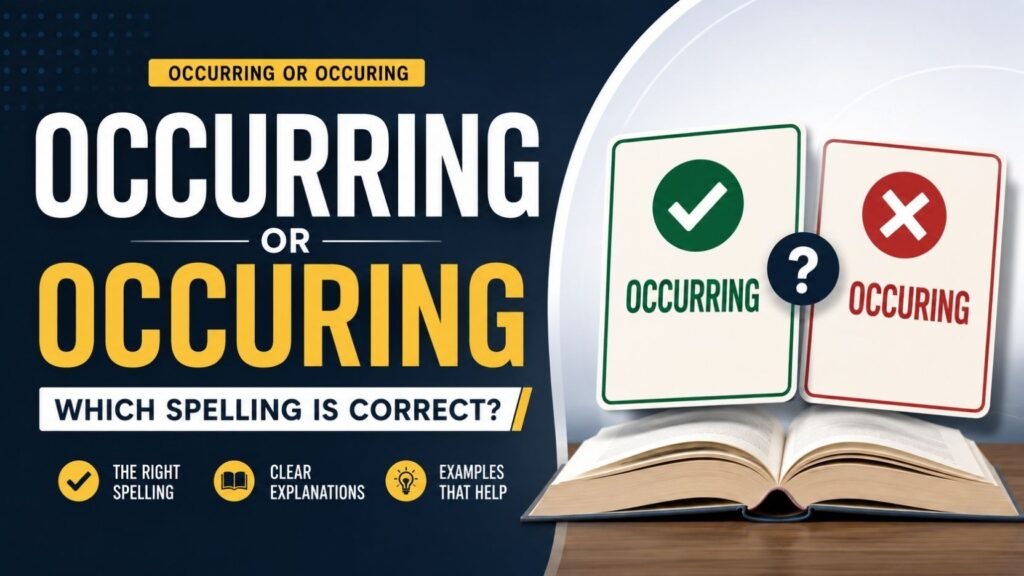
Occurring is the correct spelling. Occuring is a common misspelling that leaves out one letter. The word needs two r’s, not one, because of a specific spelling rule tied to how the word is pronounced. This mistake is extremely common, even among confident writers, because the doubled letter is easy to miss when typing quickly.
Understanding why occurring needs that second r makes the spelling much easier to remember for good. It also helps with related words like occurred, occurrence, and co-occurring, which follow the same pattern. Once you understand the rule, you will stop second-guessing yourself every time you write it.
Quick Answer
| Spelling | Correct? | Notes |
| Occurring | ✅ Correct | Standard spelling in American and British English |
| Occuring | ❌ Incorrect | Missing one r; a very common typo |
Occurring is spelled with two r’s: o-c-c-u-r-r-i-n-g.
Occuring, with only one r, is not a recognized spelling in any major dictionary, style guide, or standard reference.
See More: Heros vs Heroes
Why Occurring Has Two R’s
English has a spelling rule that explains this directly. When a word ends in a single vowel followed by a single consonant, and the stress falls on the final syllable, you double that final consonant before adding a suffix that starts with a vowel, such as -ing or -ed.
Look at the word occur:
- It ends in u-r: one vowel, one consonant.
- The stress falls on the second syllable: oc-CUR, not OC-cur.
Because both conditions are met, the final r doubles when you add -ing. That gives you occurring, not occuring.
This is the same rule that turns:
- Begin into beginning (beGIN, stress on the last syllable)
- Prefer into preferred (preFER, stress on the last syllable)
- Refer into referring (reFER, stress on the last syllable)
Compare that with a word like open. It ends in a vowel and consonant too, but the stress falls on the first syllable: OPen, not oPEN. So the consonant does not double: opening, not openning.
💡 Tip: If you are unsure whether to double a final consonant, say the word out loud and listen for where the stress lands. If the stress is on the last syllable, the consonant usually doubles before -ing or -ed.
Occurring: Meaning and Part of Speech
Occurring is the present participle of the verb occur. It functions in two main ways:
As part of a continuous verb tense, describing something happening right now or over a period of time:
- The changes are occurring gradually.
- A rare weather pattern is occurring off the coast today.
As an adjective, usually before a noun, to describe something that happens or exists:
- This is a naturally occurring mineral.
- Doctors are treating his co-occurring conditions.
The base verb, occur, means to happen, to take place, or to exist. Occurring simply marks that action as ongoing or as a descriptive quality of something else.
How to Pronounce Occurring
Occurring is pronounced uh-KUR-ing, with three syllables and the stress on the middle syllable.
In IPA, it is written as /əˈkɜːrɪŋ/ in British English and /əˈkɝːɪŋ/ in American English. The difference between the two accents is small and mostly affects the r sound in the middle of the word, which is stronger and more pronounced in American English.
There is no separate British or American spelling of this word. Occurring uk searches and occurring or occuring uk searches sometimes suggest people expect a regional spelling difference, similar to color and colour. That is not the case here. Both American English and British English spell it the same way: occurring, with two r’s.
Word Forms of Occur
Occur changes form depending on tense and grammatical role. Every form that adds -ing or -ed keeps the doubled r, for the same stress-based reason explained above.
| Form | Word | Example |
| Base verb | Occur | These delays occur every winter. |
| Present participle / adjective | Occurring | A shift is occurring in the market. |
| Past tense | Occurred | The accident occurred late last night. |
| Third-person singular | Occurs | It occurs to me that we forgot the tickets. |
| Noun | Occurrence | This is a rare occurrence in this region. |
Notice that occurrence, the noun form, also has two r’s for the same reason. Many people misspell this one too, often writing “occurance,” which is also incorrect.
Occurring or Occuring: Common Mistakes
The mix-up between occurring and occuring is one of the most frequent spelling errors connected to this word family. Here are the patterns to watch for.
❌ Incorrect: This event is occuring every morning.
✅ Correct: This event is occurring every morning.
❌ Incorrect: These are naturally occuring elements.
✅ Correct: These are naturally occurring elements.
❌ Incorrect: He has several co-occuring disorders.
✅ Correct: He has several co-occurring disorders.
❌ Incorrect: The problem keeps re-occuring.
✅ Correct: The problem keeps recurring.
That last example points to a second, related mistake worth flagging separately.
Recurring, Not Re-occurring
Many people write “re-occurring” or “reoccuring” when they mean that something keeps happening again. The standard word for this is recurring, spelled r-e-c-u-r-r-i-n-g, without a hyphen and without “occur” as its root. Recurring comes from the verb recur, not from occur plus a prefix.
- A recurring dream (not a re-occurring dream)
- A recurring payment (not a re-occurring payment)
- A recurring theme in her novels (not a re-occurring theme)
“Reoccurring” does appear informally and is understood by most readers, but recurring is the standard, dictionary-preferred word, especially in formal or professional writing.
Naturally Occurring: Meaning And Usage
The phrase naturally occurring describes something that exists or happens in nature, without being made, added, or caused by people.
- Are lemons naturally occurring? Lemons are not fully naturally occurring in the wild in the way that, say, wild berries are. Most citrus fruits, including lemons, are the result of centuries of cultivation and hybridization by humans, so they are considered a cultivated hybrid rather than a plant that developed entirely without human involvement.
- Are limes naturally occurring? Limes have a similar history to lemons. They descend from citrus hybrids shaped through long-term cultivation, so like lemons, they are not a purely wild, naturally occurring fruit in the strictest sense.
This phrase comes up often in science, nutrition, and chemistry writing, where it distinguishes between substances found in nature and substances that are synthetic or artificially added.
See More: Cosy Or Cozy
Naturally Occurring Elements
A frequent related question is how many naturally occurring elements exist. Of the elements on the periodic table, 94 are generally recognized as naturally occurring on Earth, meaning they are found in nature rather than created only in laboratories. The remaining elements past that point are synthetic, produced through nuclear reactions rather than found in natural deposits.
A commonly asked follow-up is the heaviest naturally occurring element. That title is usually given to uranium, which has an atomic number of 92 and is found in natural mineral deposits, unlike heavier synthetic elements that exist only briefly after being created in laboratory conditions.
Is plutonium naturally occurring? Trace amounts of plutonium do occur naturally, formed through certain reactions in uranium ore deposits, but these amounts are extremely small. Nearly all plutonium in existence today was produced artificially in reactors, which is why plutonium is usually classified as a synthetic element in practical terms, even though tiny natural traces exist.
Co-Occurring: Meaning And Usage
Co-occurring means happening or existing at the same time as something else. The prefix co- means “together” or “jointly,” so co-occurring describes two or more things that are present or happening simultaneously.
This term is especially common in healthcare and mental health contexts.
Co-Occurring Disorders
Co-occurring disorders refer to a situation where a person experiences both a mental health condition and a substance use disorder at the same time. For example, someone might be diagnosed with depression and also struggle with alcohol dependence. These two conditions are described as co-occurring because they exist together and often interact with and influence each other.
Common examples of co-occurring disorders include:
- Anxiety combined with substance use disorder
- Depression combined with alcohol use disorder
- Post-traumatic stress disorder combined with opioid dependence
- Bipolar disorder combined with substance misuse
Co-occurring disorder treatment typically addresses both conditions together, rather than treating one and ignoring the other. Treating only the substance use issue while leaving an underlying mental health condition unaddressed, or the reverse, tends to produce weaker, less lasting results. Many treatment centers and outpatient programs across the United States, including programs described in states such as Illinois and Florida, specifically advertise integrated co-occurring disorder services for this reason.
⚠️ Note: If you or someone you know may be dealing with co-occurring disorders, a licensed healthcare provider or mental health professional can give an accurate diagnosis and appropriate treatment plan. This article explains the term itself, not medical guidance.
Occurring Every Morning: A Common Search Phrase
The phrase occurring every morning usually appears in two different contexts.
As a description of a repeated event:
- A strange sound is occurring every morning around six o’clock.
- Traffic delays are occurring every morning near the construction site.
As a crossword clue: Occurring every morning crossword clue often points toward the word “diurnal” or, depending on the puzzle, a related term meaning “daily” or “happening each day.” Since crossword answers vary by publication and puzzle, always check the specific crossword’s letter count and existing filled-in letters to confirm the exact intended answer.
Occurring every a.m. is another phrasing of the same idea, referring to something that happens during the morning hours specifically, rather than at any point in the day.
Synonyms For Occurring
Several words can replace occurring depending on tone and context. None of them is a perfect one-to-one substitute, since each carries a slightly different shade of meaning.
| Synonym | Best Used When | Example |
| Happening | Casual, everyday tone | Something strange is happening next door. |
| Taking place | Formal or scheduled events | The ceremony is taking place this weekend. |
| Arising | Something new is emerging from a situation | New concerns are arising from the report. |
| Developing | A situation is still unfolding | The story is still developing. |
| Transpiring | Formal, sometimes journalistic tone | Investigators are examining what is transpiring. |
Happening is the closest everyday synonym and works in almost any casual sentence where occurring would otherwise appear. Taking place fits better for planned or scheduled events, such as meetings or ceremonies, rather than spontaneous ones.
Occurring in a Sentence: Examples
- A significant shift in consumer habits is occurring across the retail industry.
- Minor tremors have been occurring in the region for the past three days.
- These symptoms are commonly occurring side effects of the medication.
- Errors kept occurring in the same section of the report.
- This is a rare event, occurring roughly once every decade.
Each example uses occurring to describe something happening, either right now, repeatedly, or as a general characteristic.
A Limited Amount Of Goods: Grammar In Context
One search phrase connected to this topic is: “a limited amount of goods available means that excess is occurring.” This sentence structure is often used in basic economics materials to test understanding of supply and scarcity concepts, and it uses occurring correctly, as a present participle describing something happening as a result of limited supply.
Grammatically, the sentence follows the same pattern already covered in this article: occurring appears after “is,” forming a continuous verb structure that describes an ongoing situation.
Groupthink And Occurring: A Related Search
Another common phrase is: “which of the following strategies would effectively prevent groupthink from occurring?” This wording typically appears in psychology, business, or leadership coursework, where students are asked to identify methods for avoiding groupthink, a phenomenon in which a group of people makes flawed decisions because they prioritize agreement over critical thinking.
From a grammar standpoint, occurring here works the same way it does throughout this article: it describes an event, in this case, the emergence of groupthink, that a certain strategy is meant to stop from happening.
See More: Missus Or Misses
Frequently Asked Questions
Is it occurring or occuring?
Occurring is correct. Occuring, with a single r, is a common misspelling and is not found in standard dictionaries.
How do you spell occurring?
Occurring is spelled o-c-c-u-r-r-i-n-g, with two r’s. The double r comes from adding -ing to occur, a verb stressed on its final syllable.
Occurring or occuring, which is correct?
Occurring is the only correct spelling in both American and British English. There is no regional variation for this word.
What part of speech is occurring?
Occurring is the present participle of the verb occur. It can function as part of a verb phrase, such as “is occurring,” or as an adjective before a noun, such as “a naturally occurring substance.”
How do you pronounce occurring?
Occurring is pronounced uh-KUR-ing, with the stress on the second syllable.
What is a synonym for occurring?
Common synonyms include happening, taking place, arising, and developing, depending on the context.
Are lemons naturally occurring?
Not entirely. Lemons are the result of centuries of citrus cultivation and hybridization, so they are considered a cultivated hybrid rather than a plant that exists purely in nature without human involvement.
What does co-occurring mean?
Co-occurring means happening or existing at the same time as something else. It is frequently used to describe co-occurring disorders, where a mental health condition and a substance use disorder are present together.
What is the difference between occurring and recurring?
Occurring describes something happening, whether once or repeatedly. Recurring specifically means happening again and again, at intervals. “Re-occurring” is a nonstandard variant; recurring is the accepted spelling.
What is the heaviest naturally occurring element?
Uranium is generally recognized as the heaviest naturally occurring element, found in natural mineral deposits, while heavier elements are produced synthetically in laboratories.
Final Thoughts
Occurring is the correct spelling, and occuring is simply a missing letter away from being right. The rule behind it is not random. Because occur is stressed on its final syllable and ends in a single vowel and consonant, that final r doubles before -ing is added, giving you occurring rather than occuring. The same logic applies to occurred, occurrence, and every other form built from this verb.
Once this rule clicks, the spelling becomes automatic. Whether you are writing about naturally occurring elements, co-occurring disorders, or something simply occurring every morning, remembering the double r will keep your writing accurate and easy to trust.

Abdul Rehman Jutt is the author behind Grammar Wordz, with 4 years of experience researching and writing about English grammar, words, meanings, and language rules. Their goal is to make grammar simple, clear, and easy to understand through accurate and useful explanations.