
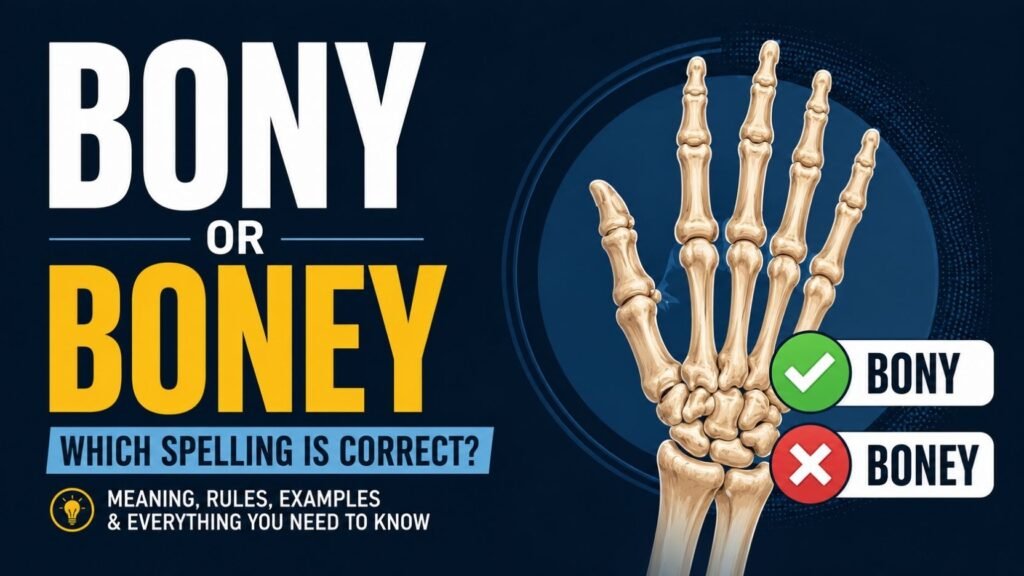
Bony is the correct spelling. It is the adjective form recognized by every major English dictionary, and it describes something with prominent bones, very little flesh, or a thin, skeletal appearance. Boney is not a standard dictionary entry for this meaning. It shows up mostly as a surname or stage name, not as a word you should use in an essay, email, or article.
This mix-up happens because the two words sound identical and English spelling doesn’t always follow a clean pattern. Once you know the simple rule behind it, though, the confusion disappears. Understanding this small detail also helps with other tricky spelling questions, since bony follows a pattern that shows up across dozens of common English adjectives.
Bony Or Boney: The Quick Answer
If you only remember one thing from this article, remember this: use bony.
| Spelling | Status | Where You’ll See It |
| Bony | Correct, standard adjective | Dictionaries, formal writing, medical text, journalism |
| Boney | Not a standard adjective | Surnames and stage names (Boney M, Boney James, Boney Kapoor) |
Bony works in every setting: casual conversation, professional writing, academic papers, and medical descriptions. Boney, when it appears at all outside of proper names, is treated as a misspelling rather than an accepted variant.
See More: Scared Or Scarred
What Does Bony Mean?
Bony is an adjective built from the noun bone plus the suffix -y, which usually means “full of” or “having the qualities of.”
Meaning 1: Having prominent or visible bones
This is the most common use. It describes a person, animal, or body part where the bone structure is easy to see, often because there is little fat or muscle covering it.
- Her bony fingers gripped the railing.
- The stray dog looked thin and bony after weeks without food.
Meaning 2: Containing many bones
This sense applies mostly to food, especially fish or meat.
- The trout was tasty but bony, so eat it slowly.
- Kids often avoid bony cuts of chicken.
Meaning 3: Relating to bone as a material or structure
This meaning shows up in anatomy and biology, where “bony” describes something made of bone or connected to the skeleton.
- The skull has several bony plates.
- Sharks lack a true bony skeleton; theirs is made of cartilage.
Bony: Grammar and Part of Speech
Bony is an adjective. Like most adjectives, it can appear before a noun or after a linking verb.
| Position | Example |
| Before the noun | She has bony shoulders. |
| After a linking verb | His face looked bony after the illness. |
Bony also has comparative and superlative forms, formed the same way as other two-syllable adjectives ending in -y:
- Positive: bony
- Comparative: bonier
- Superlative: boniest
Example: His hands got bonier every winter, and by February they were the boniest they’d ever looked.
Notice that the “y” changes to “i” before adding “-er” or “-est.” This is a standard English spelling rule, not something unique to this word. The same pattern appears in happy → happier → happiest and easy → easier → easiest.
How to Pronounce Bony
Bony is pronounced /ˈboʊ.ni/ in American English, with the stress on the first syllable. It rhymes with “phony” and “stony.”
- First syllable: sounds like “bow” (as in take a bow)
- Second syllable: a short “ee” sound
British English uses the same two-syllable pronunciation, with only a slight difference in vowel quality that most listeners won’t notice.
Origin Of Bony
Bony traces back to the Middle English word “bon” or “boon,” which came from Old English “bān,” meaning bone. The adjective form developed by adding the common English suffix “-y,” which turns a noun into a descriptive adjective (as in rain → rainy, or wind → windy).
When a base word ends in a silent “e,” English spelling convention usually drops that “e” before adding “-y.” That’s why “bone” becomes “bony,” not “boney.” The same rule applies to other words:
| Base Word | With -y Suffix |
| Bone | Bony |
| Stone | Stony |
| Nose | Nosy |
| Ice | Icy |
Boney breaks this pattern by keeping the silent “e,” which is the main reason it’s considered nonstandard.
Why People Write Boney by Mistake
A few things push writers toward the incorrect spelling:
- Pronunciation confusion. Because both words sound exactly the same, spelling by ear alone doesn’t help.
- Familiar names. Boney M, Boney James, and Boney Kapoor are all well-known names, and seeing “Boney” often in music or entertainment coverage can make the spelling feel more familiar than it actually is for the adjective.
- Inconsistent spelling rules in English. Not every “-y” adjective drops a silent “e” (see “wiley” as an informal variant of “wily,” for instance), so learners sometimes assume bony works the same way.
None of these reasons make “boney” correct as an adjective. They just explain why the mistake is common.
Boney As A Name: Not A Word
It’s worth separating the adjective from the proper nouns that share its spelling, since a lot of the confusion around this topic actually comes from searches about people and bands rather than the word itself.
- Boney M. is a German-based disco group, well known for songs like “Rasputin” and “Daddy Cool.” The band’s name is a stage name, not a spelling of the adjective.
- Boney James is an American saxophonist known for smooth jazz recordings and tours.
- Boney Kapoor is an Indian film producer, part of a well-known Bollywood family.
These names are proper nouns. Proper nouns don’t follow the same spelling rules as common adjectives, and their spelling has no bearing on how you should spell the word that means “thin” or “full of bones.” If you’re writing about the band or the producer, “Boney” with a capital B is correct because that’s their actual name. If you’re describing someone’s thin arms or a fish full of small bones, you need “bony.”
See More: Benefited Or Benefitted
Bony In Different Contexts
Everyday And Descriptive Use
In daily conversation, bony usually describes a person’s or animal’s build.
- He has a tall, bony frame.
- The old horse looked bony but healthy.
Bony Fish
In biology, “bony fish” is an actual scientific category (Osteichthyes), referring to fish with a skeleton made of bone rather than cartilage. This includes most fish species people eat or keep as pets, as opposed to cartilaginous fish like sharks and rays. The bony-eared assfish, despite its unusual name, belongs to this same broad category of bony fish.
Medical And Anatomical Use
Bony appears often in medical and anatomical language to describe structures made of, or related to, bone:
- Bony prominences are areas where bone sits close to the skin, such as the elbows, hips, and heels. These spots are watched closely in patients who are bedridden, since pressure sores tend to form there.
- Bony labyrinth refers to the bony structure of the inner ear that houses the organs of hearing and balance.
- Bony thorax describes the bone framework of the chest, including the ribs, sternum, and thoracic spine.
If you’ve noticed a firm lump near a joint, such as a bony lump on the kneecap, a hard bony lump on the gum, a bony bump on the thumb joint, or a bony bump at the back of the skull, that’s a description many people search for when trying to understand a new lump they’ve noticed on their own body.
These lumps can have many different causes, ranging from harmless bone growths to conditions that need medical attention. This article can’t diagnose a specific lump, and any new or changing bony bump is worth having checked by a doctor rather than researched online alone.
Informal And Descriptive Uses Outside The Body
The word occasionally extends to non-living things in casual, descriptive writing, such as describing a chair or a landscape as “bony” when it looks stark or skeletal. This use is more stylistic than standard, and it works because the core meaning of “visible bone-like structure” carries over naturally.
Common Mistakes: Bony Vs Boney
| Mistake | Correction | Why |
| His boney hands trembled. | His bony hands trembled. | “Boney” is not a standard adjective spelling. |
| The chicken wing was really boney. | The chicken wing was really bony. | Same rule applies to food descriptions. |
| She looked boney after the flu. | She looked bony after the flu. | Drop the silent “e” before adding “-y.” |
⚠️ Common mistake: Assuming “boney” is simply a British or American variant. It isn’t a recognized regional spelling difference at all; it’s a misspelling wherever it appears as an adjective.
✅ Correct: Bony describes appearance or bone content.
❌ Incorrect: Boney used the same way.
Similar Words That Follow the Same Pattern
| Word | Meaning | Spelling Note |
| Stony | Made of stone, or unemotional | Drops the silent “e” from “stone” |
| Nosy | Overly curious about others’ affairs | Drops the silent “e” from “nose” |
| Icy | Covered in ice, or cold in manner | Drops the silent “e” from “ice” |
| Bony | Full of bones, or thin | Drops the silent “e” from “bone” |
Recognizing this pattern makes it easier to spell similar words correctly without memorizing each one individually.
Synonyms For Bony
| Word | Meaning | Typical Use |
| Skinny | Very thin, sometimes unhealthily so | People, animals |
| Gaunt | Thin and hollow-looking, often from illness or hardship | People, faces |
| Skeletal | Extremely thin, resembling a skeleton | People, animals, sometimes structures |
| Lean | Thin but fit and healthy | People, animals |
| Scrawny | Thin and weak-looking | People, animals |
These words overlap with bony but carry slightly different tones. “Lean” sounds healthy, while “gaunt” and “skeletal” suggest illness or hardship. “Bony” sits in the middle: descriptive and neutral, though it can turn slightly negative depending on context.
Frequently Asked Questions
Is it bony or boney?
Bony is correct. Boney is not a standard spelling for the adjective describing something thin or full of bones.
What does bony mean?
Bony describes something with visible or prominent bones, such as thin arms or a fish with many small bones. It can also describe anything made of, or related to, bone.
How do you spell bony or boney correctly?
Spell it b-o-n-y. Drop the silent “e” from “bone” before adding “-y,” the same pattern used in stony, icy, and nosy.
Is bony a noun or an adjective?
Bony is an adjective. It describes a noun, as in “bony hands” or “the fish was bony.”
Is boney ever correct?
Boney is correct only as a proper noun, such as the band Boney M, the musician Boney James, or the producer Boney Kapoor. As a common adjective meaning thin or full of bones, it is not standard.
How do you pronounce bony?
Bony is pronounced boh-nee, with stress on the first syllable, rhyming with “phony” and “stony.”
What is the difference between bony and skinny?
Bony specifically points to visible bone structure, while skinny more broadly describes overall thinness without necessarily emphasizing bones.
Does British English spell it differently than American English?
No. Bony is the standard spelling in both British and American English. There is no regional variant that changes this.
What is a bony fish?
A bony fish is a fish with a skeleton made of true bone rather than cartilage, placing it in the scientific group Osteichthyes, which includes the vast majority of fish species.
Why do people confuse bony and boney?
The two spellings sound identical, and well-known names like Boney M and Boney Kapoor keep the “boney” spelling visible in everyday life, even though it doesn’t apply to the adjective.
See More: Complains Or Complaints
Conclusion
Bony is the spelling to use whenever you’re describing something thin, skeletal, or full of bones, whether you’re talking about a person’s hands, a piece of fish, or a bony prominence discussed in a medical context. Boney, while it looks like a reasonable alternative, isn’t recognized as a standard adjective in any major dictionary. It survives mainly as a proper noun, tied to names like Boney M, Boney James, and Boney Kapoor, which have nothing to do with the spelling rule for the adjective itself.
The next time you’re unsure whether to write bony or boney, remember the simple pattern: bone drops its silent “e” before adding “-y,” just like stone becomes stony and nose becomes nosy. Keep that rule in mind, and you’ll never second-guess this spelling again.

Abdul Rehman Jutt is the author behind Grammar Wordz, with 4 years of experience researching and writing about English grammar, words, meanings, and language rules. Their goal is to make grammar simple, clear, and easy to understand through accurate and useful explanations.