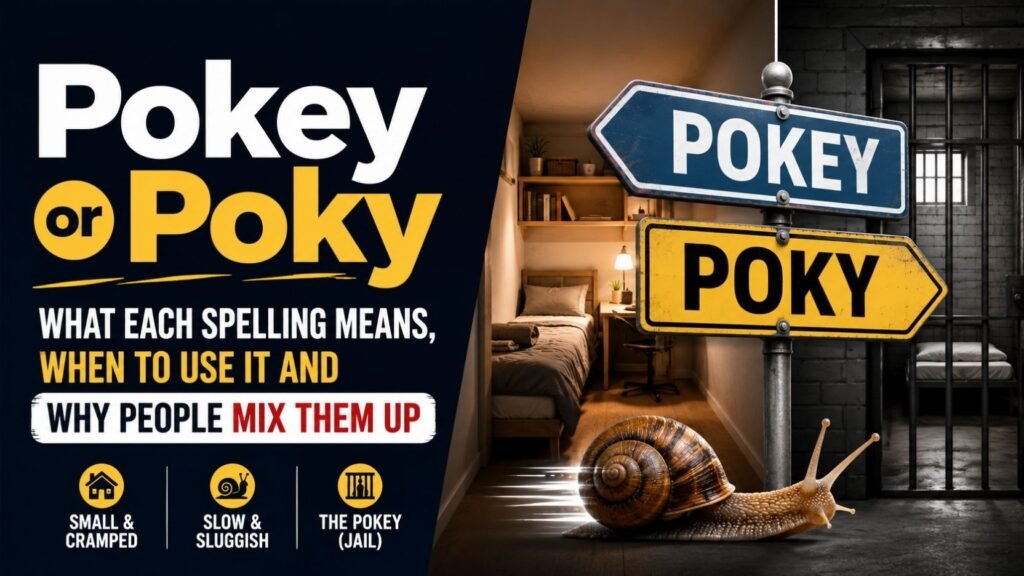
Pokey and poky are two spellings of the same word, and both are correct in different situations. In American English, poky is the standard dictionary spelling, while pokey is the more common casual variant, especially when the word refers to jail. The word can describe something small and cramped, something annoyingly slow, or, informally, a prison cell.
Confusion happens because the word carries three separate meanings that don’t obviously connect: cramped, slow, and jail. On top of that, spelling guides disagree slightly depending on which country and which meaning you’re looking at. This guide breaks down the meaning, grammar, pronunciation, and history of pokey and poky so you can use either spelling with confidence.
Pokey Or Poky: Which Spelling Is Correct?
There isn’t one “correct” spelling that beats the other. Both pokey and poky are accepted in standard dictionaries, and the choice mostly comes down to region, context, and personal or house style.
- Poky is the headword listed first in most American dictionaries, including Merriam-Webster and Collins, for the “small and cramped” and “slow” meanings.
- Pokey is the more common spelling for the jail meaning, and it’s also a widely accepted variant spelling for the other two meanings, particularly in everyday, informal writing.
- British English leans toward poky for the cramped-space meaning, and pokey is noted as an alternative used mainly in North American English.
A simple rule of thumb: if you’re writing something formal, academic, or aimed at a British audience, poky is the safer choice. If you’re writing casual American English, especially about jail, pokey fits naturally.
| Spelling | Most Common Meaning | Typical Register | Typical Region |
| Poky | Small and cramped; slow | Formal, standard, dictionary-first | British English, general American |
| Pokey | Jail; slow; small and cramped | Informal, conversational | American English |
See More: Bony Or Boney
Pokey Or Poky Meaning: The Three Core Definitions
The word covers three distinct ideas. It helps to treat them as three separate mini-definitions rather than one blended meaning, since mixing them together is what causes most of the confusion.
Meaning 1: Small And Cramped
Used as an adjective, poky or pokey describes a room, house, car, or space that feels uncomfortably tight.
- “The apartment was poky, with barely enough room for a bed and a desk.”
- “We stayed in a pokey little cabin for the weekend.”
This sense is especially common in British English, where “poky” is used, often with a note of complaint, to describe cramped housing or offices.
Meaning 2: Slow, Sluggish, Or Annoyingly Unhurried
This sense criticizes someone or something for moving, reacting, or progressing too slowly.
- “Stop being so pokey, we’re going to be late.”
- “My old laptop is so poky it takes five minutes to open a browser.”
Interestingly, this meaning almost flips in British informal usage, where “poky” can sometimes describe a car that accelerates quickly, roughly the opposite of sluggish. Context always makes the intended meaning clear.
Meaning 3: Jail (Informal, American Slang)
As a noun, usually with “the” in front of it, pokey refers to jail or a small local lockup.
- “He spent the night in the pokey after the bar fight.”
- “She joked about ending up in the pokey if she kept speeding.”
This meaning is almost always spelled pokey rather than poky, and it’s considered informal, sometimes old-fashioned, American slang.
Grammar: What Part Of Speech Is Pokey Or Poky?
Pokey and poky function as two different parts of speech depending on the meaning you intend.
As An Adjective
In the “small and cramped” and “slow” senses, the word is an adjective. It follows regular adjective patterns:
| Form | Word | Example |
| Base | poky / pokey | a poky room |
| Comparative | pokier | This room is pokier than the last one. |
| Superlative | pokiest | It’s the pokiest office I’ve ever worked in. |
Note the spelling shift: even when someone prefers “pokey” in the base form, the comparative and superlative forms typically drop the “e” and become pokier and pokiest, matching the standard dictionary spelling pattern.
As A Noun
In the jail sense, pokey is a noun, almost always paired with the definite article “the.” You don’t usually say “a pokey” or “pokeys”; you say “the pokey,” similar to how you’d say “the slammer” or “the clink.”
- Correct: “He’s in the pokey.”
- Unusual: “He’s in a pokey.” (grammatically possible but not the natural idiom)
How To Pronounce Pokey Or Poky
Both spellings are pronounced identically.
- IPA: /ˈpoʊki/ (American English) or /ˈpəʊki/ (British English)
- Simple guide: POH-kee
- Stress: The stress falls on the first syllable, POH, with the second syllable pronounced like “key.”
Since the two spellings are homophones, pronunciation is never a way to tell them apart. You have to rely on spelling and context.
Origin And Etymology
The history of this word is genuinely tangled, and honest sources admit that. Rather than pretending there’s one clean answer, it helps to separate the two senses, since they likely developed along different paths.
Origin Of “Poky” Meaning Small Or Slow
Etymology references trace this sense to the mid-19th century, built from the verb “poke,” in an older sense meaning to confine or shut in, plus the adjective-forming suffix “-y.” Something “poky” was originally linked to being confined or dealing with petty, small matters, which later narrowed into meaning cramped or slow.
See More: Scared Or Scarred
Origin Of “Pokey” Meaning Jail
The jail sense is less certain. Language researchers, including the etymology team at Merriam-Webster and the public radio show A Way with Words, note that pokey in this sense first appeared in print in the early 1900s, and it’s most likely connected to “pogey” or “pogie,” an older slang term for a poorhouse or workhouse where people were confined, sometimes to work off debts. Because “pokey” and “pogey” sounded similar and were passed around mostly in speech before showing up in print, their spellings and meanings blended together over time.
Some popular sources also mention possible influence from Scots or Irish words meaning “small” or “pocket,” but these are offered as folk theories rather than confirmed etymology. The safest, most defensible summary is this: the jail sense of pokey almost certainly grew out of, or alongside, the older “pogey” (poorhouse) slang, with the existing word “poky” (small, confined) reinforcing the connection.
Pokey Or Poky In Different Contexts
The same word shows up in surprisingly different places. Here’s how context changes what it means.
In Everyday Conversation
Most everyday use falls into the “slow” or “small” categories.
- “The traffic was pokey this morning.”
- “Their kitchen is a bit poky, but it’s cozy.”
In American Slang
“The pokey” as a stand-in for jail is common in casual American speech, older crime movies, and folk expressions. It has a slightly humorous, non-threatening tone compared to harder slang like “the slammer” or “the joint,” which is part of why it survives in family-friendly or lighthearted contexts.
In Pop Culture And Names
Several well-known names and titles use “Pokey” or “Poky,” and they’re worth knowing since they show up constantly in searches.
- The Poky Little Puppy: A classic 1942 Little Golden Book written by Janette Sebring Lowrey and illustrated by Gustaf Tenggren. It’s one of the best-selling children’s picture books in English history. Here, “poky” describes the main puppy’s tendency to dawdle and wander off instead of following his siblings.
- Gumby And Pokey: Pokey is the orange clay horse companion of Gumby, the clay animation character created by Art Clokey. This is a proper noun, a character name, so it doesn’t follow the regular spelling debate; it’s simply spelled “Pokey.”
- Hokey Pokey: A well-known participation dance and song (“You put your right foot in…”) sometimes also called the hokey cokey in British English. This name is unrelated to the “small” or “slow” meanings of poky; “hokey” here relates to nonsense or playful silliness, and “pokey” is part of the rhyming phrase rather than a literal description.
- Big Pokey: The stage name of Milton Powell, a Houston rapper and member of DJ Screw’s Screwed Up Click, known for tracks including the “June 27th Freestyle” and a feature on Paul Wall’s “Sittin’ Sidewayz.” Big Pokey died in June 2023 at age 48, and an autopsy attributed his death to a heart attack linked to hypertensive and atherosclerotic cardiovascular disease.
- Pokey Lafarge: An American singer-songwriter known for old-time and roots-influenced music.
- The Poky Dot: A name used by various independent shops, boutiques, and photography studios; it’s a proper business name, so its spelling is fixed by the business itself, not by grammar rules.
A Slang Meaning To Be Aware Of
“Pokey” or “pokie” is also used informally to describe a nipple that is visible or noticeable through clothing, sometimes referred to as “nipple poking.” This is casual slang rather than dictionary-standard usage, and it’s worth knowing simply because it explains why the word turns up in some unexpected search results.
Pokey Or Poky Sharp: What Does That Mean?
Some readers search for “pokey or poky sharp” because they’ve heard the word used to describe something with a point, like a thorny bush or a scratchy fabric tag. In casual speech, people sometimes stretch “poky” to describe something that pokes or feels sharp against the skin, related to the verb “to poke.”
This isn’t one of the three standard dictionary senses, but it’s a natural, understandable extension of the same root idea: poking, prodding, or jabbing. If you’re writing formally, a clearer word like “prickly,” “sharp,” or “scratchy” communicates the idea more precisely.
Common Mistakes With Pokey Or Poky
❌ Incorrect: “That snake is pocky.”
✅ Correct: “That snake is poky.” (Pocky is an unrelated Japanese snack brand; it isn’t a synonym for slow or sharp.)
❌ Incorrect: “He’s in a pokey.” (as a noun, missing the article)
✅ Correct: “He’s in the pokey.”
❌ Incorrect: “This is the pokeyest room I’ve seen.”
✅ Correct: “This is the pokiest room I’ve seen.” (Comparative and superlative forms drop the “e.”)
❌ Incorrect: Treating “hokey pokey” as related to jail or small spaces.
✅ Correct: Recognizing “hokey pokey” as a separate, idiomatic phrase tied to a dance and song, not a literal description.
Synonyms And Related Words
| Meaning | Synonyms | Difference In Usage |
| Small and cramped | cramped, tiny, cluttered, boxy | “Cramped” is more neutral; “poky” often carries a complaining tone. |
| Slow | sluggish, slow-moving, leisurely, dawdling | “Dawdling” suggests wasting time on purpose; “poky” can apply to people, traffic, or machines. |
| Jail | slammer, clink, jailhouse, lockup | “The pokey” sounds more old-fashioned and lighthearted than “the slammer.” |
Pokey Or Poky: Quick Reference Table
| Question | Answer |
| Is it a noun or adjective? | Both, depending on meaning: adjective for “small” or “slow,” noun for “jail.” |
| How do you pronounce it? | POH-kee, /ˈpoʊki/ |
| What is the comparative form? | pokier |
| What is the superlative form? | pokiest |
| Which spelling is more American? | Pokey, especially for the jail meaning |
| Which spelling is more British? | Poky |
| Is pocky related? | No, Pocky is a snack brand, unrelated in meaning or origin |
See More: Benefited Or Benefitted
Frequently Asked Questions
What does pokey or poky mean?
It usually means small and cramped, or slow and sluggish. Informally in American English, “the pokey” also means jail.
Is it spelled pokey or poky?
Both spellings are correct. Poky is the standard dictionary form, especially in British English, while pokey is more common in American, informal writing and is the usual spelling for the jail meaning.
How do you use pokey in a sentence?
“The office felt poky and cramped after they added two more desks.” Or, informally: “He spent a weekend in the pokey after the incident.”
Is pokey a noun or an adjective?
It can be either. As an adjective, it describes something small or slow. As a noun, almost always with “the” in front, it means jail.
What is the difference between pokey and pocky?
They’re unrelated. Pokey or poky describes something slow or cramped, or refers informally to jail. Pocky is the brand name of a Japanese chocolate-covered biscuit snack.
Where does the word pokey come from?
The “small or slow” sense likely comes from the verb “poke,” meaning to confine, combined with the suffix “-y.” The jail sense probably grew from “pogey” or “pogie,” older slang for a poorhouse, with the two words blending in speech before settling into print in the early 1900s.
Why is jail called the pokey?
The most credible explanation ties it to “pogey,” a workhouse or poorhouse term from the late 1800s where people were confined to work. Over time, oral use blurred the line between “pogey” and “poky,” and “the pokey” became established slang for a small local jail by the early 20th century.
What is the plural of pokey?
As an adjective, there’s no plural form; it doesn’t change for number (“poky rooms,” not “pokies rooms”). As the jail noun, it’s used as an uncountable idiom, “the pokey,” rather than a countable noun with a plural form.
Is hokey pokey related to poky or pokey?
Not directly. “Hokey pokey” is a fixed idiomatic phrase tied to a well-known participation dance and song. It doesn’t carry the “small,” “slow,” or “jail” meanings of poky or pokey on its own.
Who wrote The Poky Little Puppy?
Janette Sebring Lowrey wrote it, and Gustaf Tenggren illustrated it. It was first published in 1942 as one of the original twelve Little Golden Books and later became one of the best-selling hardcover children’s books in English.
Final Takeaway
Pokey and poky are the same word wearing two different spellings, and neither one is wrong. The meaning you intend, cramped, slow, or informally jail, matters far more than which spelling you pick, though poky tends to read as slightly more formal and pokey as slightly more conversational, especially in American slang.
Once you separate the three meanings in your head, small, slow, and jail, the word stops feeling confusing and starts feeling flexible. Whether you’re describing a cramped apartment, a sluggish laptop, or joking about a night in the pokey, either spelling will get your meaning across clearly to any reader.

Abdul Rehman Jutt is the author behind Grammar Wordz, with 4 years of experience researching and writing about English grammar, words, meanings, and language rules. Their goal is to make grammar simple, clear, and easy to understand through accurate and useful explanations.