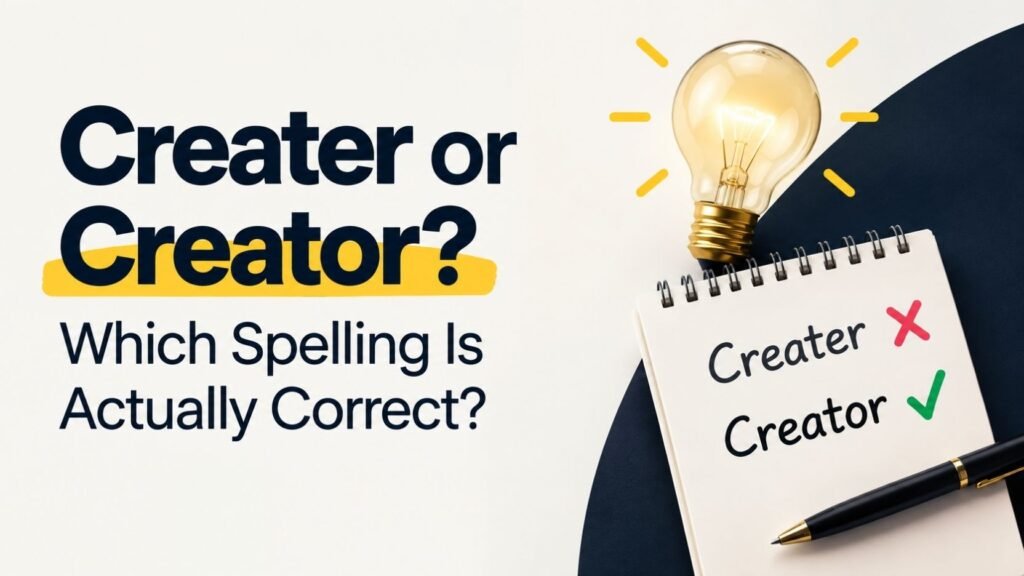
If you have ever typed the word out and paused, wondering whether it should end in “er” or “or,” you are not alone. The correct spelling is creator, not creater. Creater is a common misspelling that shows up constantly online, especially in casual writing, social media captions, and search queries, but it has no accepted place in standard English. Creator is the only version recognized by every major dictionary.
This mix up happens because English is inconsistent about how it turns verbs into “person who does this” nouns. Some words take “er,” like teacher and writer, while others take “or,” like actor and creator. There is no simple rule you can apply by ear, which is exactly why so many people guess wrong. Understanding why creator wins, and where creater slipped in, makes the spelling much easier to remember for good.
What Does Creator Mean?
Creator is a noun that describes someone or something responsible for making, inventing, or originating something new. It comes from the verb create, which means to bring something into existence that did not exist before.
At its core, a creator is a maker. The word applies broadly, so it can describe:
- A person who invents a product, story, or piece of art
- Someone who starts a business, brand, or idea
- An individual who produces online content, such as videos or posts
- A higher power, in religious and philosophical contexts, often written as Creator with a capital letter
The meaning stays consistent across these uses. Whether you are talking about a novelist, a software developer, or a deity, a creator is the one who brought something into being.
See More: Filled Or Filed
Is It Creater or Creator: The Simple Answer
Creator is correct in every context: formal writing, casual writing, business names, and everyday conversation. Creater is not a recognized spelling variant. It is not British versus American English, it is not old versus new, and it is not informal versus formal. It is simply incorrect.
You will not find creater in Merriam-Webster, Oxford, Cambridge, or Collins. Spell checkers will flag it. If you search for it, most results either correct the spelling or are pages explaining the mistake, much like this one.
Why the Confusion Happens
English speakers often assume that adding “er” to a verb is the default way to describe someone who performs an action. That instinct is not wrong, it is just incomplete.
Think about how naturally these forms come to mind:
- Teach becomes teacher
- Write becomes writer
- Bake becomes baker
- Sing becomes singer
Because “er” endings are so common, the brain applies the same pattern to create, producing “creater.” But create belongs to a smaller, less predictable group of verbs that take “or” instead. There is no shortcut that tells you which group a word falls into just by looking at the verb. You largely have to know the correct noun form, the way you know actor rather than acter, or director rather than directer.
Autocomplete and search behavior make this worse. Millions of people type creater into search bars, which keeps the misspelling visible online even though it never becomes correct.
Creator or Creater: A Quick Reference Table
| Spelling | Status | Notes |
| Creator | Correct | Found in all major dictionaries, used in every context |
| Creater | Incorrect | Common misspelling, not recognized as standard English |
Part of Speech and Grammar
Creator is a common noun. It is not capitalized unless it begins a sentence, appears in a title, or refers specifically to a deity in a religious context, such as “the Creator.”
Singular: creator
Plural: creators
The plural is formed regularly, simply by adding an “s.” There is no irregular plural form to worry about, and no apostrophe is needed unless you are showing possession, such as “the creator’s vision” or “the creators’ shared project.”
Grammatically, creator functions like any other agent noun, a noun that names the doer of an action. It can be the subject of a sentence, an object, or part of a possessive phrase.
Examples of Creator in a Sentence
- The creator of the app spent two years developing it before launch.
- She is widely known as the creator of the popular children’s book series.
- Content creators often manage filming, editing, and posting on their own.
- The museum credits the sculpture’s creator in the exhibit description.
- Many believers refer to God as the Creator of the universe.
These examples show how flexible the word is. It works equally well for a small personal project and a sweeping philosophical idea.
Common Mistakes With Creator
Beyond the creater misspelling, a few other errors show up often.
Incorrect: He is a talented creater who makes short films.
Correct: He is a talented creator who makes short films.
Incorrect: The apps’ creaters released an update.
Correct: The app’s creators released an update.
Incorrect: Content creater
Correct: Content creator
A simple way to catch the mistake is to compare it to actor. Nobody spells that word “acter,” and creator follows the same pattern.
How to Pronounce Creator
Creator is pronounced kree-AY-tur, with the stress on the second syllable. In IPA, it is written as /kriˈeɪtər/.
Breaking it into syllables helps:
- Cre, sounding like “kree”
- A, sounding like “ay”
- Tor, sounding like “ter”
American and British pronunciations are very close, with only minor differences in how the final “r” sound is articulated. In American English, the “r” is fully pronounced. In many British accents, it softens or drops slightly at the end.
Origin of the Word Creator
Creator comes from the Latin word creator, meaning “one who creates” or “producer.” That Latin word derives from creare, meaning “to make” or “to bring forth.” The word entered English through Old French and Latin influence during the medieval period, and it has kept a fairly stable spelling and meaning ever since.
Because the “or” ending traces back directly to Latin agent nouns, words like creator, actor, and director all share this pattern. English absorbed many of these words wholesale from Latin rather than building them from native English verb endings, which explains why they break the more familiar “er” pattern.
See More: Inexcusable Vs Unexcusable
Creator in Different Contexts
Everyday and Business Usage
In general conversation, creator usually refers to whoever made something specific, whether that is a product, a piece of writing, or an organization.
Content and Social Media
Online, creator has become a specific job title. A content creator is someone who produces videos, photos, posts, or other media, often across platforms, sometimes as a full time career. This usage has grown rapidly alongside platforms built around video, image, and short-form content, giving rise to related terms like ugc creator, referring to someone who makes user generated content for brands.
Tools and Products Named “Creator”
Many digital tools use “creator” in their names because the word signals that the tool helps users build something. Examples include a logo creator, a resume creator, a website creator, a qr code creator, and various ai image creator or ai video creator tools. In these cases, “creator” describes the tool’s purpose: it helps the user create something quickly.
Religious and Philosophical Usage
In religious contexts, the Creator refers to a divine being responsible for the existence of the universe. This usage is capitalized to show it is a specific reference, much like a proper noun, even though “creator” itself is a common noun.
Names and Titles
Some names simply contain the word “creator,” such as Tyler, the Creator, the musician, or The Creator, a film title. These are proper nouns and specific titles, so they follow their own capitalization rather than general grammar rules. It is worth noting these exist as names and titles, not as evidence that “creater” is ever an acceptable alternate spelling.
Creator vs Creation: What Is the Difference?
These two words are related but not interchangeable.
| Word | Meaning | Example |
| Creator | The person or force that makes something | The creator designed the entire game alone. |
| Creation | The thing that has been made, or the act of making it | The video game was his greatest creation. |
Creator is always about the doer. Creation is about the result or the process. If you are describing a person, use creator. If you are describing an object, idea, or outcome, use creation.
Synonyms and Related Words
| Word | Meaning | Difference From Creator |
| Maker | Someone who produces or builds something | More casual, often used for handmade or crafted items |
| Founder | Someone who establishes an organization or institution | Focused on starting something structural, like a company |
| Inventor | Someone who designs something new, often technical | Emphasizes original invention over general creation |
| Author | Someone who writes a text | Limited to written works, unlike the broader creator |
| Designer | Someone who plans the form or function of something | Focused on design rather than origination |
These words overlap with creator but each carries its own shade of meaning. A founder starts a company, an author writes a book, and a creator can technically do either, along with many other things, since the word is broader by nature.
See More: Hypothesis Or Hypotheses
Frequently Asked Questions
Is it creater or creator?
Creator is correct. Creater is a misspelling and is not recognized in standard English dictionaries.
What does creator mean?
Creator means a person, force, or entity that makes or originates something, whether that is a product, an idea, a piece of art, or, in religious contexts, the universe itself.
Is creator a noun or a verb?
Creator is a noun. The related verb is create.
How do you pronounce creator?
It is pronounced kree-AY-tur, with stress on the second syllable.
What is the plural of creator?
The plural is creators, formed by simply adding an “s.”
Why do people write “creater” instead of “creator”?
Because many English agent nouns end in “er,” such as teacher and writer, people assume creator follows the same pattern. It actually follows the Latin-based “or” pattern, like actor and director.
Is “content creater” ever correct?
No. The correct spelling is always content creator, regardless of context or platform.
What is the difference between creator and creation?
Creator refers to the person or source that makes something. Creation refers to the resulting thing or the act of making it.
Is creator capitalized?
Only when it starts a sentence, appears in a title, or refers specifically to a deity, as in “the Creator.”
Is creater used in any English-speaking country as an accepted spelling?
No. It is not accepted in American English, British English, or any other standard variety of English.
Final Thoughts
The spelling question has one clear answer: creator is correct, and creater is a mistake, no matter how often it appears in searches or casual writing. The confusion comes from English’s habit of forming agent nouns with “er,” while creator quietly follows an older, Latin-based pattern shared with words like actor and director. Once you connect creator to that small family of words, the correct spelling becomes much easier to remember.
Beyond spelling, creator is a genuinely useful word because it stretches across so many situations, from crediting an artist or inventor to describing a modern content creator building an online audience. Whether you are writing a caption, naming a product, or simply trying to get the spelling right in an email, remembering that creator matches actor rather than teacher will keep you on solid ground every time.

Abdul Rehman Jutt is the author behind Grammar Wordz, with 4 years of experience researching and writing about English grammar, words, meanings, and language rules. Their goal is to make grammar simple, clear, and easy to understand through accurate and useful explanations.