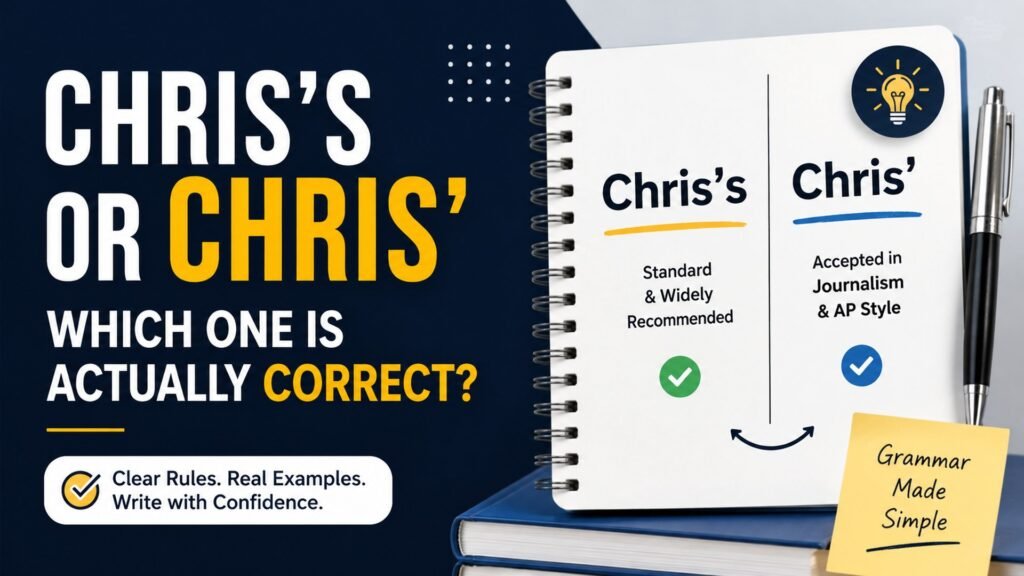
If you have ever paused mid-sentence wondering whether to write Chris’s car or Chris’ car, you are not alone. This is one of the most common possessive puzzles in English, and the honest answer is that both forms are used correctly, depending on which style guide you follow. Most modern style guides, including the Associated Press and the Chicago Manual of Style in recent editions, treat this the same way you would treat any other singular name.
For most everyday writing in the United States, Chris’s is the safer and more widely recommended choice. It follows the standard rule for forming the possessive of a singular noun, even when that noun already ends in the letter s. That said, Chris’ is also accepted by several respected style guides, particularly in journalism, so the “correct” answer depends partly on which rulebook you are writing for. Understanding why both exist will help you pick the right one with confidence, every time.
This distinction might look small, but it trips up careful writers constantly, from students formatting essays to business owners naming their restaurants. Names ending in s are genuinely irregular in English, unlike plural possessives, which follow one simple pattern. Once you understand the underlying rule and the exceptions that publishers actually use, you will never have to guess again. The rest of this guide walks through the grammar, the style guide differences, and plenty of real examples.
The Simple Answer
Chris’s is the standard possessive form recommended by most grammar authorities, including the Chicago Manual of Style, APA, and most English teachers. You add an apostrophe and an s to Chris, the same way you would with any other singular name, even though it already ends in s.
Chris’ is a shortened variant that some style guides, most notably the Associated Press Stylebook, prefer for names ending in s. It drops the extra s after the apostrophe to avoid an awkward double s sound in print.
Neither form is objectively wrong. They reflect two competing traditions in English punctuation, and the right one for you depends on the style guide your school, employer, or publication follows.
See More: Buying Puts Vs Selling Puts
Why This Confuses So Many Writers
English possessives usually follow one predictable rule: add an apostrophe and an s to a singular noun. The dog’s leash. The car’s engine. Sarah’s book. This works cleanly for almost every name in English, until you reach a name that already ends in the letter s, like Chris, James, or Charles.
At that point, writers face a choice. Adding another s after the apostrophe creates a word that has three s sounds close together, which some people find clumsy to say out loud. Dropping the final s makes the word shorter and, to some ears, smoother. Both camps have valid reasoning, which is exactly why style guides disagree.
Grammar Rule Behind Chris’s
The traditional grammar rule for forming a singular possessive is straightforward: take the noun, add an apostrophe, then add an s. This rule applies regardless of the noun’s final letter.
- The boss’s office
- The bus’s schedule
- Chris’s backpack
- James’s car
- The glass’s rim
Because Chris is a singular proper noun, the standard rule simply treats it like any other name. You are not pluralizing Chris. You are showing that something belongs to one person named Chris, so the possessive s is added in full: Chris’s.
This is the version taught in most American English classrooms, and it is the form used by the Chicago Manual of Style, one of the most widely respected style references in publishing, academic writing, and books.
Grammar Rule Behind Chris’
The alternative rule says that when a singular name already ends in s, you only add an apostrophe, without the extra s. Under this rule, Chris’ is treated the same way you would treat a plural possessive, like the dogs’ bowls or the teachers’ lounge, even though Chris is singular and not plural at all.
This approach exists mainly for pronunciation and rhythm. Newspapers, in particular, favor shorter, cleaner text that reads quickly on a page or a screen. The Associated Press Stylebook, followed by most U.S. newspapers and many news websites, recommends dropping the final s for singular proper names ending in s, which is why you will often see Chris’ company or Jones’ statement in news articles.
Chris’s or Chris’: Quick Comparison Table
| Form | Style Guides That Prefer It | Common Setting | Example |
| Chris’s | Chicago Manual of Style, APA, most classrooms | Books, academic writing, everyday writing | Chris’s phone rang twice. |
| Chris’ | Associated Press Stylebook, many newsrooms | Newspapers, journalism, some news websites | Chris’ statement was brief. |
Both rows describe correct usage. The difference is about which authority you are following, not about right versus wrong.
What Do Major Style Guides Actually Say?
Style guides disagree on this point more than on almost any other punctuation rule, so it helps to see them side by side.
| Style Guide | Preferred Form | Reasoning |
| Chicago Manual of Style | Chris’s | Applies standard singular possessive rule to nearly all names, including those ending in s |
| APA Style | Chris’s | Follows the same full apostrophe-s rule used across academic writing |
| Associated Press Stylebook | Chris’ | Drops the extra s after singular proper nouns ending in s, for cleaner print style |
| MLA Style | Chris’s | Recommends the standard apostrophe-s form for singular possessives, including names ending in s |
If you are writing a school paper using MLA or APA formatting, Chris’s is the expected form. If you are writing for a newspaper, wire service, or publication that follows AP style, Chris’ is likely what your editor wants. When no specific style guide applies, such as everyday emails, texts, or general writing, Chris’s is the more widely recommended and more broadly understood option.
See More: Puts Vs Calls
Is It Chris’s Or Chris’ In The UK?
British English generally follows the same core rule as Chicago and APA style. Most UK style guides, including those used by major British publishers, recommend Chris’s for singular names ending in s. The Oxford style guide, often referred to informally as Oxford English, supports the full apostrophe-s form for most singular possessives, Chris’s included.
Some British newspapers still trim the final s in certain names for house style reasons, similar to AP style in the United States, but this is less universal in the UK than the Chris’s form. If you are writing for a British audience without house style instructions, Chris’s is the safer default.
Is It Chris’s Or Chris’ In Australia?
Australian English typically follows British conventions rather than American ones, and the same general pattern applies here. Most Australian style guides and dictionaries support Chris’s as the standard possessive form for a singular name ending in s. As with the UK, some news outlets may follow a house style that trims the final s, but this is a publication-specific choice rather than a nationwide rule.
Chris’s or Chris’ For MLA Formatting
If you are writing an academic paper that follows MLA guidelines, use Chris’s. MLA format follows the standard rule for singular possessives, which means adding an apostrophe and an s regardless of the noun’s ending. This applies to research papers, essays, and other academic writing where MLA citation style is required.
How to Say It Out Loud
Pronunciation is actually part of why this debate exists. Chris’s is typically pronounced with an added “iz” sound at the end, similar to how you would say Chris is, but blended into one word: KRIS-iz.
Chris’, when written without the extra s, is usually pronounced the same way in casual speech. Most native English speakers say the possessive out loud the same way regardless of which spelling they use in writing, because English pronunciation naturally adds a slight “iz” sound after an s-ending name in possessive form. The real difference between Chris’s and Chris’ shows up on the page, not necessarily in conversation.
Chris’s or Chris’ In A Sentence
Seeing both forms used correctly in context makes the rule much easier to remember.
Using Chris’s, the standard form:
- Chris’s dog waited by the door all afternoon.
- I borrowed Chris’s umbrella because it started raining.
- Chris’s presentation impressed the entire team.
Using Chris’, the AP-style form:
- Chris’ dog waited by the door all afternoon.
- I borrowed Chris’ umbrella because it started raining.
- Chris’ presentation impressed the entire team.
Notice that the meaning never changes between the two versions. Only the spelling of the possessive differs, based on which style guide you are following.
Common Mistakes To Avoid
Even careful writers slip up with this rule, so it helps to see the mistakes clearly laid out.
❌ Incorrect: Chriss’s book is on the table.
✅ Correct: Chris’s book is on the table. Chris only has one s at the end of the name itself, so the possessive should never double that final letter before adding the apostrophe.
❌ Incorrect: Chris’s’ backpack was left behind.
✅ Correct: Chris’s backpack was left behind, or Chris’ backpack was left behind. Never place an apostrophe after both s letters. Choose one form and stick with it.
❌ Incorrect: Chris’ s car needs gas.
✅ Correct: Chris’s car needs gas, or Chris’ car needs gas. Do not insert a space between the apostrophe and the following s. The apostrophe and s always sit directly together with no gap.
❌ Incorrect: Switching between Chris’s and Chris’ within the same document.
✅ Correct: Pick one style and use it consistently throughout your writing. Consistency matters more than which specific form you choose. Mixing both versions in one piece of writing looks careless, even though each version is individually correct under a different style guide.
Chris’s Or Chris’ In Business Names
Business names add another layer to this question, because many businesses use the possessive form of a personal name as their brand, and business names do not always follow standard grammar rules. Once a name is trademarked or registered, the business owner’s chosen spelling becomes the official, correct version for that specific brand, regardless of general grammar rules.
For example: Restaurant names built around a personal name often keep the extra s, following the standard singular possessive form, similar to how you would see it in phrases like Chris’s burgers or Chris’s steakhouse when used as a description. However, the actual legal or trademarked name of any specific restaurant, cafe, or shop should always be written exactly as that business spells it, since brand names are proper nouns with their own fixed spelling.
This is also true for globally recognized restaurant names that include a possessive form of a personal name. The correct spelling of any specific brand should always be verified directly against that business’s own official branding, website, or signage, rather than assumed from grammar rules alone, since branded names sometimes intentionally break standard punctuation conventions for stylistic or trademark reasons.
Chris’s Or Chris’ With Other Names Ending in S
This same grammar question applies to any singular name ending in the letter s, not just Chris. Seeing the pattern applied to other familiar names can make the rule click faster.
| Name | Chicago and APA Style | AP Style |
| Chris | Chris’s | Chris’ |
| James | James’s | James’ |
| Charles | Charles’s | Charles’ |
| Thomas | Thomas’s | Thomas’ |
| Ross | Ross’s | Ross’ |
The pattern stays consistent across every name ending in s. Whatever rule you choose for Chris should be applied the same way to every other name ending in s within the same piece of writing.
Difference Between Singular Possessive and Plural Possessive
It helps to separate this rule from plural possessives, since the two are often confused.
A singular possessive shows that something belongs to one person, even if that person’s name ends in s, as with Chris’s laptop or Chris’ laptop, both referring to one person named Chris.
A plural possessive shows that something belongs to more than one person or thing, and it typically only needs an apostrophe after the existing s, without adding another one, as in the students’ books or the teachers’ lounge, referring to multiple students or multiple teachers.
The confusion between Chris’s and Chris’ partly comes from this plural rule bleeding into singular names that happen to end in s. Chris is one person, so the singular possessive rule applies, not the plural one, even though the final letter looks similar.
See More: The Color Gray Or Grey
Frequently Asked Questions
Is it Chris’s or Chris’?
Both are correct, depending on the style guide. Chris’s follows Chicago, APA, and MLA style. Chris’ follows AP style, commonly used in journalism.
Which is more commonly used Chris’s or Chris’?
Chris’s is more commonly recommended for general and academic writing, since Chicago, APA, and MLA style all support it. Chris’ appears mainly in news writing that follows AP style.
Do you say Chris’s or Chris’ out loud?
Most speakers pronounce both forms the same way in casual conversation, adding a soft “iz” sound after the name. The difference is mainly a written one, not a spoken one.
Is Chris’s or Chris’ correct for a birthday message?
Either is grammatically acceptable for something like Chris’s birthday party or Chris’ birthday party. For informal writing like cards or messages, Chris’s is the more broadly recognized choice.
Would it be Chris’s or Chris’ in UK English?
UK style guides, including Oxford style, generally support Chris’s as the standard form, following the same core rule used in Chicago and APA style.
Is it Chris’s or Chris’ for MLA papers?
Use Chris’s for MLA-formatted academic writing, since MLA follows the standard singular possessive rule.
What is the difference between Chris’s and Chris’ in AP style specifically?
AP style is one of the few major style guides that recommends dropping the extra s for singular names already ending in s, which is why Chris’ appears more often in newspapers and wire service articles than in books or academic papers.
Can both Chris’s and Chris’ appear in the same document?
No. Even though both forms are individually correct under different style guides, mixing them within a single piece of writing looks inconsistent. Choose one form and use it throughout.
Is Chris’ or Chris’s used more often for restaurant and shop names?
This depends entirely on how the individual business has branded and trademarked its name. Some businesses use the full apostrophe-s form, and others intentionally shorten it. The official spelling of any specific business should be confirmed directly through that business rather than assumed from general grammar rules.
Does the rule change for plural names like the Chrises?
Yes. If you were referring to more than one person named Chris, the plural form would be Chrises, and the possessive of that plural would typically be the Chrises’, following the standard plural possessive rule rather than the singular one discussed throughout this guide.
Final Thoughts
The choice between Chris’s and Chris’ comes down to which style guide you are following, not a single universal rule that every writer must obey. Chris’s is the more broadly taught and more widely recommended form, supported by Chicago, APA, MLA, and most everyday writing standards, both in the United States and internationally. Chris’ remains a valid and intentional choice mainly within AP-style journalism, where a shorter, cleaner possessive form is preferred for print and digital news writing.
Whichever version you choose, the most important habit is consistency. Pick the form that matches the style guide relevant to your writing, whether that is a school assignment, a professional publication, or simply your own personal preference, and use that same form every time Chris’s name appears in possessive form throughout your document. Once you understand the reasoning behind both versions, you will never have to second-guess this small but surprisingly common grammar question again.

Abdul Rehman Jutt is the author behind Grammar Wordz, with 4 years of experience researching and writing about English grammar, words, meanings, and language rules. Their goal is to make grammar simple, clear, and easy to understand through accurate and useful explanations.