
If you have ever paused mid sentence and wondered whether to type “spicy” or “spicey,” you are not alone. This is one of the most common spelling mix ups in everyday English, especially when people are texting, writing menus, or leaving online reviews.
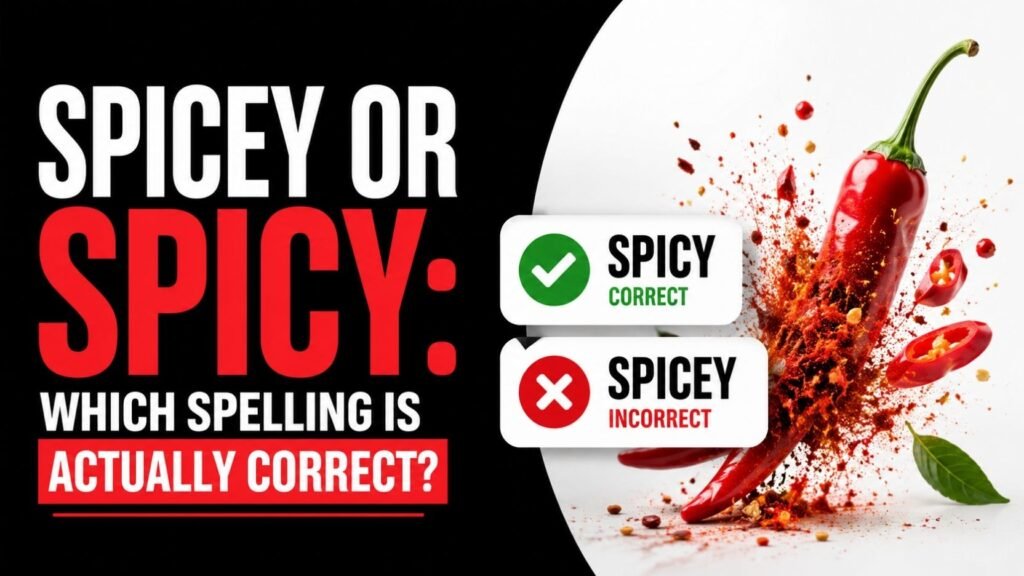
The short answer is simple. “Spicy” is the correct and standard spelling in modern English. “Spicey” is a common misspelling that shows up often online, but it is not recognized as correct by major dictionaries.
This article breaks down the meaning, the grammar, the pronunciation, and the reasons people keep mixing these two spellings up. It also covers regional habits, common usage patterns, and the small handful of cases where “spicey” does appear correctly, just not as an adjective for hot food.
Quick Answer: Spicy Is Correct
Before going further, here is the direct answer.
- Correct spelling: spicy
- Incorrect spelling (for the adjective): spicey
- Part of speech: adjective
- Meaning: having a strong, hot, or pungent flavor, often from spices like chili, pepper, or ginger
Every major English dictionary, including Merriam-Webster, Oxford, and Cambridge, lists “spicy” as the standard form. “Spicey” does not appear as a recognized headword in any of these references.
So if you are asking, “is it spicey or spicy,” the answer stays the same no matter where you are writing from: use “spicy.”
See More: Sprats vs Sardines
Why Do People Write “Spicey” Instead Of “Spicy”?
This mix up is not random. It comes from a real pattern in English spelling, and understanding that pattern makes the confusion easier to avoid.
The Silent E Habit
Many English adjectives end in a silent “e” followed by “y” when a suffix gets added. Words like “size” become “sizey” in casual writing (even though “sizable” is the real word), and “space” sometimes gets written as “spacey,” which actually is correct in that specific case.
Because so many words in English keep the “e” before adding “y,” it feels natural to assume “spice” should follow the same rule and become “spicey.” But English is inconsistent here, and “spicy” simply drops the “e.”
Autocorrect And Muscle Memory
On phones and keyboards, autocorrect sometimes fails to catch this error because “spicey” looks like a plausible word. Once someone types it a few times, muscle memory takes over, and the incorrect spelling starts to feel normal.
Influence From Similar Words
Words like “juicy,” “spacey,” and “lacy” all keep or drop the “e” in different ways, which adds to the confusion:
| Base Word | Correct Adjective | Keeps the E? |
| Spice | Spicy | No |
| Space | Spacey | Yes |
| Juice | Juicy | No |
| Lace | Lacy | No |
| Grace | Gracious | Changes form |
There is no single universal rule that explains all of these at once, which is exactly why so many people guess wrong with “spicy.”
Is “Spicey” Ever Correct?
This is where the answer gets a little more interesting.
“Spicey” is not a recognized standard word, but it does show up in a few specific, limited situations:
- As a surname. Some people are named “Spicey” or “Spicey” appears as part of a business or brand name. Proper nouns follow their own spelling, not standard dictionary rules.
- As a stylized brand choice. Some food products, restaurants, or apps intentionally spell it “spicey” to stand out or to match a domain name that was already taken. This is a marketing decision, not a grammar rule.
- As a widespread typo. Most of the time, when you see “spicey” online, in a text message, or on a handwritten menu, it is simply a spelling mistake.
Outside of names and branding, there is no context where “spicey” is the grammatically correct choice over “spicy.”
Spicy: Full Meaning Breakdown
“Spicy” carries more than one shade of meaning depending on context. Separating these clearly helps you understand exactly how the word works.
Meaning 1: Strong or Hot in Flavor
This is the most common meaning. It describes food that produces a burning, tingling, or intense sensation, usually from ingredients like chili peppers, black pepper, mustard, ginger, or horseradish.
Example: The curry was so spicy that he needed a glass of milk.
Meaning 2: Containing Many Spices
This meaning is broader and does not always mean “hot.” A dish can be described as spicy simply because it uses a lot of aromatic spices such as cinnamon, cardamom, or cloves, even if it is not fiery.
Example: The holiday bread had a spicy, warm flavor from the cinnamon and nutmeg.
Meaning 3: Informal Slang for Exciting, Bold, or Slightly Scandalous
In casual conversation, “spicy” is often used away from food entirely. It can describe something exciting, daring, gossip worthy, or a little edgy.
Example: That comment section got spicy fast once people started disagreeing.
This slang usage has grown significantly in online conversation, memes, and social media, where “spicy” now regularly means bold, controversial, or intense rather than literally hot.
Spicy In Different Contexts
The meaning of “spicy” shifts depending on where and how it is used. Here is a breakdown of the most common contexts.
Spicy Food
This is the original and most literal use. It applies to dishes, sauces, snacks, and drinks that create a noticeable heat sensation.
Common examples include:
- Spicy ramen
- Spicy noodles
- Spicy mayo
- Spicy tuna rolls
- Spicy chicken sandwiches
Spicy in Slang and Online Conversation
Online, “spicy” often describes tone rather than taste. A “spicy” take is a bold or controversial opinion. A “spicy” reply is one with attitude or sharp wit.
This usage is common in:
- Social media comments
- Group chats
- Meme captions
- Reaction videos
Spicy In Games And Icebreakers
Games like “Never Have I Ever” or “Would You Rather” sometimes get labeled “spicy” when the questions are bolder, more personal, or more daring than the standard version. Here, “spicy” signals intensity of content rather than flavor.
Spicy As A Personality Or Mood Descriptor
People sometimes describe themselves or others as “spicy” to mean fiery, sharp tempered, or full of personality, usually in a lighthearted or affectionate way.
Example: My grandmother is in her eighties and still spicy as ever.
See More: Time Flies Or Flys
Grammar Of “Spicy”
Understanding the grammar helps you use the word correctly in every sentence structure.
Part of Speech
“Spicy” is an adjective. It describes a noun and cannot function as a verb or a standard noun on its own.
Comparative And Superlative Forms
Because “spicy” ends in a consonant plus “y,” the “y” changes to “i” before adding the ending.
| Form | Word | Example |
| Base | Spicy | This sauce is spicy. |
| Comparative | Spicier | This sauce is spicier than the last one. |
| Superlative | Spiciest | This is the spiciest dish on the menu. |
Do not write “spicyer” or “spicyest.” These forms are incorrect. The rule is straightforward: when a short adjective ends in a consonant followed by “y,” change the “y” to “i” before adding “er” or “est.”
Adverb Form
The adverb form is “spicily,” though it is used far less often than the adjective.
Example: The dish was spicily seasoned, almost too much for beginners.
Because this adverb form feels a little awkward, most writers avoid it and rephrase the sentence instead, such as “The dish was seasoned with a lot of spice.”
How to Pronounce “Spicy”
Pronunciation is simple and consistent across English speaking regions.
- American English: SPY-see
- British English: SPY-see
The stress falls on the first syllable in both American and British English. There is no meaningful pronunciation difference between regions for this word, which is part of why the spelling confusion is unusual. If the word were pronounced differently in different places, that might explain the “spicey” spelling. Since it is not, the mistake comes purely from writing habits rather than speech patterns.
Spicy or Spicey: Regional Usage
A common search question is whether British English, Australian English, or another regional variety treats “spicey” as acceptable. It does not.
| Region | Correct Spelling | Notes |
| United States | Spicy | Standard in all major American dictionaries |
| United Kingdom | Spicy | Standard in Oxford and Cambridge dictionaries |
| Australia | Spicy | Follows British spelling conventions |
| Canada | Spicy | Follows a mix of American and British norms, but spicy is standard |
There is no dialect or regional standard where “spicey” is the accepted spelling. This separates it from genuine American versus British spelling differences, such as “color” versus “colour” or “flavor” versus “flavour,” where both spellings are correct depending on the country. “Spicy” does not have a regional variant. It only has one correct form.
Common Mistakes With Spicy And Spicey
Here are the most frequent errors, shown clearly so you can avoid them.
Incorrect: This salsa is way too spicey for me.
Correct: This salsa is way too spicy for me.
Incorrect: She likes spicey food more than I do.
Correct: She likes spicy food more than I do.
Incorrect: That was a spicyer version of the recipe.
Correct: That was a spicier version of the recipe.
Incorrect: It’s the spicyest wing on the menu.
Correct: It’s the spiciest wing on the menu.
A simple way to remember the rule: picture the word “spice” losing its silent “e” before “y” joins the word, the same way “nice” becomes “nicer,” not “nicier” or “niceyer.”
Spicy vs. Similar Words
Several related words are sometimes confused with “spicy” because they touch on similar ideas. The table below shows the differences.
| Word | Meaning | How It Differs From Spicy |
| Hot | Can mean high temperature or spicy flavor | “Hot” is more general and can refer to actual temperature, not just seasoning |
| Zesty | Fresh, tangy, and lively flavor | Zesty leans toward citrus or tangy notes, not necessarily heat |
| Piquant | Pleasantly sharp or spicy taste | More formal and less common in everyday speech |
| Fiery | Very intense heat, often stronger than spicy | Suggests a more extreme or overwhelming level of spice |
| Pungent | Sharp, strong smell or taste | Can apply to smell as well as taste, not limited to heat |
These words overlap with “spicy” but are not direct substitutes in every sentence. Choosing the right one depends on exactly what sensation or quality you want to describe.
See More: Buying Puts Vs Selling Puts
Frequently Asked Questions
Is it spicey or spicy?
“Spicy” is the correct spelling. “Spicey” is a common misspelling and does not appear in standard dictionaries as the adjective for hot or heavily seasoned food.
Is spicey a real word?
No, not as an adjective describing flavor. “Spicey” only appears correctly as a surname or as a stylized brand name, never as the standard spelling for describing hot food.
What is the correct spelling of spicy food?
The correct spelling is “spicy food.” “Spicey food” is incorrect.
Is spicy an adjective or a noun?
“Spicy” is an adjective. It describes a noun, such as “spicy sauce” or “spicy noodles,” and cannot be used as a noun on its own.
How do you spell the comparative form of spicy?
The comparative form is “spicier,” not “spicyer.” The superlative form is “spiciest,” not “spicyest.”
Does British English spell it differently than American English?
No. Both British and American English use “spicy.” This is not one of the words with regional spelling differences, unlike “color” and “colour.”
What does spicy mean as slang?
As slang, “spicy” describes something exciting, bold, or slightly controversial, such as a heated online discussion or a daring opinion, separate from its literal meaning about flavor.
Why do so many people misspell spicy as spicey?
The mistake likely comes from other English words that keep the silent “e” before adding “y,” such as “spacey.” Since English spelling rules are inconsistent, this creates confusion for “spicy” specifically.
Is “spicey” used anywhere correctly?
Yes, but only as a proper noun, such as a surname or a stylized business or product name. It is not correct as a general adjective describing food or flavor.
Final Takeaway
“Spicy” is the correct spelling every time you are describing hot, pungent, or heavily seasoned food, and it is also the correct choice when using the word informally to describe something bold or exciting. “Spicey” is a spelling mistake that has become common simply because it looks like it could follow the same pattern as words like “spacey,” even though it does not.
The next time you are writing a menu description, a text to a friend, or a comment online, remember that the “e” in “spice” drops before “y” is added. Keep that one detail in mind, and you will never second guess “spicy or spicey” again.

Abdul Rehman Jutt is the author behind Grammar Wordz, with 4 years of experience researching and writing about English grammar, words, meanings, and language rules. Their goal is to make grammar simple, clear, and easy to understand through accurate and useful explanations.