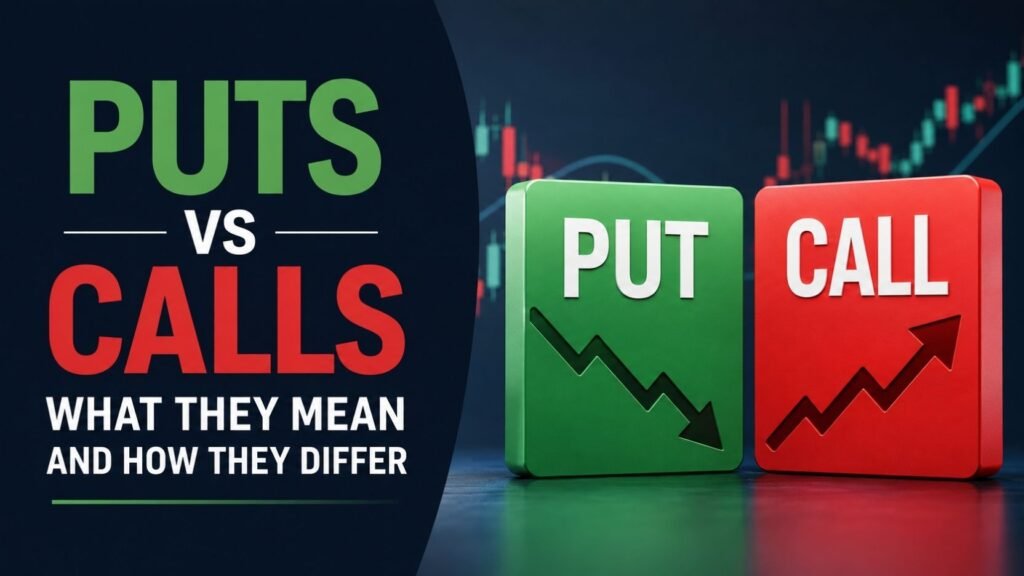
A put and a call are the two basic types of stock options. A call option gives the buyer the right to buy a stock at a set price. A put option gives the buyer the right to sell a stock at a set price. That single difference the right to buy versus the right to sell is the whole idea behind puts vs calls.
Traders use calls when they expect a stock to go up. They use puts when they expect a stock to go down, or when they want to protect a position they already own. Understanding puts vs calls is the first real step into options trading, because almost every other options strategy is built from these two contracts.
Puts Vs Calls: The Simple Definition
Both puts and calls are options contracts. An options contract gives the buyer a right, not an obligation, to trade a stock at a fixed price before a certain date. That fixed price is called the strike price. The date is called the expiration date.
- A call option gives the buyer the right to buy 100 shares of a stock at the strike price.
- A put option gives the buyer the right to sell 100 shares of a stock at the strike price.
The person who sells the option, rather than buys it, is called the writer. The writer takes on the opposite obligation. If someone buys a call, the person who sold it must sell the stock if the buyer chooses to exercise the option. If someone buys a put, the seller must buy the stock if the buyer exercises.
| Term | Meaning |
| Call option | Right to buy a stock at the strike price |
| Put option | Right to sell a stock at the strike price |
| Strike price | The fixed price written into the contract |
| Expiration date | The last date the option can be used |
| Premium | The price paid to buy the option |
Why Puts Vs Calls Matters
The difference between puts and calls determines which direction a trader is betting on. This matters because options are one of the few tools that let a trader profit from a stock falling, not just rising.
Calls are the more intuitive of the two, since buying a call feels similar to buying a stock: both are bets that the price goes up. Puts confuse more beginners, because buying a put means profiting when a stock loses value, which is the opposite of how most people first learn to invest.
See More: Sprats vs Sardines
Calls: How They Work
A call option becomes more valuable as the underlying stock price rises above the strike price. Traders buy calls when they expect a stock to climb.
Example: A stock trades at $50. A trader buys a call with a $55 strike price, expiring in one month, for a premium of $2 per share. If the stock rises to $60 before expiration, the trader can buy shares at $55 and immediately have $5 of value per share, minus the $2 premium paid, for a $3 profit per share. If the stock stays below $55, the call expires worthless and the trader loses only the $2 premium.
Calls have a defined maximum loss for the buyer, which is the premium paid. The potential gain is theoretically unlimited, since a stock price can keep rising.
Puts: How They Work
A put option becomes more valuable as the underlying stock price falls below the strike price. Traders buy puts when they expect a stock to drop, or when they want insurance against a drop in a stock they already hold.
Example: A stock trades at $50. A trader buys a put with a $45 strike price for a premium of $2 per share. If the stock falls to $35, the trader can sell shares at $45 even though the market price is only $35, capturing $10 of value per share, minus the $2 premium, for an $8 profit per share. If the stock stays above $45, the put expires worthless and the loss is limited to the $2 premium.
Like calls, the maximum loss for a put buyer is the premium paid. The maximum gain is limited only by how far the stock can fall, since a stock price cannot go below zero.
Puts Vs Calls: Side-By-Side Comparison
| Feature | Call Option | Put Option |
| Right granted to buyer | Buy the stock | Sell the stock |
| Buyer profits when | Stock price rises | Stock price falls |
| Buyer’s maximum loss | Premium paid | Premium paid |
| Buyer’s maximum gain | Unlimited | Limited to stock reaching zero |
| Common use | Bet on upward movement | Bet on downward movement, or hedge a holding |
| Feels similar to | Owning the stock | Shorting the stock |
Buying Puts Vs Calls
Buying either a put or a call gives a trader a defined, limited risk. The most a buyer can lose is the premium they paid for the contract. This is one reason new traders are often drawn to buying options rather than selling them.
- Buying a call is a bullish trade. The trader expects the stock to rise above the strike price before expiration by more than the premium cost.
- Buying a put is a bearish trade, or a protective one. A trader might buy a put because they expect a decline, or because they own the stock and want to limit downside risk without selling their shares.
See More: Quantify Vs Qualify
Selling Puts Vs Calls
Selling options works differently from buying them, and it carries a different risk profile.
- Selling a call (also called writing a call) means agreeing to sell shares at the strike price if the buyer exercises. If a trader already owns the shares, this is called a covered call, and the risk is limited to giving up further upside. If the trader does not own the shares, this is called a naked call, and the potential loss is unlimited, since the stock price can rise indefinitely.
- Selling a put means agreeing to buy shares at the strike price if the buyer exercises. This is often done through a strategy called a cash secured put, where the seller sets aside enough cash to buy the shares if needed. The seller collects the premium up front, and their maximum loss is limited to the strike price minus the premium received, since a stock cannot fall below zero.
| Position | What You Agree To Do | Main Risk |
| Selling a covered call | Sell shares you already own if exercised | Limited: you cap your upside |
| Selling a naked call | Sell shares you do not own if exercised | Unlimited: the stock can rise indefinitely |
| Selling a cash secured put | Buy shares at the strike if exercised | Limited to strike price minus premium collected |
Puts Vs Calls Vs Shorts
Buying a put and shorting a stock both profit when a stock price falls, but they are not the same thing.
- Shorting a stock means borrowing shares, selling them immediately, and buying them back later at a lower price. Losses on a short are theoretically unlimited, because the stock price can keep rising with no ceiling.
- Buying a put also profits from a falling stock, but the maximum loss is capped at the premium paid. A put buyer also does not need a margin account for borrowing shares in the same way a short seller does, though options trading has its own approval requirements.
In short, a put is often described as a safer, defined-risk way to bet against a stock compared with shorting it outright.
Puts To Calls Ratio
The put to call ratio compares the trading volume of puts to the trading volume of calls on a stock or index over a given period. It is used by some traders as a sentiment indicator.
- A high put to call ratio suggests more traders are buying puts, which can signal bearish sentiment, or sometimes signal that traders are hedging existing positions.
- A low put to call ratio suggests more traders are buying calls, which can signal bullish sentiment.
This ratio is a sentiment gauge, not a guaranteed predictor of where a stock will go next.
Common Mistakes With Puts Vs Calls
❌ Incorrect: “A put option means you are buying the stock at a lower price.”
✅ Correct: A put option means you have the right to sell the stock at the strike price. It does not involve buying shares unless you are the one who sold the put and it gets exercised against you.
❌ Incorrect: “Buying a call and selling a put are the same trade.”
✅ Correct: Both can reflect a bullish view, but they carry different risk profiles. Buying a call limits loss to the premium paid. Selling a put carries a much larger potential loss if the stock falls sharply.
❌ Incorrect: “Options are always riskier than owning stock.”
✅ Correct: Buying options limits risk to the premium paid, which can actually be less risky in dollar terms than owning shares outright. Selling options, particularly uncovered calls, can carry more risk than owning stock.
Puts Vs Calls For Specific Stocks
The mechanics of puts and calls are identical no matter which stock is involved, whether it is a widely traded name like Tesla or a smaller company like ImmunityBio, known by its ticker IBRX. What changes from stock to stock is the premium cost, the available strike prices, and the liquidity of the options chain.
Highly traded stocks and index funds, such as the SPY exchange traded fund, tend to have tighter bid ask spreads and more strike prices to choose from than smaller or less liquid stocks.
Options Skew: Puts Vs Calls In Volatile Markets
In markets known for sharp price swings, such as certain cryptocurrency markets, options traders sometimes track something called volatility skew. This measures whether puts or calls are pricing in more expected volatility relative to each other.
A skew toward puts often reflects greater demand for downside protection, while a skew toward calls can reflect greater demand for upside speculation. This is a more advanced concept generally used by experienced options traders rather than beginners.
Frequently Asked Questions
What is the simple difference between puts and calls?
A call gives the right to buy a stock at a set price. A put gives the right to sell a stock at a set price.
Do you buy a put or a call if you think a stock will go up?
You would typically buy a call if you expect the stock price to rise.
Do you buy a put or a call if you think a stock will go down?
You would typically buy a put if you expect the stock price to fall.
What is the maximum loss when buying a put or a call?
The maximum loss for a buyer of either a put or a call is the premium paid for the contract.
Is selling a put riskier than buying a put?
Selling a put carries a larger potential loss than buying one, since the seller may be required to buy shares at the strike price even if the stock has fallen significantly.
What is a covered call?
A covered call is when a trader sells a call option on a stock they already own, which limits further upside in exchange for collecting the premium.
What is a cash secured put?
A cash secured put is when a trader sells a put option while holding enough cash to buy the shares if the option is exercised.
Is buying a put the same as shorting a stock?
No. Both profit from a falling stock price, but a put buyer’s loss is capped at the premium paid, while a short seller’s loss is theoretically unlimited.
What does the put to call ratio measure?
It measures the trading volume of puts relative to calls, and is sometimes used as a sentiment indicator, though it is not a guaranteed predictor of price direction.
Are puts and calls only used for stocks?
No. Puts and calls also exist for exchange traded funds, indexes, and other underlying assets, including some cryptocurrencies.
See More: Tuille Vs Tuile
Final Thoughts
Puts and calls are simply two sides of the same tool. A call is the right to buy a stock at a fixed price, and it rewards traders who expect prices to rise. A put is the right to sell a stock at a fixed price, and it rewards traders who expect prices to fall or who want to protect an existing position.
Once the core difference is clear, the rest of options trading becomes easier to follow, since strategies like covered calls, cash secured puts, and hedges are all built from this same basic pair of contracts. Anyone learning puts vs calls should focus first on this direction of the bet, then move on to premiums, strike prices, and risk before trading with real money.

Abdul Rehman Jutt is the author behind Grammar Wordz, with 4 years of experience researching and writing about English grammar, words, meanings, and language rules. Their goal is to make grammar simple, clear, and easy to understand through accurate and useful explanations.