
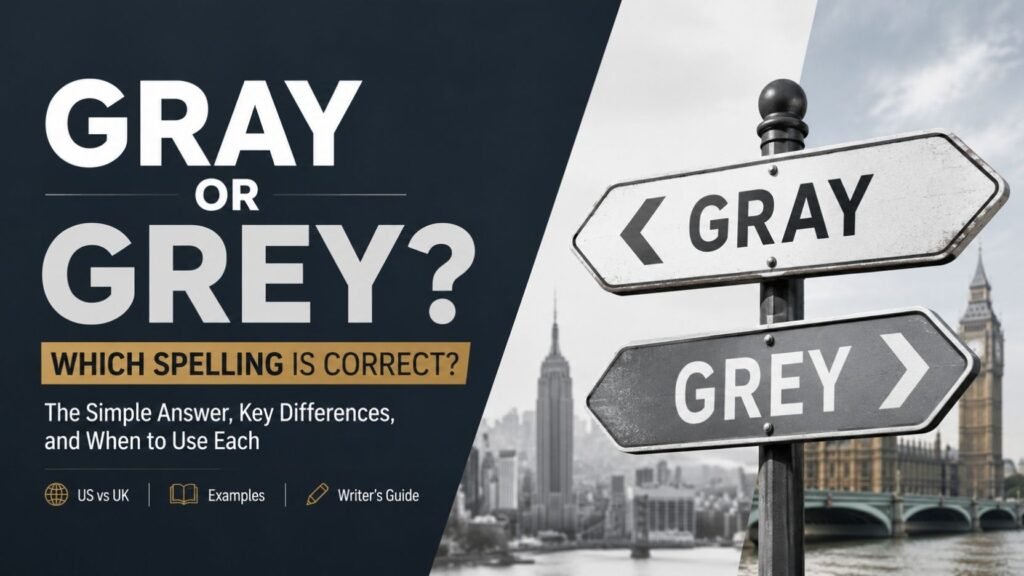
Both gray and grey are correct spellings of the same color, and neither one is a mistake. Gray is the standard spelling in American English, while grey is the standard spelling in British English. If you are writing for readers in the United States, gray is the safer choice. If you are writing for readers in the United Kingdom, Canada, Australia, or most other English speaking countries outside the US, grey fits better.
This small spelling difference confuses a lot of people because both words sound exactly the same and mean the same thing. There is no difference in meaning, no difference in pronunciation, and no rule that makes one version more “correct” than the other. The real answer depends on your audience, your country, and sometimes a specific brand name or proper noun that has already chosen one spelling for you.
Gray or Grey: The Simple Answer
Here is the short version before we go deeper.
- Gray is preferred in American English, including in the United States and often in the Philippines and other regions that follow US spelling conventions.
- Grey is preferred in British English, including in the United Kingdom, Ireland, Australia, and New Zealand.
- Canada commonly uses grey, following British spelling habits, though gray also appears due to close contact with American English.
- Both words describe the same neutral color that sits between black and white.
- Neither spelling is grammatically incorrect. The choice is regional, not a matter of right and wrong.
Think of it the same way you think of color and colour, or favorite and favourite. The pattern is consistent: American English tends to simplify spellings, while British English keeps older forms.
See More: Favor Or Favour
Why Are There Two Spellings in the First Place?
Gray and grey are not two different words that happen to look similar. They are the same word that developed two accepted spellings over time, largely because English spelling was not standardized until dictionaries and style guides became widespread in the 18th and 19th centuries.
Before that standardization, spelling was flexible. Writers often chose whichever version looked or sounded right to them. Over time, dictionary editors on each side of the Atlantic settled on different preferences.
- In the United States: Noah Webster’s dictionaries pushed for simplified, more phonetic spellings. This influenced many American versus British spelling differences, including color versus colour, center versus centre, and eventually gray versus grey.
- In the United Kingdom: Samuel Johnson’s dictionary and later British lexicographers kept the older “grey” form, which had already been common in British writing for centuries.
Neither version is newer or more modern than the other. Both spellings existed side by side long before the split became associated with specific countries.
American English vs British English: A Quick Comparison
| Region | Preferred Spelling | Typical Usage |
| United States | Gray | Used in books, newspapers, official documents, and everyday writing |
| United Kingdom | Grey | Used in books, newspapers, official documents, and everyday writing |
| Canada | Grey (with some gray) | Grey is more common, but gray appears often due to American influence |
| Australia | Grey | Follows British spelling conventions |
| Philippines | Gray | Follows American spelling conventions due to historical ties with the US |
This table reflects general patterns, not strict rules. Individual writers, companies, and publications sometimes break from the regional norm, especially online where American and British English mix constantly.
Which Spelling Should You Use?
The right spelling depends on three things: your audience, your style guide, and any proper nouns already locked into one spelling.
1. Consider Your Audience
If you are writing for an American audience, whether that is a blog post, a business email, or a school essay, use gray. If your readers are mostly in the UK, Australia, or another Commonwealth country, use grey.
2. Follow a Style Guide When One Exists
Many companies, schools, and publications have a style guide that already specifies which spelling to use. When a style guide exists, follow it consistently throughout the entire piece of writing. Mixing gray and grey in the same document looks careless, even though both spellings are technically correct on their own.
3. Respect Proper Nouns
Some names always keep their original spelling, no matter where you are writing from. A few examples:
- Jean Grey, the Marvel comic book and X-Men character, is always spelled with an “e.”
- Meredith Grey, the main character in the television show Grey’s Anatomy, is always spelled with an “e.”
- Earl Grey tea is always spelled with an “e,” regardless of American or British usage.
- Grey Goose vodka is always spelled with an “e” as part of the brand name.
- Fifty Shades of Grey uses the British spelling in its official title.
- Grey’s Anatomy as a show title always uses the “e” spelling.
These names do not change based on your country. A proper noun keeps its official spelling everywhere, the same way you would never change how you spell someone’s name just because you live in a different country.
💡 Tip: When in doubt about a brand name, celebrity name, or title, search for the official spelling rather than guessing based on regional habit.
Grammar: What Part of Speech Is Gray or Grey?
Gray and grey can function as three different parts of speech, depending on how the word is used in a sentence.
As an Adjective
Most commonly, gray or grey describes a color.
- The sky turned gray before the storm.
- She wore a grey sweater to the office.
As a Noun
The word can also refer to the color itself as a thing.
- Gray is a calm, neutral color.
- The designer chose a soft grey for the walls.
As a Verb
Less commonly, gray or grey can describe hair turning that color over time.
- His hair began to gray in his early thirties.
- Her temples had started to grey by her forties.
In all three uses, the meaning stays the same. Only the grammatical role in the sentence changes.
How To Pronounce Gray Or Grey
Both spellings are pronounced exactly the same way: /ɡreɪ/, rhyming with “day,” “way,” and “say.” The spelling difference has no effect on pronunciation. If you say the word out loud, no listener can tell which spelling you have in mind. This is one of the clearest signs that gray and grey are the same word, not two separate ones.
Origin And Etymology Of Gray And Grey
The word traces back to the Old English term “grǣg,” which already meant the same neutral color it describes today. That Old English word came from an even older Proto-Germanic root, shared with related words in other Germanic languages, including the German “grau” and the Dutch “grauw.”
As English developed through the Middle Ages, spelling was inconsistent, and both “gray” and “grey” style spellings appeared in manuscripts. There was no single accepted form yet, since English spelling had not been standardized. The regional split we recognize today, American gray versus British grey, only solidified much later, largely through the influence of dictionaries in the 1700s and 1800s.
So while the words feel like a modern American versus British divide, the underlying word itself is over a thousand years old.
Gray Or Grey In Different Contexts
The spelling debate shows up constantly in everyday situations. Here is how it plays out in some of the most common contexts people search for.
Hair Color Gray or Grey
When talking about aging hair, American writers say gray hair, while British writers say grey hair. Both describe the same natural process where hair loses pigment over time.
- American: “My dad’s hair turned gray in his fifties.”
- British: “My dad’s hair turned grey in his fifties.”
Car Color Gray or Grey
Car manufacturers and dealerships often use whichever spelling matches their home market. American car listings almost always say gray, while British and Australian listings say grey.
- American: “I bought a gray sedan last month.”
- British: “I bought a grey saloon last month.”
Eye Color Gray or Grey
Gray eyes and grey eyes describe the same rare eye color. The spelling again depends on the writer’s regional English, not on any difference in the eye color itself.
Gray Ground Beef
This search often comes from a food safety question rather than a spelling question. Ground beef that has turned gray or grey, especially on the inside where it has not been exposed to air, has often started to spoil. Fresh ground beef is usually bright red on the outside, and it may look slightly darker or brownish gray on the inside simply from lack of oxygen exposure.
However, a strong grayish or greenish color across the whole surface, combined with a sour or off smell, is a sign that the meat should be thrown away. When food safety is the real question, always trust smell and texture over color alone, and check the sell by date.
⚠️ Important: If ground beef looks fully gray throughout, smells sour, or feels slimy, do not eat it, regardless of how the color is spelled.
What Does the Color Gray Represent?
Gray is often associated with:
- Neutrality and balance
- Calmness and stability
- Formality, especially in business settings
- Sometimes sadness or a lack of emotion, depending on context
These associations are cultural rather than fixed rules, and they can shift depending on the surrounding colors, the setting, and personal interpretation.
See More: Dought Vs Doubt
Gray or Grey in Paint
Paint brands sell colors under both names depending on their target market. American paint companies label cans as gray, while UK based paint companies typically label the same color family as grey. The actual color does not change, only the label on the can.
Common Mistakes With Gray And Grey
Most mistakes with this word come from mixing spellings inconsistently, rather than from spelling either version incorrectly.
Incorrect: She painted her bedroom grey, but the hallway was gray.
Correct: She painted her bedroom gray, and the hallway was gray too. (Pick one spelling and use it consistently throughout the same piece of writing.)
Incorrect: Changing “Jean Grey” to “Jean Gray” because you are writing in American English. Correct: Jean Grey, since proper nouns keep their original spelling no matter what regional English you are using.
Incorrect: Assuming one spelling is more “correct” or more “modern” than the other.
Correct: Recognizing that gray and grey are equally valid, standard spellings, each tied to a different English speaking region.
Grey vs Gray: A Side by Side Look
| Feature | Gray | Grey |
| Region | United States, Philippines | United Kingdom, Australia, Ireland, most of Canada |
| Pronunciation | Identical | Identical |
| Meaning | Same neutral color | Same neutral color |
| Grammar Use | Adjective, noun, verb | Adjective, noun, verb |
| Proper Nouns | Rarely used in brand names | Often used in brand names (Earl Grey, Grey Goose, Jean Grey) |
Similar And Related Words
| Word | Meaning | Difference From Gray/Grey |
| Silver | A lighter, more metallic shade related to gray | Silver has a reflective quality gray does not always have |
| Charcoal | A dark shade of gray | Charcoal is always darker and warmer toned than plain gray |
| Slate | A blue tinted gray | Slate leans cooler and often has a blue or green undertone |
| Ash | A very light, pale gray | Ash is softer and lighter, often used for hair color descriptions |
These related words are useful when you want more precise color language, but they are not substitutes for gray or grey in everyday usage.
Examples Of Gray Or Grey Used Correctly
- The overcast sky stayed gray all afternoon. (American)
- The overcast sky stayed grey all afternoon. (British)
- He noticed the first gray strands in his beard. (American)
- He noticed the first grey strands in his beard. (British)
- The company’s logo uses a soft gray background. (American)
- The company’s logo uses a soft grey background. (British)
Notice that the sentence structure never changes. Only the single letter shifts between the two versions.
Frequently Asked Questions
Is the color gray or grey correct?
Both are correct. Gray is standard in American English, and grey is standard in British English. Neither spelling is a mistake.
How do you spell the color gray or grey?
You can spell it either way, depending on your audience. Use gray for American readers and grey for British, Australian, or most Canadian readers.
Which spelling is more common worldwide?
Grey is technically more common globally, since more English speaking countries follow British spelling conventions than American ones. However, gray is extremely common due to the size and influence of American English media.
Is grey older than gray, or is it the other way around?
Neither spelling is older. Both forms existed in English writing for centuries before dictionaries standardized regional preferences in the 1700s and 1800s.
Why is Earl Grey tea spelled with an “e”?
Earl Grey tea is named after a British historical figure, Charles Grey, the 2nd Earl Grey. Since it is a proper noun tied to a specific person’s surname, the spelling never changes, regardless of American or British usage elsewhere in the sentence.
Do Canadians spell it gray or grey?
Most Canadians use grey, following British spelling traditions, though gray also appears frequently because of close cultural and media ties with the United States.
Is gray a noun, adjective, or verb?
Gray, and grey, can function as all three. It is most often used as an adjective to describe color, but it can also be a noun referring to the color itself, or a verb describing hair turning that color over time.
Does Crayola use gray or grey?
Crayola, as an American company, uses the gray spelling on its crayon labels and packaging.
What does the color gray symbolize?
Gray is often linked to neutrality, calmness, balance, and formality. In some contexts it can also suggest sadness or a lack of strong emotion, depending on the surrounding tone.
Is it wrong to mix gray and grey in the same document?
It is not grammatically wrong, but it looks inconsistent. Style guides almost always recommend choosing one spelling and using it throughout an entire piece of writing.
See More: Platform or Flatform
Conclusion
Gray and grey are the same word with two accepted spellings, split mainly along regional lines. Gray belongs to American English, while grey belongs to British English, and both describe the identical neutral color with the identical pronunciation. The only real rule to follow is consistency: pick the spelling that matches your audience or your style guide, and stick with it throughout your writing.
The one place this rule bends is with proper nouns. Names like Jean Grey, Earl Grey, Grey Goose, and Fifty Shades of Grey keep their original spelling no matter where you are writing from, since brand names and titles do not change based on regional English. Once you understand that the difference between gray and grey comes down to geography rather than grammar, the choice becomes simple. Pick the version that fits your reader, respect any proper nouns already in place, and move forward with confidence.

Abdul Rehman Jutt is the author behind Grammar Wordz, with 4 years of experience researching and writing about English grammar, words, meanings, and language rules. Their goal is to make grammar simple, clear, and easy to understand through accurate and useful explanations.