
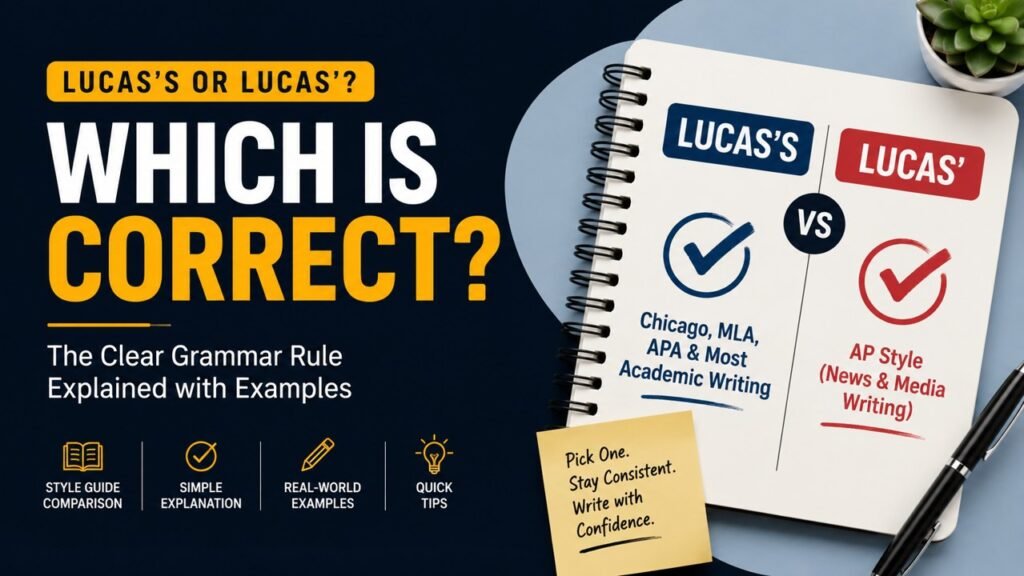
If you have ever paused mid-sentence wondering whether to write “Lucas’s book” or “Lucas’ book,” you are not alone. Both forms show up in print, and both are defended by respected style guides. The short answer is that “Lucas’s” is the standard choice in most American writing today, while “Lucas'” is the accepted alternative under a small number of style guides, most notably AP style.
Neither form is a spelling mistake. This comes down to a genuine disagreement among style authorities about how to handle possessives for singular names that already end in the letter s. Understanding why the disagreement exists, and which form fits your writing situation, will help you stop guessing and start writing with confidence.
Quick Answer
- Lucas’s is correct under the Chicago Manual of Style, MLA, APA, and most book publishing and academic writing standards.
- Lucas’ is correct under AP style, which many newspapers, magazines, and news websites follow.
- Both are grammatically defensible. Pick one based on the style guide you’re following, then stay consistent throughout your document.
See More: Spicey or Spicy
What Does “Lucas’s” Or “Lucas'” Mean?
Both spellings are attempts to do the same job: show that something belongs to a person named Lucas. This is a possessive noun. A possessive shows ownership, connection, or relationship, the same job an apostrophe does in phrases like “the dog’s leash” or “my sister’s car.”
The confusion only appears because Lucas already ends in the letter s. For most singular nouns, you simply add an apostrophe and an s, as in “Emma’s bag” or “the teacher’s desk.” When the base word already ends in s, writers have historically split into two camps: add an apostrophe and another s anyway (“Lucas’s”), or add only an apostrophe (“Lucas'”). Both approaches are trying to mark the same possessive relationship. They just disagree on the mechanics.
The Grammar Rule Behind The Confusion
In English, the standard rule for singular possessives is simple: add an apostrophe, then an s.
- Sarah becomes Sarah’s.
- The dog becomes the dog’s.
- Lucas becomes Lucas’s.
This rule does not officially change just because a word ends in s. The Chicago Manual of Style, MLA Handbook, and APA Publication Manual all apply the same rule to singular nouns and names ending in s that they apply to any other singular noun. Under this logic, “Lucas’s” is simply the regular possessive form, formed the regular way.
AP style takes a different approach for proper nouns. Instead of adding another s, AP style adds only an apostrophe to singular proper nouns that already end in s. Under this system, Lucas becomes “Lucas’,” James becomes “James’,” and Kansas becomes “Kansas’.” The reasoning is mostly about visual and spoken simplicity: AP style aims to avoid piling up an extra s sound, especially in fast-moving news copy meant to be read quickly.
So the disagreement is not really about grammar in the sense of right or wrong. It is a style choice, and different professional style guides have made different choices.
Lucas’s or Lucas’: Style Guide Comparison
| Style Guide | Preferred Form | Typical Use |
| Chicago Manual of Style | Lucas’s | Books, academic writing, general nonfiction |
| MLA Handbook | Lucas’s | Academic essays, literature papers |
| APA Publication Manual | Lucas’s | Psychology, education, social science writing |
| AP Stylebook | Lucas’ | Newspapers, news websites, press releases |
If you are not writing for a publication with a defined house style, Chicago’s approach (Lucas’s) is the safer default. It matches how most books, blogs, and general writing already treat names like this, and it mirrors ordinary spoken pronunciation, where most English speakers naturally say an extra “-iz” sound at the end: “LOO-kus-iz.”
Is It Lucas’s or Lucas’? How to Decide
Ask yourself three questions.
- Am I following a specific style guide?
If your employer, publication, school, or client specifies AP style, use Lucas’. If they specify Chicago, MLA, or APA, use Lucas’s. - Am I writing something formal, like a book, essay, report, or academic paper? Lucas’s is the safer and more widely expected choice.
- Am I writing news copy, a press release, or anything modeled on journalistic style?
Lucas’ fits that context.
If none of those apply, and you’re simply writing a birthday card, an email, a social media caption, or a personal blog post, either form is acceptable. What matters most at that point is consistency. Do not switch between Lucas’s and Lucas’ within the same piece of writing.
Examples of Correct Usage
Using the Chicago/MLA/APA form (Lucas’s):
- Lucas’s backpack is by the front door.
- Everyone admired Lucas’s presentation.
- Lucas’s mother picked him up early from school.
- That is Lucas’s favorite restaurant.
Using the AP form (Lucas’):
- Lucas’ backpack is by the front door.
- Everyone admired Lucas’ presentation.
- Lucas’ mother picked him up early from school.
- That is Lucas’ favorite restaurant.
Notice that the meaning of each sentence is identical. Only the spelling of the possessive changes.
Lucas’s or Lucas’ In A Sentence: Common Mistakes
Incorrect: Lucas’s’s shoes were muddy.
Correct: Lucas’s shoes were muddy.
There is never a need for a double possessive ending. Adding “‘s” once is enough, even though the base name already ends in s.
Incorrect: Lucas’’s dog ran into the yard.
Correct (Chicago style): Lucas’s dog ran into the yard.
Correct (AP style): Lucas’ dog ran into the yard.
Mixing both conventions in a single word is the most common error people make with this name. Choose one apostrophe pattern, not both.
Incorrect: The book belongs to Lucas’s family (mixed with Lucas’ teacher in the same paragraph).
Correct: Pick one form and use it consistently for every possessive of Lucas throughout the same document.
⚠️ Common mistake: Confusing the possessive form with the plural form. “Lucases” (no apostrophe) refers to more than one person named Lucas, such as a family. “Lucas’s” or “Lucas'” refers to something belonging to one person named Lucas. These are not interchangeable.
See More: Time Flies Or Flys
Lucas’s or Lucas’ In The UK And Australia
British and Australian style guides largely follow the same split found in American English, though the balance tips slightly differently. British publishing houses and style guides such as the Oxford style guide generally favor adding ‘s to singular names ending in s, similar to Chicago style, producing “Lucas’s.” British and Australian newspapers, much like their American counterparts, sometimes follow a more AP-influenced house style that drops the extra s.
In everyday British and Australian usage outside of formal publishing, “Lucas’s” is the more commonly taught and expected form in schools, which mirrors the general rule that a possessive apostrophe is followed by an s for singular nouns, regardless of the final letter.
Pronunciation
Both written forms are typically pronounced the same way in natural speech: “LOO-kuhs-iz,” with an extra “-iz” sound added at the end to mark possession. This is one reason many style guides prefer writing Lucas’s. Since most speakers pronounce the extra syllable anyway, spelling it out with ‘s keeps the written form matching the spoken form.
Under AP style, some readers pronounce “Lucas'” without the extra syllable when reading silently, though most speakers will still add it aloud, since dropping it can sound unnatural or unclear in conversation.
Origin Of The Name Lucas
Lucas is a given name with roots in Latin, ultimately connected to the Greek name Loukas. It is closely related to the name Luke and is generally understood to be associated with the region of Lucania in ancient Italy, or with meanings tied to light, depending on the etymological source consulted. The name has remained popular for centuries across English-speaking countries, continental Europe, and Latin America, and it appears as both a first name and, less commonly, a surname.
Because Lucas is a proper noun, all of the possessive rules described in this guide apply to it the same way they apply to any other proper name ending in s, such as James, Chris, Charles, or Thomas.
Singular Vs Plural: Lucas’s, Lucas’ And Lucases
It helps to separate three different forms that are easy to confuse.
| Form | Meaning | Example |
| Lucas | The name itself, no possession or plural involved | Lucas is coming to dinner. |
| Lucas’s / Lucas’ | Something belonging to one person named Lucas | Lucas’s coat is on the chair. |
| Lucases | More than one person named Lucas | Both Lucases in our class share a birthday. |
| Lucases’ | Something belonging to multiple people named Lucas | The Lucases’ project won an award. |
The plural possessive, Lucases’, follows the regular rule for plural nouns ending in s: add only an apostrophe after the final s, with no additional s needed.
Similar Names And Words
The same possessive question comes up constantly with other names and words ending in s. The pattern for Lucas applies identically to these:
| Name or Word | Chicago/MLA/APA Form | AP Style Form |
| James | James’s | James’ |
| Charles | Charles’s | Charles’ |
| Chris | Chris’s | Chris’ |
| Kansas | Kansas’s | Kansas’ |
| the boss | the boss’s | the boss’ |
If you can remember how to handle Lucas’s possessive form, you already know how to handle every other singular name ending in s, since the underlying rule never changes based on the specific word.
See More: Buying Puts Vs Selling Puts
Frequently Asked Questions
Is it Lucas’s or Lucas’?
Both are correct, depending on style guide. Lucas’s follows Chicago, MLA, and APA style. Lucas’ follows AP style, which is common in journalism.
Which one should I use in everyday writing?
Unless you’re required to follow AP style, Lucas’s is the safer and more widely taught default in schools, books, and general writing.
Is Lucas’ or Lucas’s more common in the United States?
Lucas’s is more common overall in American books, academic writing, and everyday writing. Lucas’ remains standard specifically in AP-style journalism.
Do British and Australian writers use a different rule?
Not fundamentally. Both regions show the same split between formal publishing style, which tends to prefer Lucas’s, and journalistic house style, which sometimes drops the extra s.
How do you pronounce the possessive form of Lucas?
Most speakers pronounce it “LOO-kuhs-iz,” with an extra syllable at the end, regardless of which spelling is used in writing.
What is the plural possessive of Lucas?
If referring to more than one person named Lucas, the plural is Lucases, and the plural possessive is Lucases’, following the standard rule of adding only an apostrophe after a plural that already ends in s.
Can I mix Lucas’s and Lucas’ in the same document?
No. Choose one form and use it consistently throughout a single piece of writing, even if both forms are individually correct under different style guides.
Is there ever a form with two extra letters, like Lucas’s’s?
No. That form does not exist under any style guide. The possessive of Lucas only ever takes one added apostrophe, either alone or paired with a single additional s.
Does the possessive rule change if Lucas is a surname instead of a first name?
No. The same rule applies whether Lucas is used as a first name or a surname. The possessive form still depends only on which style guide you are following, not on what kind of name it is.
Why do style guides disagree about this in the first place?
The disagreement comes down to differing priorities. Chicago, MLA, and APA prioritize a single consistent rule for every singular noun. AP style prioritizes simplicity and readability in fast-paced news writing, which leads it to treat proper nouns ending in s differently from other singular nouns.
Conclusion
The choice between Lucas’s and Lucas’ is not a matter of correct versus incorrect grammar. It is a matter of which style guide you are writing under. Lucas’s follows the standard rule used by Chicago, MLA, and APA, where every singular noun gets an apostrophe and an s, no exceptions for names ending in s. Lucas’ follows the simplified approach used in AP style, common in newspapers and news writing, where singular proper nouns ending in s take only an apostrophe.
For most everyday, academic, and formal writing, Lucas’s is the safer and more widely recognized choice. If you’re writing for a newsroom or a publication that specifically follows AP style, Lucas’ is equally correct. Whichever form you choose, the most important rule is consistency: pick one, and use it the same way every time it appears in your writing.

Abdul Rehman Jutt is the author behind Grammar Wordz, with 4 years of experience researching and writing about English grammar, words, meanings, and language rules. Their goal is to make grammar simple, clear, and easy to understand through accurate and useful explanations.