
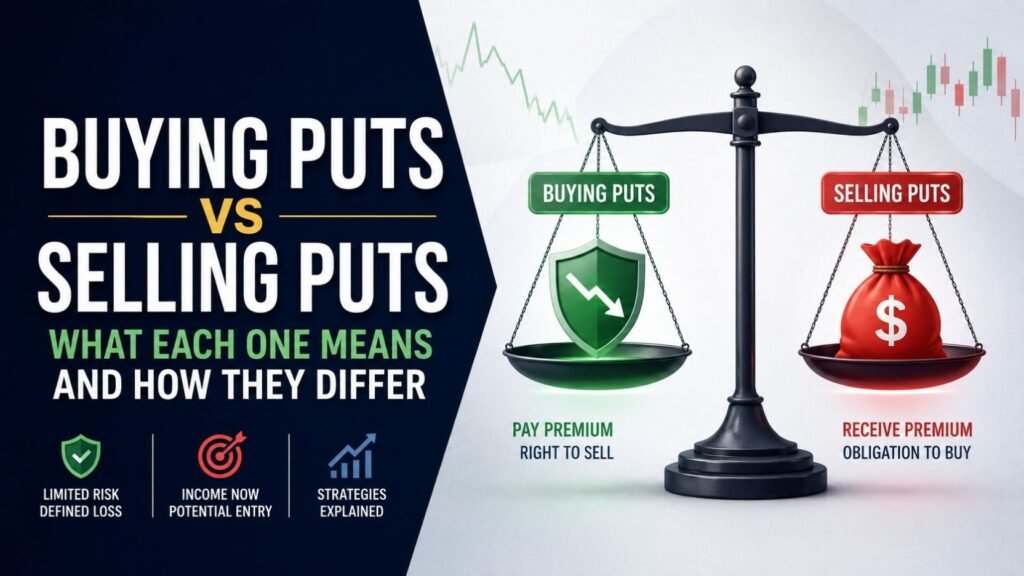
Buying puts and selling puts are two opposite sides of the same options contract, and mixing them up is one of the most common mistakes new options traders make. When you buy a put, you are paying for the right to sell a stock at a set price, and you profit if the stock falls. When you sell a put, you are collecting money now in exchange for a promise to buy the stock later if it drops, and you profit if the stock stays flat or rises.
Understanding this difference matters because the two strategies carry almost opposite risk profiles. Buying puts is often used to protect a portfolio or bet on a decline, with a known, limited cost. Selling puts is often used to generate income or to buy a stock at a discount, but it carries a much larger potential loss. The rest of this article breaks down both sides in plain English, with examples you can follow step by step.
Buying Puts Vs Selling Puts: The Simple Meaning
In the simplest terms:
- Buying a put means you pay a premium for the right, not the obligation, to sell 100 shares of a stock at a fixed price before a certain date.
- Selling a put (also called writing a put) means you collect a premium now, and in exchange, you take on the obligation to buy 100 shares at a fixed price if the buyer decides to use that right.
One side pays for a right. The other side gets paid to accept an obligation. That single distinction explains almost every difference between the two strategies.
What Is A Put Option
A put option is a contract tied to a stock or other asset. It gives the buyer the right to sell that asset at a specific price, called the strike price, on or before a specific date, called the expiration date.
Every put option has two sides:
- The buyer (also called the holder) pays a premium and gains the right to sell.
- The seller (also called the writer) receives the premium and takes on the obligation to buy if the holder exercises that right.
Think of a put option like an insurance policy on a stock. The buyer pays a premium for protection against the price falling. The seller collects that premium, similar to an insurance company, and has to pay out if the price drops enough to trigger a claim.
What Does Buying A Put Mean
Buying a put means you expect a stock to fall, or you want to protect shares you already own. When you buy a put, you pay the premium upfront, and that premium is the most you can lose on the trade.
Here is what happens depending on where the stock ends up:
- If the stock falls below the strike price, your put gains value, and you can sell it for a profit or exercise it to sell shares at the higher strike price.
- If the stock stays above the strike price, the put loses value and can expire worthless, meaning your loss is limited to the premium you paid.
Buying puts explained with a simple example: Suppose a stock trades at fifty dollars. You buy one put with a forty-five dollar strike price for two dollars per share, or two hundred dollars total, since each contract covers one hundred shares.
If the stock drops to thirty-five dollars, your put is now worth at least ten dollars per share, since you have the right to sell at forty-five dollars a stock now worth thirty-five dollars. Your profit, before accounting for the original premium, is significant. If instead the stock rises to sixty dollars, the put expires worthless, and your loss is capped at the two hundred dollars you paid.
See More: Puts Vs Calls
What Does Selling A Put Mean
Selling a put means you are willing to buy a stock at a lower price than where it currently trades, and you get paid immediately for making that promise. This is sometimes called being “short a put.”
When you sell a put:
- You receive the premium right away, and that premium is yours to keep no matter what happens next.
- If the stock stays above the strike price at expiration, the put expires worthless, and you keep the full premium as profit.
- If the stock falls below the strike price, you may be assigned, meaning you must buy one hundred shares at the strike price, even though the market price is lower.
Selling puts explained with a simple example: Using the same stock at fifty dollars, suppose you sell one put with a forty-five dollar strike price and collect two dollars per share, or two hundred dollars total. If the stock stays above forty-five dollars through expiration, you keep the two hundred dollars, and nothing else happens. If the stock drops to thirty-five dollars, you are obligated to buy one hundred shares at forty-five dollars each, a total of four thousand five hundred dollars, even though those shares are only worth three thousand five hundred dollars on the open market.
Buying Puts Vs Selling Puts: Quick Comparison Table
| Feature | Buying Puts | Selling Puts |
| Market outlook | Bearish, or protective | Neutral to bullish |
| Cash flow at open | You pay a premium | You receive a premium |
| Maximum profit | Large, if the stock falls sharply | Limited to the premium collected |
| Maximum loss | Limited to the premium paid | Substantial, if the stock falls sharply |
| Obligation | None, it is a right | Yes, you may have to buy shares |
| Common goal | Protect a position, or speculate on a drop | Earn income, or buy a stock at a discount |
This table shows the core trade-off. Buying puts caps your risk and leaves your reward open-ended on the downside. Selling puts caps your reward and leaves your risk larger, though still limited to the stock falling to zero.
How Does Buying Puts Work
Buying puts works in three basic steps.
- You choose a stock you expect to fall, or a stock you already own and want to protect.
- You select a strike price and expiration date, then pay the premium to open the position.
- Before or at expiration, you either sell the put for a profit, exercise it to sell your shares at the strike price, or let it expire worthless if the stock did not fall enough.
The premium you pay depends on several factors, including how far the stock price is from the strike price, how much time remains until expiration, and how volatile the stock is expected to be. A put that is easier to profit from, because the strike is close to the current price or there is more time left, generally costs more.
How Does Selling Puts Work
Selling puts, sometimes called put writing, also works in three basic steps.
- You choose a stock you would not mind owning, at a price you find attractive.
- You sell a put at a strike price near or below that target price, and you collect the premium immediately.
- At expiration, you either keep the full premium if the stock stays above the strike, or you are assigned the shares and buy them at the strike price if the stock falls below it.
Many traders sell puts on stocks they already want to own, treating the strategy as a way to get paid while waiting for a lower entry price. Others sell puts purely for income, without any real intention of holding the stock, which increases their risk if the stock drops sharply.
Buying Puts Vs Shorting: Is Buying Puts The Same As Shorting
Buying puts and short selling both let you profit when a stock falls, but they are not the same thing, and the differences matter.
| Feature | Buying Puts | Short Selling |
| Maximum loss | Limited to the premium paid | Theoretically unlimited |
| Upfront cost | A relatively small premium | Requires margin and a borrowed stock |
| Time limit | Expires on a set date | Can be held indefinitely, subject to broker terms |
| Complexity | Simpler for most retail traders | Involves borrowing shares and margin requirements |
So, is buying puts the same as shorting? The goal can be similar, profiting from a decline, but the mechanics and the risk are different. Shorting a stock means selling borrowed shares now with the plan to buy them back later at a lower price, and if the stock rises instead, your losses can keep growing with no ceiling.
Buying a put gives you a similar directional bet, but your loss is capped at what you paid for the option, which is why many traders see buying puts as a safer way to bet against a stock than shorting it outright.
Buying Puts Vs Selling Calls
Buying puts and selling calls are both ways to express a bearish view, but they work differently.
- Buying a put costs you a premium, and profits grow the further the stock falls, with losses capped at the premium.
- Selling a call earns you a premium upfront, but if the stock rises sharply, your losses can be very large, since you may have to deliver shares at a price far below the market.
A trader who wants defined, limited risk while betting on a decline usually prefers buying puts. A trader who believes a stock will stay flat or fall only slightly, and wants to collect income, might prefer selling calls, understanding that a sharp rally works against them.
Selling Puts Vs Buying Calls
This comparison comes up often because both strategies can reflect a bullish view on a stock, though they behave differently.
- Selling a put earns income now and profits if the stock stays flat, rises, or falls only slightly. The risk is that a sharp drop can lead to a large loss, or force you to buy shares above the current market price.
- Buying a call costs a premium and profits if the stock rises significantly. The risk is limited to the premium paid, but the call can expire completely worthless if the stock does not move enough.
Is selling puts better than buying calls? Neither is universally better. Selling puts tends to perform better in flat or slowly rising markets, since you collect income even without a big move. Buying calls tends to perform better when a stock makes a large, fast move upward, since the potential gain is not capped the way a put seller’s gain is. The right choice depends on your outlook, your risk tolerance, and how much capital you are willing to commit.
Is Selling Puts Bullish
Yes, selling a put is generally considered a bullish to neutral strategy. You profit as long as the stock stays above the strike price, which means you are betting the stock will not fall significantly. This is different from buying a put, which is a bearish or protective strategy that profits when the stock falls.
Risk Of Buying Puts
The main risk of buying puts is straightforward: you can lose the entire premium you paid if the stock does not fall enough, or does not fall at all, before expiration.
Key risks to understand:
- Time decay. As expiration approaches, a put option loses value even if the stock price does not move, because there is less time left for the trade to work out.
- Wrong direction. If the stock rises instead of falls, the put can lose most or all of its value.
- Volatility changes. If expected volatility drops after you buy the put, the option can lose value even if the stock price barely moves.
The advantage is that these risks are all capped. You know your maximum loss the moment you buy the put, since it can never exceed the premium you paid.
Risk Of Selling Puts
The risk of selling puts is larger and less obvious at first glance. Because a stock’s price can only fall to zero, your maximum loss on a single cash secured put is the strike price minus the premium received, multiplied by one hundred shares.
Key risks to understand:
- Assignment risk. You can be forced to buy shares at the strike price even after a sharp decline, meaning you own stock worth far less than what you paid.
- Margin risk. If you sell puts without setting aside the full cash to buy the shares, a sharp drop can create a large, sudden loss relative to your account size.
- Opportunity cost. Your maximum profit is fixed at the premium collected, so if the stock skyrockets, you do not participate in those extra gains the way a stockholder would.
Selling puts is sometimes described as picking up pennies in front of a steamroller, because the income collected in calm markets can look attractive, right up until a sharp decline produces a loss that erases many months of premiums at once.
See More: Poopy Or Poopie
Selling Puts For Income
Selling puts for income is a popular strategy among investors who want to generate cash flow from stocks they are comfortable owning. The idea is simple: sell a put below the current price, collect the premium, and either keep the full premium if the stock stays up, or end up buying the stock at a price you already found acceptable.
This approach works best when:
- You genuinely would not mind owning the stock at the strike price.
- You set aside enough cash to cover the purchase if assigned, known as a cash secured put.
- You choose strike prices and expiration dates that match your income goals and risk comfort, rather than chasing the highest premium available.
Selling Puts On Margin
Selling puts on margin means using borrowed funds from your broker, rather than setting aside the full cash amount, to support the obligation. This increases your potential return relative to the capital committed, but it also increases risk substantially.
If the stock falls sharply while you are short several puts on margin, you can face a margin call, meaning your broker may require you to deposit more funds immediately or close positions at an unfavorable price. Because of this added risk, selling puts on margin is generally considered a strategy for more experienced traders who actively monitor their positions.
Selling Puts On Stock You Own, And The Covered Approach
Selling covered calls and buying puts are sometimes combined into a single strategy known as a protective collar. Here is how the pieces fit together:
- If you already own one hundred shares of a stock, selling a call against those shares brings in premium income, but caps your upside if the stock rallies past the call’s strike price.
- Buying a put at the same time protects those same shares from a sharp decline, since the put gains value as the stock falls.
Combining the two, selling a call to help pay for a put, creates a range where your gains and losses are both limited. This differs from simply selling puts on stock you own, which is a separate idea: some investors sell puts on a stock they already hold shares of, aiming to acquire even more shares at a lower price if the market pulls back.
Buying Puts Without Owning Stock
Buying puts without owning stock is extremely common, and it does not require holding any shares at all. Since a put simply gives you the right to sell at a fixed price, many traders buy puts purely to speculate on a decline, with no intention of ever owning or delivering the underlying shares.
In practice, most retail traders who buy puts close the position before expiration by selling the option back on the open market, capturing the change in value without ever exercising the right to sell actual shares.
Buying Puts Strategy: When Traders Use It
Traders and investors typically buy puts for one of three reasons:
- Speculation. They expect the stock to fall and want to profit from that decline with limited, defined risk.
- Protection. They already own shares and want insurance against a drop, similar to buying insurance on a car or a home.
- Hedging a portfolio. They may buy puts on a broad market index to protect a diversified portfolio from a wider downturn, rather than insuring a single stock.
Advantages Of Selling Puts Over Buying Calls
Some investors prefer selling puts over buying calls for a few specific reasons:
- Time works in your favor. As a put seller, time decay generally helps you, since the option loses value each day that passes without a significant drop, and that lost value is money you get to keep.
- You do not need the stock to move. A put seller can profit even if the stock goes nowhere, while a call buyer needs the stock to rise enough to overcome the premium paid.
- A built-in entry price. If assigned, you end up buying the stock at a price you already decided was reasonable, rather than chasing a rally.
The trade-off is that selling puts caps your profit at the premium collected, while buying calls, though riskier and more dependent on timing, has no upper limit on potential gains.
Common Mistakes With Buying And Selling Puts
Common mistakes with buying and selling puts include the following.
✅ Correct: Buying a put to protect one hundred shares you already own, matching the contract size to your position.
❌ Incorrect: Buying a put without checking that it actually corresponds to the number of shares you hold, leaving part of your position unprotected.
✅ Correct: Selling a cash secured put only when you have enough cash set aside to buy the shares if assigned.
❌ Incorrect: Selling puts on margin across many stocks at once without accounting for how a broad market decline could affect all of them simultaneously.
⚠️ Common mistake: Assuming buying puts and short selling carry the same risk. They do not. A put’s loss is capped at the premium, while a short sale’s loss is theoretically unlimited.
⚠️ Common mistake: Selling puts purely for the premium, without any interest in actually owning the underlying stock if assigned.
💡 Tip: Before buying or selling any put, write down your maximum possible loss in dollar terms. If that number would be uncomfortable to lose, the position size is too large.
See More: Dought Vs Doubt
Frequently Asked Questions
What is the main difference between buying puts and selling puts?
Buying a put means paying a premium for the right to sell a stock at a fixed price, and it profits when the stock falls. Selling a put means collecting a premium in exchange for the obligation to buy a stock at a fixed price, and it profits when the stock stays flat or rises.
Is buying puts the same as shorting a stock?
No. Both can profit from a decline, but buying puts has a loss capped at the premium paid, while short selling has theoretically unlimited loss potential if the stock rises.
Is selling puts bullish or bearish?
Selling puts is generally a bullish to neutral strategy, since you profit as long as the stock does not fall significantly below the strike price.
What does buying puts mean in simple terms?
It means you are paying for the right to sell a stock at a set price later, which is useful if you expect the price to drop or want to protect shares you own.
What does selling puts mean in simple terms?
It means you are getting paid now for agreeing to buy a stock at a set price later, if the person who bought the put decides to exercise it.
Can you buy puts without owning the underlying stock?
Yes. Most traders who buy puts do not own the underlying shares, and they typically close the position by selling the option rather than exercising it.
Is selling puts better than buying calls?
Neither is better in every situation. Selling puts tends to do better in flat or slowly rising markets through steady income, while buying calls tends to do better when a stock makes a large, fast move upward.
What happens if a put I sold gets assigned?
You are required to buy one hundred shares per contract at the strike price, even if the stock is trading below that price at the time.
What is a cash secured put?
It is a sold put backed by enough cash in your account to buy the shares at the strike price if you are assigned, rather than relying on margin.
Do buying puts and selling calls both profit from a falling stock?
Yes, both are bearish strategies, but buying puts has limited, defined risk, while selling calls carries a much larger potential loss if the stock rises instead of falls.
Conclusion
Buying puts and selling puts sit on opposite sides of the same contract, and that single fact explains nearly everything about how they behave. The buyer pays a premium for the right to sell at a fixed price and profits from a decline, with risk limited to that premium. The seller collects the premium upfront and takes on the obligation to buy if the stock falls, accepting a larger potential loss in exchange for that income.
Neither approach is automatically the right one. Buying puts fits traders who want protection or a limited-risk bet on a decline, while selling puts fits investors who want income or a disciplined way to buy a stock at a lower price. Before using either strategy, it helps to fully understand the maximum gain, the maximum loss, and what obligation, if any, you are taking on, since options can move quickly and are not the same as simply owning or shorting a stock. This article is for informational purposes only and is not financial advice.

Abdul Rehman Jutt is the author behind Grammar Wordz, with 4 years of experience researching and writing about English grammar, words, meanings, and language rules. Their goal is to make grammar simple, clear, and easy to understand through accurate and useful explanations.