
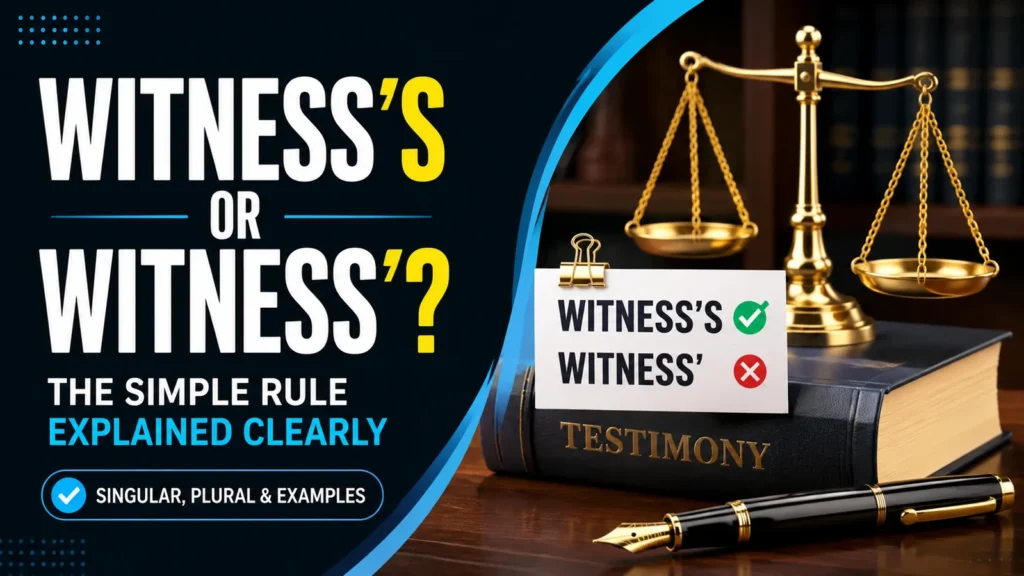
Witness’s is the correct possessive form of the singular noun witness in almost every major American style guide. You write the witness’s testimony, not “the witness’ testimony,” when you mean something belonging to one witness. This holds true whether you are writing a legal document, a news report, an academic paper, or an everyday sentence.
The confusion happens because witness already ends in the letter s. Many writers assume that any word ending in s should only get an apostrophe in the possessive form. That assumption is wrong for singular nouns like witness, though it is correct once the noun becomes plural. Understanding this small difference clears up one of the most common punctuation mistakes in English.
Quick Answer: Witness’s or Witness’
For one witness, the possessive is witness’s.
- The Associated Press Stylebook, The Chicago Manual of Style, APA Style, and MLA all treat witness as a singular common noun ending in s, and all four recommend adding an apostrophe plus s.
- Witness’ (apostrophe only) is a minority style, used mainly in older journalism practice or in the rare AP exception when the next word begins with the letter s.
- For more than one witness, the possessive is witnesses’, formed from the plural witnesses plus a single apostrophe.
| Form | Meaning | Example |
| Witness’s | Belonging to one witness | The witness’s account matched the video. |
| Witness’ | Same meaning, alternate or exception style | The witness’ story seemed rehearsed (AP exception before an s sound). |
| Witnesses’ | Belonging to more than one witness | The witnesses’ accounts did not match. |
See More: Poopy Or Poopie
What Does Witness Mean?
Before looking at the possessive form, it helps to understand the base word.
A witness is a person who sees an event happen, especially a crime, accident, or legally significant moment. The word also works as a verb, meaning to see something happen firsthand.
- Noun: A witness described the car speeding away.
- Verb: She witnessed the entire argument from her window.
- Legal noun: A witness is a person who gives testimony in court or who signs a document to confirm it is genuine.
Because witness is used constantly in legal, journalistic, and everyday English, getting its possessive form right matters for clarity and professionalism.
Witness’s or Witness’: The Grammar Rule Explained
English forms the possessive of most singular nouns by adding an apostrophe and an s. This rule does not stop just because the noun already ends in s.
- Add ‘s to a singular noun, even one ending in s: the witness’s statement, the boss’s office, the class’s schedule.
- Add only an apostrophe to a regular plural noun ending in s: the witnesses’ statements, the bosses’ offices, the classes’ schedules.
The reason writers get this wrong is that they apply the plural rule to a singular word. Witness looks like it should follow the plural pattern because it ends in s, but grammatically it is still one singular noun, so it takes the full ‘s ending.
Why Witness’s Sounds Natural
Say the possessive out loud. Most English speakers naturally pronounce an extra “iz” sound at the end of witness’s, similar to how you would say boss’s or class’s. Written English usually matches that spoken sound, which is part of why ‘s is the standard choice for a singular noun like witness.
How Different Style Guides Treat Witness’s or Witness’
Style guides mostly agree on this point, though the reasoning behind each guide is slightly different.
| Style Guide | Rule for Singular Common Nouns Ending in S | Result for Witness |
| AP Stylebook | Add ‘s, unless the very next word begins with s | Witness’s (or Witness’ only before an s sound) |
| Chicago Manual of Style | Add ‘s to almost all singular nouns ending in s | Witness’s |
| APA Style | Add ‘s to singular nouns ending in s | Witness’s |
| MLA Handbook | Add ‘s to singular nouns ending in s | Witness’s |
💡 Tip: If you are not writing under a specific style guide, choose witness’s. It matches the majority rule, sounds natural when spoken, and avoids ambiguity.
The One AP Exception
AP Style includes a small exception worth knowing. If the singular noun ends in s and the very next word also begins with s, AP allows dropping the extra s to avoid an awkward double s sound.
- The witness’s answer (correct, standard AP form)
- The witness’ story (AP exception, since “story” begins with an s sound… note the exception actually applies when the next word literally starts with the letter s, such as “witness’ summary”)
Outside of that narrow situation, AP still uses witness’s, just like Chicago, APA, and MLA.
A Common Misunderstanding
Some writers confuse the rule for singular proper names ending in s, such as personal names, with the rule for singular common nouns like witness. AP Style does drop the extra s for many singular proper names, so you may see Harris’ or Achilles’ heel.
That exception applies to certain names, not to ordinary nouns such as witness, boss, class, or waitress. This is where a lot of the online confusion about witness’s or witness’ comes from.
Witness’s Or Witnesses’: The Plural Possessive
The rules change once you are talking about more than one witness.
- Witness = one person who saw something.
- Witnesses = more than one person who saw something.
- Witnesses’ = something belonging to more than one witness.
Because witnesses is a regular plural already ending in s, you only add an apostrophe after the final s. You do not add another s.
| Situation | Correct Form | Example Sentence |
| One witness, something belongs to them | Witness’s | The witness’s memory of the event was detailed. |
| Multiple witnesses, something belongs to all of them | Witnesses’ | The witnesses’ memories of the event did not match. |
| Just the plural noun, no possession | Witnesses | Three witnesses came forward after the broadcast. |
⚠️ Common mistake: Writing “witnesses’s” is incorrect. Once a plural noun already ends in s, English never adds a second s for the possessive.
How to Pronounce Witness’s
The word witness is pronounced WIT ness, with stress on the first syllable.
- Witness: /ˈwɪt.nəs/
- Witness’s (possessive): /ˈwɪt.nə.sɪz/, adding a light “iz” sound at the end
- Witnesses (plural): /ˈwɪt.nə.sɪz/, pronounced the same as the possessive singular
Because witness’s and witnesses sound almost identical when spoken, most English speakers rely on context and spelling, rather than sound alone, to tell them apart in writing.
Origin Of The Word Witness
Witness comes from Old English witnes, related to the word wit, meaning knowledge or awareness. The original sense was close to “knowledge” or “testimony,” and it later came to describe the person who holds that knowledge, someone who saw an event and can speak to what happened.
Over time, the noun kept its legal and observational meaning, while the verb form, to witness, developed alongside it to describe the act of seeing something firsthand. The possessive form, witness’s, simply follows the general English pattern for singular nouns and did not change independently through history.
Witness’s Testimony, Witness’s Signature And Other Common Phrases
The possessive form of witness appears often in legal, journalistic, and everyday writing. Here are a few natural, correct examples.
- The witness’s testimony helped convict the suspect.
- Please confirm the witness’s signature on the final page.
- The detective questioned the witness’s account of the timeline.
- The witness’s identity was protected during the trial.
- The reporter checked the witness’s version of events against the security footage.
Each of these sentences refers to something belonging to exactly one witness, so each one uses witness’s.
See More: Favor Or Favour
Common Mistakes With Witness’s Or Witness’
Even careful writers slip up with this word. Here are the most frequent errors.
❌ Incorrect: The witness’s testified in court.
✅ Correct: The witness testified in court.
Why: No possession is involved here, so no apostrophe is needed at all. Witness’s is only correct when something belongs to the witness.
❌ Incorrect: Two witness’s arrived at the station.
✅ Correct: Two witnesses arrived at the station.
Why: This sentence needs a plural noun, not a possessive. An apostrophe should never be used just to make a word plural.
❌ Incorrect: The witnesses’s statements were reviewed.
✅ Correct: The witnesses’ statements were reviewed.
Why: Once the plural witnesses already ends in s, the possessive only needs an apostrophe, not an extra s.
❌ Incorrect: The witness’ testimony was clear. (in most formal American style contexts)
✅ Correct: The witness’s testimony was clear.
Why: Under AP, Chicago, APA, and MLA, the singular possessive of a common noun ending in s still takes ‘s, so dropping the s is generally treated as nonstandard outside AP’s narrow exception.
Similar Words That Follow the Same Rule
Witness is far from the only common noun that causes this confusion. The same singular possessive rule applies to any noun ending in s.
| Word | Singular Possessive | Plural | Plural Possessive |
| Witness | Witness’s | Witnesses | Witnesses’ |
| Boss | Boss’s | Bosses | Bosses’ |
| Waitress | Waitress’s | Waitresses | Waitresses’ |
| Class | Class’s | Classes | Classes’ |
| Business | Business’s | Businesses | Businesses’ |
Recognizing this pattern makes it easier to handle witness’s correctly, since it is simply one example of a much larger, consistent rule in English grammar.
Witness’s or Witness’ In Legal Writing
Legal documents rely heavily on precise, unambiguous language, so getting this possessive right actually matters in practice. A phrase like the witness’s signature clearly points to one signer. If a document instead reads the witness’ signature, careful readers may briefly wonder whether the writer means one witness or several, especially in a document where multiple witnesses are involved elsewhere.
Because of this, many legal style guides and court documents default to witness’s for a single witness and witnesses’ for multiple witnesses, which removes any ambiguity between singular and plural possession.
Quick Reference Table: Witness in All Its Forms
| Form | Type | Example |
| Witness | Singular noun | A witness saw the accident. |
| Witnesses | Plural noun | Several witnesses saw the accident. |
| Witness’s | Singular possessive | The witness’s report was detailed. |
| Witnesses’ | Plural possessive | The witnesses’ reports were consistent. |
| Witnessed | Past tense verb | She witnessed the accident. |
| Witnessing | Present participle | He is witnessing the event now. |
See More: Buying Puts Vs Selling Puts
Frequently Asked Questions
Is it witness’s or witness’?
For one witness, witness’s is the standard and widely recommended form under AP, Chicago, APA, and MLA style. Witness’ appears mainly as an older or exception style.
Is witness’s or witnesses’ correct for more than one witness?
Use witnesses’ when something belongs to more than one witness. Witness’s is only for a single witness.
Why does witness end in an apostrophe s if it already has an s?
Because witness is a singular noun. English forms singular possessives with ‘s regardless of the noun’s final letter. Only plural nouns that already end in s drop the extra s and use just an apostrophe.
Is witness’s testimony grammatically correct?
Yes. Witness’s testimony correctly shows that the testimony belongs to one witness.
Do AP style and Chicago style agree on witness’s?
Yes, in almost every case. Both recommend witness’s for a single witness. AP has one narrow exception when the next word starts with an s sound.
Is witness’ ever correct?
Yes, in limited situations. It appears in AP style right before a word that begins with s, and it shows up in some older or informal writing that follows a simpler, apostrophe only rule for any word ending in s.
What is the plural of witness?
The plural of witness is witnesses, formed by adding es because the word ends in the letter s.
How do you make witnesses possessive?
Add only an apostrophe after the final s: witnesses’.
Is witness a noun or a verb?
Witness can be both. As a noun, it refers to a person who saw something. As a verb, it means to see something happen firsthand.
What is the difference between witness’s and witnesses?
Witnesses is simply the plural noun, referring to more than one witness, with no possession involved. Witness’s is the singular possessive, showing that something belongs to one witness.
Conclusion
Choosing between witness’s and witness’ comes down to one simple rule: witness is a singular noun, so it takes ‘s to form the possessive, even though it already ends in s. This matches the guidance given by AP, Chicago, APA, and MLA, which makes witness’s the safest and most widely accepted choice in almost every context, from courtrooms to news articles to everyday writing. Witness’ survives mainly as a narrow AP exception before a word starting with s, or as an older, less common style choice.
The next time you are unsure whether to write witness’s or witness’, ask a simple question first: does this belong to one witness or to several? If the answer is one witness, write witness’s. If the answer is several witnesses, write witnesses’. Keeping that one distinction in mind removes almost all the confusion around this word.

Abdul Rehman Jutt is the author behind Grammar Wordz, with 4 years of experience researching and writing about English grammar, words, meanings, and language rules. Their goal is to make grammar simple, clear, and easy to understand through accurate and useful explanations.