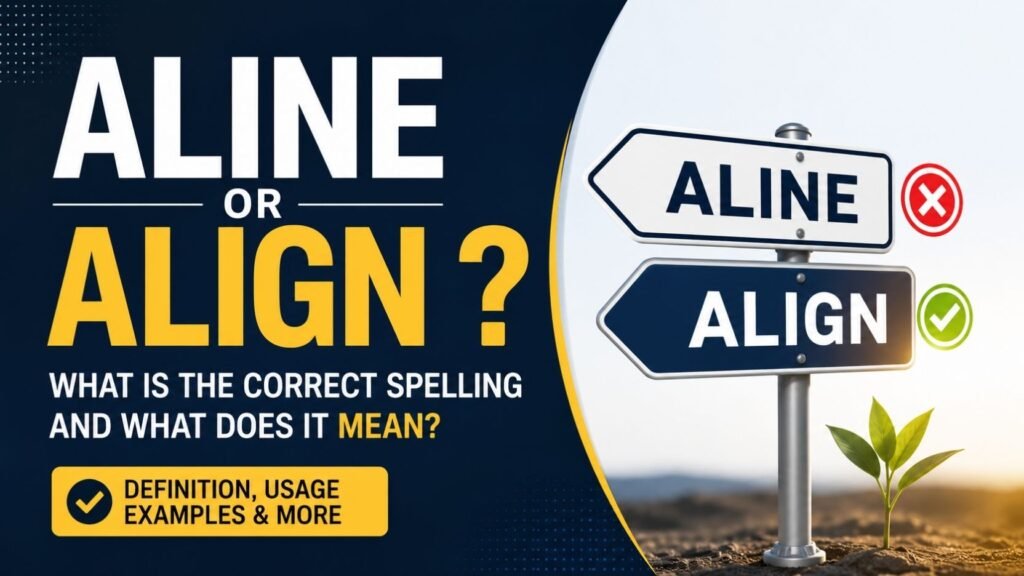
Align is the correct spelling to use in modern English. It means to arrange things in a straight line, or to bring people, ideas, or plans into agreement. Aline is not a mistake, exactly, but it is an old, rarely used spelling of the same word. If you are writing anything today, from a text message to a business report, align is the word you want.
This mix-up shows up constantly online, and it is easy to see why. The two words sound identical when spoken aloud. Spell-check tools sometimes let “aline” slip through because it technically exists in some dictionaries. And “Aline” is also a real first name, which adds another layer of confusion when the word pops up in search results. This guide clears up the spelling, explains the meaning in plain terms, and shows you exactly how to use align correctly in a sentence.
Aline Or Align: Quick Answer
| Question | Answer |
| Which spelling is correct today? | Align |
| Is “aline” a real word? | Yes, but it is archaic and rarely used |
| Part of speech | Verb (align, aligns, aligned, aligning) |
| Simple meaning | To arrange in a line, or to bring into agreement |
| Should you use “aline” in modern writing? | No, except in historical fiction or quoted old text |
See More: Witness’s or Witness’
What Does Align Mean?
Align has two main meanings, and both are common in everyday English.
Meaning 1: To arrange in a straight line. This is the physical, literal meaning. It describes objects placed in a row or positioned correctly against each other.
- Please align the chairs before the guests arrive.
- The mechanic checked whether the front wheels were aligned.
Meaning 2: To bring into agreement or cooperation. This is the figurative meaning, and it is probably the one you see more often in writing about goals, teams, and ideas.
- Our marketing plan needs to align with the company’s overall strategy.
- The two countries decided to align their trade policies.
- Her values align closely with her career choice.
Both meanings share the same core idea: things fitting together properly, whether that is physical position or shared purpose.
Is Align A Verb? Grammar Breakdown
Align is a verb. It is a regular verb, so it follows standard conjugation patterns.
| Form | Example |
| Base form | align |
| Third person singular | aligns |
| Past tense | aligned |
| Past participle | aligned |
| Present participle | aligning |
Align can be used transitively (with a direct object) or intransitively (on its own, often followed by “with”).
- Transitive: “Align the edges of the paper before you staple it.”
- Intransitive: “Her schedule doesn’t align with mine.”
The noun form of align is alignment, which refers to the state or process of being arranged correctly or in agreement.
- The printer has an alignment problem.
- The two teams reached alignment on the project timeline.
How To Pronounce Align
Align is pronounced uh-LYNE, with stress on the second syllable. In IPA, it is written as /əˈlaɪn/.
The “g” is silent. This is actually one of the reasons “aline” existed historically, since the “g” was never pronounced in the first place, and some older writers saw no reason to keep a letter that made no sound.
Is Aline A Real Word?
Yes. Aline is a genuine, dictionary-recorded spelling, but it belongs to an earlier stage of English. Historical dictionaries and etymology references show “aline” used in English texts from the 1600s through the 1800s, describing the same action of arranging things in a straight line.
By the time modern English spelling settled into its current form, “align” had become the standard, and “aline” faded almost completely out of everyday use. Today, most dictionaries either label “aline” as a rare or archaic spelling of align, or they leave it out entirely.
Where “Aline” Came From
Align traces back to Old French alignier, which combined à (“to”) with lignier (“to line”), itself rooted in Latin linea, meaning “line.” English borrowed the word without the French “g” at first, giving early writers the spelling “aline.” Over time, English spelling shifted back closer to the French original, and “align” won out as the accepted form.
Language historians note that the “g” in align doesn’t reflect pronunciation at all. It was added back into the spelling mostly to keep the word visually closer to its French and Latin roots, not because English speakers started pronouncing it.
When Might You Actually See “Aline”?
There are only a few situations where “aline” as a verb might reasonably appear:
- Quoting historical texts. Older documents, letters, or literature from past centuries may use “aline” naturally, and quoting them accurately means keeping the original spelling.
- Deliberately archaic or period writing. A historical novel set in the 1700s might use “aline” to give dialogue or narration an old-fashioned feel.
- Typing errors. Most modern appearances of “aline” are simply typos where a writer meant to type “align” and dropped the “g.”
Outside of these cases, “aline” has no place in contemporary writing, whether that’s an email, an essay, a website, or a text message.
Aline As A Name
Separate from the archaic spelling, “Aline” is also a common given name used in French, Portuguese, and other languages. It has no connection to the verb “align” beyond sharing similar letters and sound.
If you’ve searched “aline or align” because you saw the name “Aline” somewhere and wondered if it was a misspelling, it isn’t. It’s simply a name, unrelated in meaning to the verb discussed in this article.
Correct vs. Incorrect Examples
Seeing the two side by side makes the difference easy to remember.
❌ Incorrect: “We need to aline our schedules for next week.”
✅ Correct: “We need to align our schedules for next week.”
❌ Incorrect: “The picture frame doesn’t aline properly on the wall.”
✅ Correct: “The picture frame doesn’t align properly on the wall.”
❌ Incorrect: “Their goals don’t aline with the company’s mission.”
✅ Correct: “Their goals don’t align with the company’s mission.”
💡 Tip: If you’re ever unsure which spelling to use, default to align. It is correct in essentially every modern context, while “aline” is correct in almost none.
See More: Lucas’s or Lucas’
Synonyms For Align
Depending on the context, several words can substitute for align without changing the meaning much.
| Word | Best Used For |
| Line up | Casual, everyday phrasing |
| Coordinate | Teams, schedules, or efforts working together |
| Match | Ideas, values, or styles that fit each other |
| Straighten | Purely physical arrangement |
| Sync / synchronize | Timing-related agreement |
| Position | Precise physical placement |
Example: “Let’s line up our calendars” works just as naturally as “Let’s align our calendars,” though “align” tends to sound slightly more formal.
Common Phrases Using Align
A few set expressions use align or its related forms regularly.
“The stars align.” This idiom describes a moment when circumstances happen to work out perfectly, almost by luck. It has nothing to do with actual stars aligning in the sky, though the phrase originally drew on astrology.
- Everything came together perfectly for the launch; the stars really aligned this time.
“Align with” Used constantly in business and everyday speech to describe agreement between two things.
- The proposal doesn’t align with our budget.
- This decision aligns with our long-term goals.
“Get aligned” or “reach alignment” Common in workplace settings when a group needs to agree on a plan before moving forward.
- Let’s schedule a call to get aligned before the meeting.
Words That Sound Or Look Similar
A few related terms often show up alongside “align” in search results, and it helps to know they mean something different.
A-line (with a hyphen) is a fashion term, not related to the verb at all. It describes a garment, usually a dress or skirt, that is narrow at the top and flares out gradually toward the hem, forming the shape of a capital letter A. If you were searching for clothing rather than grammar, “A-line” with a hyphen is the term you want, and it has no connection to “align” beyond a coincidental similarity in spelling.
Align also appears as part of several product and brand names, including yoga and athletic wear lines, probiotic supplements, and business software tools. In those cases, the companies are simply using the everyday meaning of the word, arrangement and agreement, as a brand concept. The word itself still functions exactly as described in this article; only the branding context changes.
See More: Chris’s or Chris’
Frequently Asked Questions
Is it “aline” or “align”?
Align is correct in modern English. Aline is an old, rarely used spelling of the same word.
What does align mean in simple terms?
Align means to arrange things in a straight line, or to bring people, plans, or ideas into agreement.
Is align a noun or a verb?
Align is a verb. The related noun form is alignment.
How do you use align in a sentence?
You can use it physically (“Align the boxes on the shelf”) or figuratively (“Our goals align with the team’s mission”).
Is “aline” a spelling mistake?
Not technically, since it does appear in some dictionaries as an archaic form. But in everyday modern writing, it will read as a typo or an outdated spelling, so it’s best avoided.
What is a synonym for align?
Common synonyms include line up, coordinate, match, and synchronize, depending on the context.
Does “align” have a silent letter?
Yes. The “g” in align is silent; the word is pronounced uh-LYNE.
Is “Aline” related to the word “align”?
Only historically, as an old spelling. As a first name, “Aline” is unrelated in meaning.
What does “the stars align” mean?
It’s an idiom meaning that circumstances have come together favorably, often by chance.
Is “A-line” the same as “align”?
No. A-line (hyphenated) is a fashion term describing a dress or skirt shape. It is unrelated to the verb align.
Final Thoughts
Align is the word you should use whenever you’re writing about arranging things in order or bringing plans, people, or ideas into agreement. Aline is a real but outdated spelling that mostly survives in historical texts, and it has no place in everyday modern writing.
The next time you’re typing quickly and pause to wonder whether it’s “aline” or “align,” you now have a simple rule to fall back on: unless you’re quoting a centuries-old document, align is always the safer, correct choice.

Abdul Rehman Jutt is the author behind Grammar Wordz, with 4 years of experience researching and writing about English grammar, words, meanings, and language rules. Their goal is to make grammar simple, clear, and easy to understand through accurate and useful explanations.