
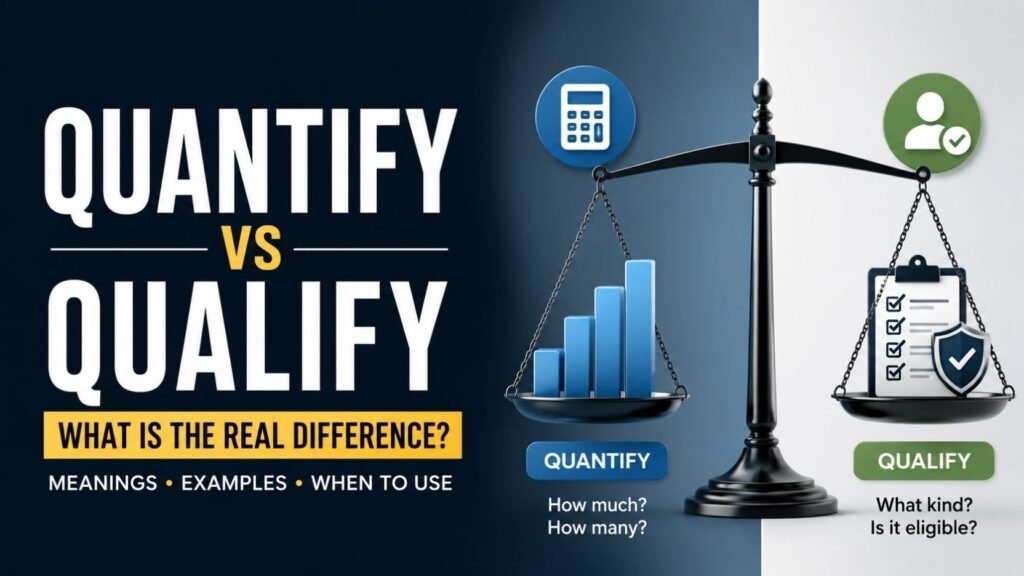
Quantify means to measure something and express it as a number. Qualify means to describe the nature, quality, or condition of something, or to meet the requirements needed for something. The two words look similar and often appear in the same sentence, but they answer completely different questions. Quantify answers “how much” or “how many.” Qualify answers “what kind” or “does this meet the standard.”
People mix these words up in business writing, data reports, and everyday conversation because both words relate to evaluating something. Understanding the difference matters because using the wrong word can confuse a reader or weaken a report. This article breaks down the meaning, grammar, and real-world usage of quantify vs qualify so you can use both words correctly and confidently.
Quantify Vs Qualify: Quick Answer
| Word | Simple Meaning | Answers The Question |
| Quantify | To measure or express something as a number | How much? How many? |
| Qualify | To describe a quality, or to meet a requirement | What kind? Is it eligible? |
A short way to remember it: quantify is about quantity, and qualify is about quality or eligibility. That single connection covers most real-world uses of both words.
What Does Quantify Mean?
Quantify is a verb. It means to determine or express the amount, size, or degree of something using numbers or measurable data.
- Part of speech: Verb (transitive)
- Pronunciation: KWON-tuh-fy (/ˈkwɒntɪˌfaɪ/ in American English)
- Simple definition: To turn something into a measurable number or value
Quantify Meaning In Everyday Use
When someone says “we need to quantify the results,” they mean the results need to be turned into numbers, percentages, or measurable data instead of staying as a vague description. If a manager says customer satisfaction improved, that is an opinion. If a manager quantifies customer satisfaction with a score, that is a measurement.
Example sentences:
- The scientist tried to quantify the effect of sunlight on plant growth.
- It is hard to quantify how much time the new software actually saves.
- The report quantifies the company’s carbon emissions in metric tons.
What Does Qualify Mean?
Qualify is also a verb, but it carries two distinct meanings that readers commonly search for.
- Part of speech: Verb (transitive and intransitive)
- Pronunciation: KWOL-uh-fy (/ˈkwɒlɪˌfaɪ/ in American English)
Meaning 1: To Meet A Requirement Or Become Eligible
This is the most common everyday use. It means someone or something meets the necessary conditions to receive, do, or enter something.
Example sentences:
- She worked hard to qualify for the Boston Marathon.
- Not everyone will qualify for a mortgage at that amount.
- His income was too high to qualify for food stamps.
Meaning 2: To Describe Or Limit The Nature Of Something
This meaning is more common in writing and grammar. It means to describe a quality, add detail, or place a limit or condition on a statement.
Example sentences:
- An adjective is used to qualify a noun.
- I want to qualify that statement, since it is not always true.
- The report qualifies its conclusion by noting the small sample size.
This second meaning is where “qualify” connects to grammar. A qualifying word, such as an adjective or adverb, adds description or limits the meaning of another word.
Quantify Vs Qualify: Key Differences
| Category | Quantify | Qualify |
| Core idea | Measure with numbers | Describe quality or meet a requirement |
| Typical question answered | How much? How many? | What kind? Is it eligible? |
| Common field of use | Data, science, business, statistics | Eligibility, grammar, description |
| Example | Quantify the sales growth | Qualify for a loan |
| Opposite focus | Objective, numerical | Subjective quality, or pass/fail eligibility |
Quantify Vs Qualify Examples Side By Side
Seeing both words used in nearly identical sentences makes the contrast clear.
- Quantify: The team tried to quantify the risk of the new investment in dollar terms.
- Qualify: The team tried to qualify the risk of the new investment by describing what could go wrong.
- Quantify: Can you quantify how much faster the new process is?
- Qualify: Can you qualify what you mean by “faster”?
In both pairs, quantify pushes toward a number, while qualify pushes toward a description, a condition, or an eligibility check.
Quantify Vs Qualify In Data And Business Contexts
In business and data work, quantify and qualify often appear together because good analysis usually needs both.
- Quantifiable data is data that can be measured and expressed numerically, such as revenue, click-through rate, or defect count.
- Qualitative data, related to the idea of qualifying something, describes characteristics that are not naturally numeric, such as customer feedback or brand perception.
A useful way analysts separate the two:
| Approach | What It Captures | Example |
| Quantitative (from quantify) | Numbers, measurements, statistics | 4.2 out of 5 average rating |
| Qualitative (related to qualify) | Descriptions, opinions, themes | Customers say the app feels intuitive |
How To Quantify Something
To quantify something in practice, you turn a general observation into a measurable value. Common methods include:
- Assigning a numeric score or rating
- Counting occurrences or frequency
- Measuring a percentage change over time
- Converting an outcome into a dollar value
For example, quantifying customer satisfaction often means using a survey score, such as a Net Promoter Score, instead of relying on general impressions. Quantifying risk usually means assigning a probability or a potential financial loss to a possible outcome, rather than simply calling the risk “high” or “low.”
What It Means To Qualify For Something
Qualifying for something means meeting the specific conditions set by a program, organization, or institution. This is the sense behind common searches like qualifying for disability, Medicaid, or unemployment benefits.
- To qualify for a benefit, applicants typically must meet criteria such as income level, medical condition, work history, or age.
- Eligibility rules differ by program and by state or country, so the exact requirements always come from the official source, such as a government agency, rather than a general dictionary definition.
- The word “qualify” here simply means “meets the required standard,” regardless of the specific rules involved.
If you need to know the exact conditions for a specific program, such as disability benefits or a mortgage, check the official guidelines from the relevant agency or lender, since those requirements can change and vary by location.
Quantify Vs Qualify: Grammar And Word Forms
Both words follow regular English verb patterns, but their related forms differ slightly.
| Form | Quantify | Qualify |
| Base verb | quantify | qualify |
| Present (he/she/it) | quantifies | qualifies |
| Past tense | quantified | qualified |
| Past participle | quantified | qualified |
| Gerund / present participle | quantifying | qualifying |
| Noun form | quantification | qualification |
| Adjective form | quantifiable | qualified / qualifying |
Notice that “qualified” also works as a standalone adjective, as in “a qualified nurse,” meaning someone who has met the required training or credentials. “Quantified” is rarely used this way as a standalone adjective; it stays closer to its verb meaning.
Example Sentences Using Different Forms
- Quantify: We need to quantify the damage before filing the claim.
- Quantified: The savings were quantified at nearly two thousand dollars a year.
- Quantifying: Quantifying happiness is far harder than quantifying income.
- Qualify: You must qualify before you can compete in the finals.
- Qualified: She is fully qualified for the position.
- Qualifying: The qualifying round begins next week.
Synonyms And Related Words
| Word | Meaning | How It Differs |
| Measure | To determine the size, amount, or degree of something | Broader and more general than quantify; quantify often implies expressing the result as a specific figure |
| Calculate | To work out a value using math | Focuses on the process of computing, while quantify focuses on the outcome of turning something into a number |
| Qualify (eligibility sense) | To meet a required standard | Synonymous with “become eligible,” not related to measurement at all |
| Qualify (description sense) | To describe or add a condition | Close to “describe,” “modify,” or “limit,” especially in grammar |
| Assess | To evaluate the value, quality, or extent of something | Can lean toward either quantify or qualify, depending on whether the outcome is a number or a description |
Quantify does not have a true synonym that is also its grammatical twin, since “measure” and “calculate” are the closest matches. Qualify’s closest synonyms depend entirely on which of its two meanings is being used.
Common Mistakes With Quantify And Qualify
❌ Incorrect: “We can’t qualify exactly how much revenue increased.”
✅ Correct: “We can’t quantify exactly how much revenue increased.”
The sentence is about a number, so quantify is the correct word.
❌ Incorrect: “She didn’t quantify for the scholarship because her GPA was too low.”
✅ Correct: “She didn’t qualify for the scholarship because her GPA was too low.”
The sentence is about meeting eligibility requirements, so qualify is correct.
❌ Incorrect: “The adjective is used to quantify the noun in this sentence.”
✅ Correct: “The adjective is used to qualify the noun in this sentence.”
In grammar, describing or adding detail to a noun is called qualifying it, not quantifying it.
💡 Tip: If the sentence could be answered with a number, use quantify. If the sentence is about meeting a standard or adding description, use qualify.
Origin Of Quantify And Qualify
Both words trace back to Latin roots, which explains why they look alike despite their different meanings.
- Quantify comes from the Latin word “quantus,” meaning “how much.” The suffix “-fy” comes from the Latin “facere,” meaning “to make.” So quantify literally means “to make into a quantity” or “to make measurable.”
- Qualify comes from the Latin word “qualis,” meaning “of what kind.” With the same “-fy” suffix, qualify literally means “to make into a certain kind” or “to give a certain quality to something.”
This shared “-fy” ending is why the two words sound alike, even though “quantus” (how much) and “qualis” (what kind) point in different directions from the start.
Frequently Asked Questions
What does quantify mean in simple terms?
Quantify means to measure something and express it as a number, such as an amount, percentage, or statistic.
What does qualify mean in simple terms?
Qualify means either to meet the requirements needed for something, or to describe and add detail to something.
Is quantify a noun or a verb?
Quantify is a verb. Its noun form is “quantification.”
Is qualify a noun or a verb?
Qualify is a verb. Its noun form is “qualification.”
What is the difference between quantify and qualify in data analysis?
Quantify refers to turning information into numbers, such as statistics or measurements. Qualify, through its related term “qualitative,” refers to describing characteristics that are not naturally numeric, such as opinions or themes.
How do you use quantify in a sentence?
Use quantify when you want to express something as a measurable value, such as “The study quantified the drop in air pollution.”
How do you use qualify in a sentence?
Use qualify when talking about eligibility, such as “He didn’t qualify for the loan,” or when adding description, such as “Let me qualify that answer.”
Can qualify ever relate to numbers?
Not directly. Even in eligibility contexts, such as income limits for a program, the word “qualify” describes whether someone meets a standard, not the measurement itself. The measurement is quantified; the eligibility outcome is qualified.
Why do quantify and qualify look so similar?
Both words share the Latin suffix “-fy,” meaning “to make.” They come from different Latin roots: “quantus” (how much) for quantify, and “qualis” (what kind) for qualify.
What is a quantifiable goal?
A quantifiable goal is a goal that can be measured with a specific number, such as “increase sales by ten percent,” rather than a vague goal like “improve sales.”
Final Thoughts
Quantify and qualify share a Latin ending and a similar shape, but they serve very different purposes in English. Quantify is about numbers: measuring, counting, and expressing size or degree in figures a reader can compare. Qualify covers two related ideas: meeting the requirements for something, and describing or adding a condition to a statement or a noun.
The easiest way to choose between them is to ask what the sentence is really doing. If it needs a number, reach for quantify. If it needs eligibility or description, reach for qualify. Keeping that one question in mind will make the difference between quantify vs qualify easy to remember every time you write or speak.

Abdul Rehman Jutt is the author behind Grammar Wordz, with 4 years of experience researching and writing about English grammar, words, meanings, and language rules. Their goal is to make grammar simple, clear, and easy to understand through accurate and useful explanations.