
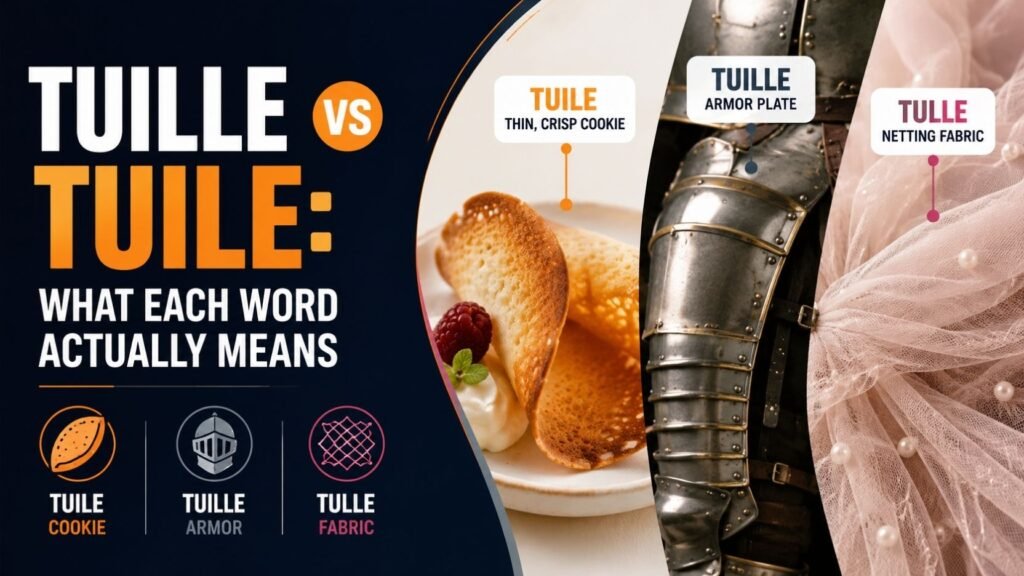
Tuile is the correct spelling for the thin, curved French cookie you see on dessert plates. Tuille is a different, much older English word that once described a piece of medieval leg armor. Most people who search for tuille actually mean tuile, and many who search for tuille fabric or tuille dress actually mean tulle, the netting used in veils and skirts.
This mix-up happens for a simple reason. Three words that look and sound almost alike, tuile, tuille, and tulle, get swapped in recipes, sewing forums, and casual writing every day. Knowing which word belongs where takes only a few minutes to learn, and it will save you from an awkward moment the next time you write a menu, a blog post, or a shopping list.
Quick Answer: Tuille vs Tuile at a Glance
Before going further, here is the short version.
| Word | Meaning | Used In |
| Tuile | A thin, curved, crisp cookie or wafer | Cooking and baking |
| Tuille | A historical armor plate that covered the thigh | Medieval history, armor studies |
| Tulle | A fine netting fabric | Fashion, wedding dresses, tutus |
If you are talking about a crisp almond cookie shaped like a small roof tile, you want tuile. If you are talking about a see-through, netted skirt or veil, you want tulle. Tuille, with two Ls, belongs to neither of those worlds. It is a real word, but it lives in armor history books, not kitchens or fabric stores.
See More: Its Self Vs Itself
What Does Tuile Mean?
Tuile is a French loanword that entered English cooking vocabulary largely unchanged. In French, tuile simply means “tile,” and the cookie earned that name because of its shape.
A tuile is a thin, delicate wafer that is baked flat and then curved while still warm, usually over a rolling pin or a bottle. Once it cools, it hardens into a shape that resembles a curved roof tile, the kind found on country houses in Provence. Pastry chefs use tuiles as an elegant garnish for plated desserts such as panna cotta, mousse, or ice cream, and savory versions appear on appetizer plates as well.
- Meaning 1: The cookie or wafer A tuile is a crisp, thin baked good, sweet or savory, shaped while warm into a curved or rolled form.
- Meaning 2: The French word for tile In everyday French, tuile is simply the ordinary word for a roof tile. English speakers borrowed the food-related sense, not the construction sense.
Part of Speech
Tuile is a noun. It follows regular English pluralization, so the plural is tuiles, not tuiless or tuils.
| Form | Example |
| Singular | The chef placed a single tuile on top of the mousse. |
| Plural | The dessert came with three delicate tuiles arranged like a fan. |
What Does Tuille Mean?
Tuille, spelled with two Ls, is a much older and far less common word. Dictionaries define it as a piece of medieval plate armor, specifically a hinged plate that hung in front of the thigh, sometimes described as part of a tasset.
💡 Tip: If you ever see tuille in a historical novel, a museum placard, or a discussion of knights and jousting, it almost certainly refers to armor, not food or fabric.
Interestingly, language historians who have traced this word closely note something worth knowing: the armor meaning appears to come from a single medieval account of a 1467 tournament, and some scholars now suspect that early antiquarians misread the original text. In other words, tuille as an armor term is a real dictionary entry, but its history is thinner and more uncertain than most readers would expect. Merriam-Webster and Wiktionary both flag this uncertainty in their etymology notes rather than presenting the armor meaning as settled fact.
Part of Speech
Tuille is also a noun, and it is grammatically a synonym of tasset in historical armor writing.
| Form | Example |
| Singular | The reenactor adjusted the tuille before the demonstration. |
| Plural | Both tuilles were fastened to the lower edge of the breastplate. |
Are Tuille and Tuile the Same Word?
Not quite, but they are cousins. Both words trace back to the same Latin ancestor, tegula, meaning “tile.” That root passed into Old French in slightly different spelled forms, including tieule, tiule, teuille, and tuile. Over time, one branch of that word family settled into modern French as tuile, the cookie and construction term. Another branch drifted into Middle English as toile or tuille, eventually narrowing to the specific armor meaning that dictionaries still record today.
So the short answer is this: tuile and tuille share a common ancestor, but centuries of separate use in two different languages gave them completely different jobs. One describes something you eat. The other describes something a knight once wore.
The Real Source of Confusion: Tuille, Tuile And Tulle
Search data shows that many people typing tuille fabric, tuille dress, or tuille or tuile skirt are not actually thinking about cookies or armor at all. They are thinking about tulle, the fine netting fabric used in wedding veils, ballet tutus, and layered party skirts.
This happens for an understandable reason. Tulle and tuile look similar on a page, sound somewhat alike when spoken quickly, and both come from French. Add an extra L out of habit, and tuille becomes the accidental middle ground between two unrelated words.
⚠️ Common mistake: Searching for “tuille skirt” when you actually want a “tulle skirt.” Tuille has never referred to fabric in any dictionary, past or present.
Here is how to keep all three words straight.
| Word | Category | What It Describes | Example Sentence |
| Tuile | Food | A thin, curved cookie or savory wafer | She topped the cake with a caramel tuile. |
| Tuille | Armor | A hinged plate protecting the thigh | The suit of armor still had its original tuilles. |
| Tulle | Fabric | Fine, lightweight netting | The bride’s veil was made of soft tulle. |
If your sentence involves a kitchen, a pastry chef, or a garnish, you want tuile. If your sentence involves a wedding dress, a tutu, or netting, you want tulle. If your sentence involves knights, tournaments, or medieval armor, you want tuille.
How To Pronounce Tuile And Tuille
Both words are pronounced the same way in English: /twiːl/, which rhymes with “wheel.” Say it as one smooth syllable, “tweel,” with the emphasis naturally falling on that single syllable since there is only one.
| Word | Pronunciation | Rhymes With |
| Tuile | tweel | wheel, kneel |
| Tuille | tweel | wheel, kneel |
This shared pronunciation is part of why the spelling gets confused so often. Two words that sound identical but serve completely different purposes are a natural source of mix-ups, especially when one of them (tuille) is rare enough that most readers have never seen it in print.
Tulle, by contrast, is pronounced differently. It rhymes with “dull” or “full,” typically said as /tʌl/ or /tuːl/ depending on regional accent, not “tweel.” Keeping the pronunciation difference in mind can help you remember that tulle belongs to a separate word family entirely, even though it is spelled similarly.
Origin And Etymology
Tracing where these words came from helps explain why they diverged so much in meaning.
Tuile: comes directly from modern French, where it simply means “tile.” The word entered English culinary vocabulary as pastry chefs and cookbook writers borrowed French terms for specific techniques and dishes, much like they did with words such as soufflé or mousse.
Tuille: has a longer, more layered history. It traces back through Middle English toile, from Anglo-French toille or tuille, from Old French tieule or teuille, ultimately from Latin tegula, meaning “tile” or “roofing tile.” The armor sense appears to be tied to the plate’s tile-like, overlapping shape, similar to how roof tiles overlap on a house. As noted earlier, some etymologists now question whether the armor meaning was ever widely used in medieval French at all, or whether it survived mainly because of one surviving historical account.
Tulle: for comparison, has an entirely different origin. It is named after Tulle, a town in France once known for its lace and silk weaving. The fabric took on the town’s name sometime in the early 1800s and has carried it ever since. Unlike tuile and tuille, tulle has no connection to the Latin word for tile.
See More: Thus Far vs So Far
Tuile In Cooking: What You Need To Know
Because tuile is the word most people are actually looking for, it deserves a closer look at how it is used in the kitchen.
A tuile is defined by three things: it is thin, it is crisp, and it is shaped while still warm. Bakers pour or spread a thin layer of batter onto a baking sheet, often using a stencil to create a clean, even shape, then bake it briefly at a moderate to high temperature.
The moment it comes out of the oven, while it is still pliable, it gets draped over a curved surface, such as a rolling pin, a wine bottle, or a purpose-made tuile mold. As it cools, it hardens into that signature curved shape.
Common Types of Tuiles
- Almond tuile: The most traditional version, made with ground almonds, sugar, egg whites, and butter.
- Parmesan tuile: A savory version made almost entirely from grated Parmesan cheese, baked until lacy and golden, with no flour needed.
- Sesame tuile: A nutty, crunchy variation that uses sesame seeds in place of or alongside almonds.
- Honey tuile: A sweeter version that relies on honey for both flavor and the deep amber color.
- Chocolate tuile: Made with cocoa powder folded into the batter for a rich, dark finish.
- Sugar tuile: A very simple version made mostly from caramelized sugar, often used to create decorative shards rather than curved shapes.
- Coral tuile: Named for its lacy, web-like appearance, often made from a thin batter that spreads into an open, lattice pattern as it bakes.
- Savory tuile: A general term for any non-sweet version, which can include herbs, spices, or cheese.
Tuile Molds
A tuile mold is a curved tool, often a half-pipe or wave shape, used to hold the warm tuile in place while it hardens. Bakers who make tuiles often will keep a few molds on hand, though a simple rolling pin works just as well for home cooking.
A Simple Approach to Making a Tuile
While exact recipes vary by flavor, most tuile batters share a similar base: butter, sugar, egg whites, and a small amount of flour, whisked into a thin, pourable batter. The batter is spread thinly on a lined baking sheet, baked for just a few minutes until the edges turn golden, then removed and shaped immediately while hot.
Because the window for shaping is short, usually under a minute before the wafer sets, working quickly and keeping a curved surface ready nearby matters more than any specific ingredient ratio.
✅ Correct: “I baked a batch of almond tuiles for the plated dessert.”
❌ Incorrect: “I baked a batch of almond tuilles for the plated dessert.”
Grammar Notes: Using Tuile And Tuille Correctly in a Sentence
Both words function as ordinary countable nouns in English, meaning they take an article (a, the) and follow standard plural rules.
- A tuile sits on top of the panna cotta. (singular, used as a subject)
- The pastry chef arranged several tuiles around the plate. (plural, used as an object)
- His costume included an authentic pair of tuilles. (plural, historical armor context)
Neither word functions as a verb or an adjective in standard English. You will not correctly say “to tuile something” or describe an object as “tuille-shaped” in formal writing, even though such phrasing occasionally shows up informally online.
Common Mistakes to Avoid
Because these words overlap so closely in sound and spelling, a few patterns of error show up again and again.
Mistake 1: Writing “tuille” when you mean the cookie.
❌ Incorrect: She served coral tuille with the sorbet.
✅ Correct: She served a coral tuile with the sorbet.
Mistake 2: Writing “tuille” or “tuile” when you mean the fabric.
❌ Incorrect: The dress had a tuille skirt.
✅ Correct: The dress had a tulle skirt.
Mistake 3: Assuming tuille and tuile are just alternate spellings of the same word.
❌ Incorrect belief: Tuille is just the British spelling of tuile.
✅ Correct understanding: They are two different words with two different meanings. Neither is a regional spelling variant of the other.
Mistake 4: Mispronouncing tulle as if it were tuile.
❌ Incorrect: Pronouncing tulle as “tweel.”
✅ Correct: Tulle is pronounced closer to “tull” or “tool,” not “tweel.”
See More: Modelling vs Modeling
Similar And Related Words
A few other terms show up alongside tuile and tuille in casual writing, and it helps to know how they differ.
| Word | Meaning | Difference from Tuile or Tuille |
| Tulle | Netting fabric | Different origin, different pronunciation, used in fashion |
| Toile | A printed cotton or linen fabric, or a test garment | Shares an old spelling history with tuille but means something else entirely today |
| Wafer | A thin, crisp baked good | A broader category that tuiles belong to |
| Tasset | Armor plates protecting the thigh or hip | A near synonym of tuille in historical armor writing |
Examples Of Tuile And Tuille In Real Sentences
- The dessert was finished with a single almond tuile balanced on top of the mousse.
- Parmesan tuiles make an easy, gluten free garnish for soup.
- The armor exhibit included a full set of tuilles from the late fifteenth century.
- She practiced curving the warm tuile over a rolling pin before it hardened.
- Historians still debate how common tuilles actually were on medieval battlefields.
Frequently Asked Questions
What does tuille mean?
Tuille is a historical English word for a hinged armor plate that protected the thigh, closely related to a tasset. It has no connection to cooking or fabric.
What does tuile mean in cooking?
A tuile is a thin, crisp cookie or wafer, usually curved while warm into a shape resembling a roof tile. It is the French word for “tile.”
Is it tuille or tuile for a cookie recipe?
It is tuile, with one L. Tuille is a different word entirely, referring to armor, not food.
How do you pronounce tuile?
Tuile is pronounced “tweel,” rhyming with wheel or kneel.
Is tuille the same as tulle fabric?
No. Tulle is a netting fabric used in dresses and veils, pronounced differently from tuile and tuille, and it has a completely separate origin tied to the French town of Tulle.
What is the plural of tuile?
The plural is tuiles, following standard English pluralization rules.
Why do people write tuille instead of tuile?
Because the two words sound identical when spoken, and tuille, despite being far rarer, sometimes gets treated as a natural-looking way to spell the sound “tweel.”
Can tuille refer to a dress or skirt?
No. Dictionaries have never defined tuille as a fabric or clothing term. Anyone searching for a “tuille skirt” or “tuille dress” almost certainly means tulle.
Is a parmesan tuile the same as a cracker?
Not exactly. A parmesan tuile is thinner and more delicate than a typical cracker, and it is shaped while still warm rather than left flat like most crackers.
What is the difference between a tuile and a wafer?
A wafer is a general term for any thin, crisp baked good. A tuile is a specific type of wafer that is shaped into a curve while still warm, usually to resemble a tile.
Final Thoughts
Tuille and tuile look almost identical, but they describe two completely different things. Tuile is the correct word for the thin, curved cookie that chefs use to add texture and elegance to a dessert plate. Tuille, spelled with two Ls, belongs to a much older and rarer vocabulary tied to medieval armor, and it has no place in a recipe, a fashion description, or a bakery menu.
The next time you are unsure which spelling to use, remember the simple rule that separates them: one L for the kitchen, two Ls for the armory. And if the sentence you are writing involves a dress, a veil, or a netted skirt, neither word applies at all. What you are actually looking for is tulle.

Abdul Rehman Jutt is the author behind Grammar Wordz, with 4 years of experience researching and writing about English grammar, words, meanings, and language rules. Their goal is to make grammar simple, clear, and easy to understand through accurate and useful explanations.