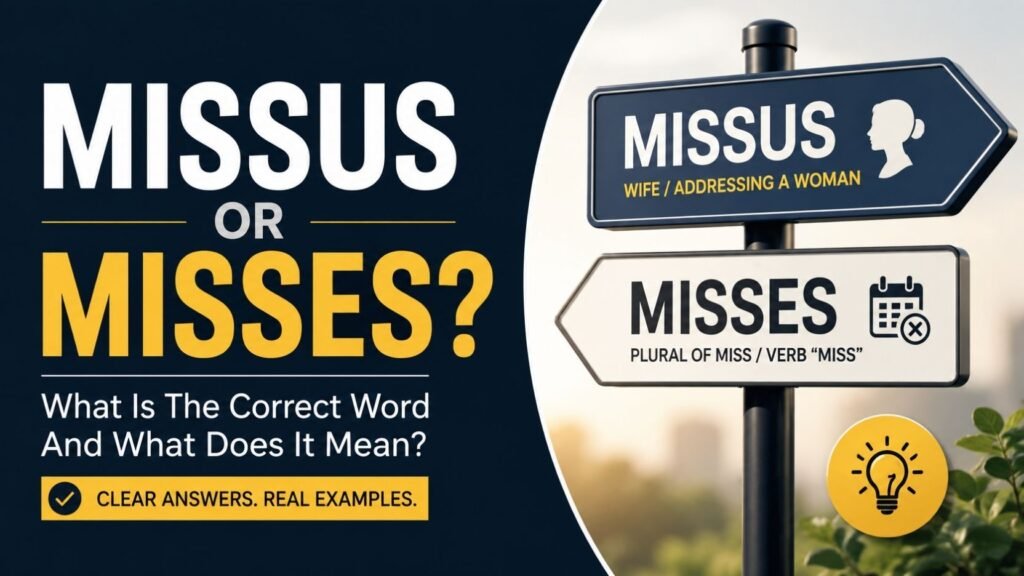
Missus or misses trips people up because the two words sound almost identical but do completely different jobs. Missus is a casual, spoken way of saying wife, and it also works as an informal way to address a woman you do not know. Misses is something else entirely: it is the plural of Miss, and it is also the everyday verb form of miss, as in “she misses her train.”
If you have ever typed “the missus or misses” into a search bar while writing a text to a friend, you are not alone. The confusion usually comes from the fact that missus is pronounced almost exactly like misses. Once you separate the sound from the spelling, the two words stop overlapping, and the correct choice becomes easy to remember for good.
Missus Or Misses: The Quick Answer
If you mean someone’s wife, or you are informally addressing a woman, the correct word is missus. If you are talking about more than one Miss, or about someone missing something, the correct word is misses. They are pronounced the same way in casual speech, but they are not interchangeable in writing.
Here is the short version in table form.
| Word | What it means | Example |
| Missus | Informal word for wife, or a casual way to address an unfamiliar woman | “How’s the missus doing?” |
| Misses | Plural of Miss, or the verb miss with an s | “Two misses attended the reception.” / “He misses his old job.” |
Keep that distinction in mind, and the rest of this guide will fill in the details: pronunciation, origin, grammar, regional usage, and the mistakes people make most often.
See More: Tweak Or Tweek
What Does Missus Mean?
Missus is an informal, spoken word used mainly in British and Australian English, though it appears in American English too. It has two closely related meanings.
Meaning 1: Wife
The most common use of missus is as a casual stand-in for “wife.” A man might refer to “the missus” the way he would say “my wife,” but with a warmer, more conversational tone. This use often shows up in dialogue, in text messages between friends, and in everyday speech rather than in formal writing.
- “I’ll check with the missus and get back to you.”
- “The missus wants to repaint the kitchen this weekend.”
Some modern usage has stretched missus to include a girlfriend a man lives with, not only a legally married wife. This is a newer, looser sense, and it is more common among younger speakers.
Meaning 2: An informal way to address a woman
In British English especially, missus can be used to speak to a woman whose name you do not know, similar to how “mister” is sometimes used for an unfamiliar man.
- “Excuse me, missus, is this seat taken?”
- “Need a hand with that, missus?”
This use is casual and, in many regions, considered a bit old-fashioned or working-class in tone. It is not rude by default, but it is not something you would use in a formal or professional setting.
A third, older meaning
Older dictionary entries also list missus as a spoken form of “mistress,” meaning the woman in charge of a household, back when household staff were more common. You will mostly encounter this sense in older novels or historical writing rather than in everyday conversation today.
Missus Or Misses: How To Tell Them Apart Fast
The easiest way to keep these words straight is to check what job the word is doing in the sentence.
- Is it standing in for a person, specifically a wife or an unnamed woman? Use missus.
- Is it the plural of Miss, or is it a verb describing someone missing something? Use misses.
A simple mental test: if you can replace the word with “wife” and the sentence still makes sense, you want missus. If you can replace it with “misses (the verb)” or “more than one Miss,” you want misses.
- “My missus is running late.” → replace with “wife” → correct.
- “She misses the bus every Monday.” → this is the verb miss, not a person → misses.
Is It Missus Or Misses? Answering The Direct Question
People often type “is it missus or misses” when they are unsure how to spell the spoken word they hear in conversation. The answer depends entirely on meaning, not on how the word sounds.
If you are trying to write down what someone said about their wife, the correct spelling is missus. Writing “misses” in that context is a common mistake, because misses looks like the more “proper” English word, while missus looks unusual on the page. But missus is the accepted, dictionary-recognized spelling for this informal word.
If you are talking about a woman missing a bus, missing a shot, or missing someone she loves, the correct spelling is always misses, since that is simply the verb miss with an s added for the third person singular form.
My Missus Or Misses: A Common Phrase Explained
“My missus” is an extremely common informal phrase in British and Australian English, meaning “my wife” or, in looser modern use, “my girlfriend.” It carries a relaxed, familiar tone, the kind you would use when chatting with a friend rather than writing a formal letter.
- “My missus and I are heading to her parents’ place this weekend.”
- “Ask my missus, she’ll know the address.”
“My misses” is grammatically wrong in this context, because misses is not a possessive noun for a person. If you see someone write “my misses” meaning their wife, that is a spelling mistake, even though it is a fairly common one online.
Missus Or Misses Meaning: Breaking Down Each Meaning Clearly
Since both words carry a few different meanings depending on context, here is each one laid out separately so nothing gets mixed together.
Missus Meaning 1: Wife The informal, everyday word for a man’s wife, used mostly in spoken conversation.
Missus Meaning 2: Unfamiliar woman A casual, sometimes old-fashioned way of addressing a woman whose name is not known, mostly heard in British English.
Missus Meaning 3: Woman of the house (older use) An older, now less common meaning referring to a woman in charge of a household or its staff.
Misses Meaning 1: Plural of Miss Used when referring to more than one unmarried woman or girl, particularly in formal or traditional contexts such as pageant titles or old-fashioned social references.
- “Three misses from the same family entered the competition.”
Misses Meaning 2: Verb form of miss The third person singular present tense of the verb “to miss,” used when someone fails to hit, catch, attend, or feel the absence of something or someone.
- “He misses his childhood home.”
- “The kicker misses the field goal.”
Missus Sauce: Where Does That Phrase Come From?
“Missus sauce” is not a standard grammar or dictionary term. It typically shows up as a nickname or brand-style phrase, often used playfully to mean a sauce a wife or partner makes, or as a product name that leans on the warm, homely feel of the word missus.
If you have come across “missus sauce” in a specific context, such as a product label or a regional phrase, it is worth checking that particular source directly, since it functions more as a branding or slang usage than as a fixed part of the English language.
Define Missus: A Simple, Clear Definition
To define missus in the simplest possible terms: it is an informal spoken word meaning “wife,” and in some regions, it also means an unfamiliar woman being addressed casually.
Missus definition, at a glance:
- Part of speech: noun
- Register: informal, spoken
- Primary meaning: wife
- Secondary meaning: form of address for an unnamed woman
- Common regions of use: United Kingdom, Australia, Ireland, and parts of the United States
What Is Missus? Understanding The Word In Everyday Speech
Missus works almost like a nickname for the word “wife,” carrying a friendlier, more personal tone. People use it in casual talk the same way they might say “the kids” instead of “my children,” or “the car” instead of naming the specific vehicle. It signals familiarity and warmth rather than formality.
You will hear it often in conversations like these.
- “The missus made a roast for Sunday dinner.”
- “I need to run this by the missus first.”
- “How’s the missus and the kids?”
Missus Drive: A Quick Note
“Missus Drive” most often appears as a street or place name rather than a grammar term, since “Drive” frequently follows a name in addresses. If you searched for “missus drive” hoping for a grammar explanation, it likely refers to a specific location rather than a usage of the word missus itself. Always check the specific place name if you are trying to confirm an address or map location.
What Does Missus Mean In Slang?
In casual and slang use, missus almost always circles back to the same core idea: a wife or a live-in girlfriend. Some regional slang stretches it slightly further, using it warmly or even humorously to refer to any romantic partner, regardless of marital status.
- “Me and the missus are going away for the weekend.” (girlfriend or wife)
- “Tell the missus I said hi.” (wife)
It rarely carries a negative tone on its own, though delivery and context can shape whether it sounds affectionate, casual, or a little old-fashioned.
Miss Vs Missus: What Is The Difference?
Miss and missus look related, and they are, historically, but they serve different purposes today.
- Miss is a formal title used before the name of an unmarried woman, or as a general form of address for a girl or young woman.
- Missus is an informal, spoken word for a wife, or a casual way to address a woman whose name is unknown.
| Word | Formality | Typical Use |
| Miss | Formal, used as a title | “Miss Johnson will see you now.” |
| Missus | Informal, spoken | “The missus is at work today.” |
Notice that Miss is used before a name, while missus is typically used with “the” or a possessive word like “my” or “his.”
Missus Synonym: Words With A Similar Meaning
If you want an alternative word for missus, several informal options exist, though each carries a slightly different tone.
- Wife — the neutral, standard term
- Partner — gender-neutral and modern
- Better half — playful and affectionate
- Old lady — very informal, sometimes seen as dated or slightly disrespectful depending on tone
- Mrs. — formal, used with a surname
None of these are exact one-to-one replacements. Missus carries a specific casual, conversational flavor that formal words like “wife” or “spouse” do not fully capture.
Misses Or Missus: Reversing The Question
Some readers search “misses or missus” instead of “missus or misses,” but the answer works exactly the same way regardless of word order. Check the meaning you intend first. If you mean a wife, choose missus. If you mean the plural of Miss or the verb miss, choose misses.
What Is A Missus?
A missus is, in plain terms, someone’s wife, described informally rather than formally. The word functions as a stand-in noun, almost like calling someone “the boss” instead of using their name or title. It is typically used with an article or possessive pronoun, such as “the missus,” “my missus,” or “his missus,” rather than on its own.
Misses: What This Word Means And How It Works
Misses serves two separate grammatical roles, and understanding both prevents confusion with missus.
As a plural noun Misses is the plural of Miss, referring to more than one unmarried woman or girl. This use appears in older or formal writing, and in specific naming conventions such as beauty pageant categories.
- “The misses lined up for the photograph.”
As a verb Misses is the third person singular present tense form of the verb “to miss.” It describes someone failing to hit a target, failing to attend something, or feeling the absence of someone or something.
- “She misses her flight every time she oversleeps.”
- “He misses his best friend since the move.”
- “The goalkeeper misses the save.”
Signs He Misses You During No Contact: A Different Kind Of Search
Searches like “signs he misses you during no contact” use misses purely as the verb, describing an emotional state rather than anything related to missus. This kind of search sits in relationship advice territory rather than grammar, but the word itself is simply the everyday verb miss, conjugated for “he.”
Sports And Pop Culture Uses Of Misses
The word misses shows up constantly in sports commentary and headlines, always as the verb form.
- “The kicker misses the game-winning field goal.”
- “The striker misses an open net from close range.”
- “The skier misses out on a medal after a costly fall.”
These uses follow the same grammar rule every time: singular subject, present tense, verb misses. There is no connection to missus in any of these contexts, even though search engines sometimes group them together because the words look and sound alike.
See More: CIA Or FBI
Miss Or Misses: Singular Versus Plural
When people search “miss or misses,” they are usually asking about subject-verb agreement rather than the title Miss.
- Use “miss” with I, you, we, and they: “I miss my old apartment.” “They miss the deadline every year.”
- Use “misses” with he, she, it, and singular nouns: “He misses his old apartment.” “The team misses the deadline every year.”
This is standard English grammar, following the same pattern as most regular verbs: add an s for third person singular present tense.
| Subject | Verb Form | Example |
| I / You / We / They | miss | “I miss you.” |
| He / She / It | misses | “She misses you.” |
Missus Abbreviation And Mrs: Are They The Same Word?
A frequent question is whether missus is simply another way of writing Mrs. The short answer: they come from the same root, but they are not interchangeable in formal writing.
Mrs is the formal, written abbreviation placed before a woman’s surname, such as “Mrs. Johnson.” Missus is the informal, spoken word used in everyday conversation, and it is not typically followed by a surname.
- Correct formal use: “Mrs. Johnson will join us shortly.”
- Correct informal use: “The missus will join us shortly.”
- Incorrect: “Missus Johnson will join us shortly.” (this mixes an informal word with a formal naming pattern)
Is Mrs missus or misses? Historically, Mrs developed from mistress, the same root word that gave us missus. So while Mrs is the formal written abbreviation, missus is its informal spoken cousin, and misses is an entirely separate word.
Pronunciation Of Missus
Missus is pronounced “MISS-uhs,” with the stress on the first syllable. In the International Phonetic Alphabet, it is typically written as /ˈmɪsɪz/ or /ˈmɪsəz/, depending on regional accent.
This pronunciation is nearly identical to how many speakers pronounce misses, which is exactly why the two words get confused so often in everyday writing. The sound is shared; the spelling and meaning are not.
- American pronunciation: MISS-uhz
- British pronunciation: MISS-iz
There is no meaningful difference in stress or rhythm between American and British speech here, only slight vowel variation.
Pronunciation Of Misses
Misses is pronounced the same way as missus in casual speech: “MISS-iz” or “MISS-uhz.” Since misses is simply miss with an added syllable for the plural or verb form, its pronunciation follows regular English pluralization rules for words ending in a hissing or hushing sound.
Because pronunciation overlaps so closely, spelling is really the only way to tell the words apart in writing. Context does the rest of the work.
Origin Of Missus
Missus comes from an informal pronunciation of mistress, a word that entered English through Old French in the medieval period, originally referring to a woman with authority or control, particularly over a household. Over time, as English speech patterns shifted and casual pronunciation smoothed out consonant clusters, “mistress” became “missus” in everyday spoken use.
Dictionary records place the first known written use of missus in its modern sense around the late 1700s. This lines up with the same period that gave English the abbreviation Mrs, since both words trace back to the same original term, mistress, just developing along two different paths: one formal and written, one informal and spoken.
Origin Of Misses
Misses does not share the same origin story. As a verb, it follows the regular pattern of Old English verb conjugation, where an s or es ending marks the third person singular present tense. As a plural noun, misses simply follows standard English pluralization, adding es to Miss because the word ends in a sound that requires an extra syllable to pronounce clearly in its plural form, much like “kiss” becomes “kisses” and “class” becomes “classes.”
Miss itself, as a title, developed as a shortened form of “mistress” as well, but along a completely different branch of usage: as a title for unmarried women and girls, distinct from the informal noun missus.
Missus Or Misses In American English Versus British English
Regional usage explains a lot of the confusion around missus or misses, since American and British English treat the word missus somewhat differently.
British English: Missus is common and widely understood, used casually to mean wife, and also used, particularly in working-class or regional British speech, to address an unfamiliar woman.
American English: Missus appears far less often in casual speech, though it is recognized in dictionaries and does show up informally, especially among older generations or in certain regional dialects. American speakers are more likely to say “my wife” directly rather than “the missus.”
Australian English: Missus is common and carries a similar warm, informal tone to its British use, frequently appearing in everyday conversation about a partner or wife.
Misses, by contrast, behaves identically across all English-speaking regions, since it is governed by standard grammar rules rather than regional slang.
The Missus Or Misses: Using The Word With “The”
“The missus” is one of the most common ways this word appears in real conversation, functioning almost like a nickname for “my wife” when the speaker is clearly referring to their own partner.
- “The missus is picking up the kids today.”
- “I told the missus we’d be home by six.”
“The misses,” on the other hand, only makes sense grammatically when referring to multiple people who each hold the title Miss, which is a fairly rare and formal use.
- “The misses from the debate club all qualified for finals.”
If you are describing your own wife in a casual sentence, “the missus” is almost always the phrase you are reaching for, not “the misses.”
Mister And Missus Or Misses: A Related Question
“Mister and missus” is a common informal phrase referring to a married couple, paralleling “mister” for the husband and “missus” for the wife. This phrase leans casual and old-fashioned, often used with a slightly humorous or nostalgic tone.
- “Mister and missus are off on their anniversary trip.”
“Mister and misses” would be incorrect here, since misses does not refer to a wife in any context.
You And The Missus Or Misses: Everyday Usage
“You and the missus” is a common conversational phrase used when asking someone about them and their wife together.
- “How are you and the missus doing these days?”
- “Are you and the missus coming to the barbecue?”
This phrase always uses missus, never misses, since it is directly referring to a person, the listener’s wife.
Common Mistakes With Missus Or Misses
Confusing missus and misses is one of the most frequent small spelling errors in casual writing, largely because the words sound alike when spoken aloud.
⚠️ Common Mistake 1
❌ Incorrect: “I need to ask my misses about dinner.”
✅ Correct: “I need to ask my missus about dinner.”
⚠️ Common Mistake 2
❌ Incorrect: “He missus the bus every morning.”
✅ Correct: “He misses the bus every morning.”
⚠️ Common Mistake 3
❌ Incorrect: “The missus Johnson family arrived early.”
✅ Correct: “The Johnson family arrived early.” or “Mrs. Johnson arrived early.”
The clearest way to avoid these mistakes: missus is always about a person, specifically a wife, while misses is either a plural title or a verb describing an action.
Similar Words That Cause Confusion
A few related words often get tangled up alongside missus and misses.
| Word | Meaning | Example |
| Mrs. | Formal title before a married woman’s surname | “Mrs. Patel called earlier.” |
| Ms. | Neutral formal title, does not indicate marital status | “Ms. Lee will present next.” |
| Miss | Formal title for an unmarried woman or girl | “Miss Carter teaches third grade.” |
| Missus | Informal spoken word for wife | “The missus is out shopping.” |
| Misses | Plural of Miss, or verb form of miss | “He misses his old neighborhood.” |
Keeping these five words distinct comes down to remembering one thing: only missus and Mrs relate to describing or addressing a wife informally versus formally, while Miss and Ms are titles for women regardless of relationship status, and misses is either a plural title or an entirely separate verb.
See More: Muah Or Mwah
Frequently Asked Questions
Is it missus or misses when talking about a wife?
It is missus. Misses never means wife; it is either the plural of Miss or the verb miss.
What does missus mean in a text message?
In a text, missus almost always means wife or, in more casual modern use, a live-in girlfriend.
Is missus the same as Mrs.?
They share the same historical root, mistress, but missus is the informal spoken word, while Mrs. is the formal written abbreviation used before a surname.
How do you pronounce missus?
Missus is pronounced “MISS-uhz” or “MISS-iz,” with stress on the first syllable.
What is the plural of Miss?
The plural of Miss is misses, used when referring to more than one unmarried woman or girl.
Is missus used in American English?
Yes, though less commonly than in British or Australian English. American speakers more often say “my wife” directly.
Can missus refer to a girlfriend, not just a wife?
Yes, in modern informal use, especially among younger speakers, missus can refer to a girlfriend someone lives with, not only a legal wife.
Why do missus and misses sound the same?
Because missus developed from an informal pronunciation of mistress, and that pronunciation happens to overlap closely with how misses is pronounced as a plural or verb form, even though the two words have entirely different origins and meanings.
Is “the missus” disrespectful?
Not inherently. It carries a casual, familiar tone rather than a disrespectful one, though some listeners may find it a bit old-fashioned depending on context and delivery.
What is the correct spelling: misses or missus?
Both spellings are correct, but they mean different things. Choose missus for a wife, and misses for a plural title or a verb.
Conclusion
Missus or misses comes down to one simple distinction once you strip away the shared pronunciation: missus is an informal word for a wife, or a casual way to address an unfamiliar woman, while misses is either the plural of Miss or the everyday verb form of miss. They sound alike, but they never do the same job in a sentence.
The next time you are unsure which word fits, ask yourself whether you are talking about a person’s wife or about someone missing something. That one question settles the missus or misses question every time, and it will keep your writing clear whether you are texting a friend, writing dialogue, or drafting something more formal.

Abdul Rehman Jutt is the author behind Grammar Wordz, with 4 years of experience researching and writing about English grammar, words, meanings, and language rules. Their goal is to make grammar simple, clear, and easy to understand through accurate and useful explanations.