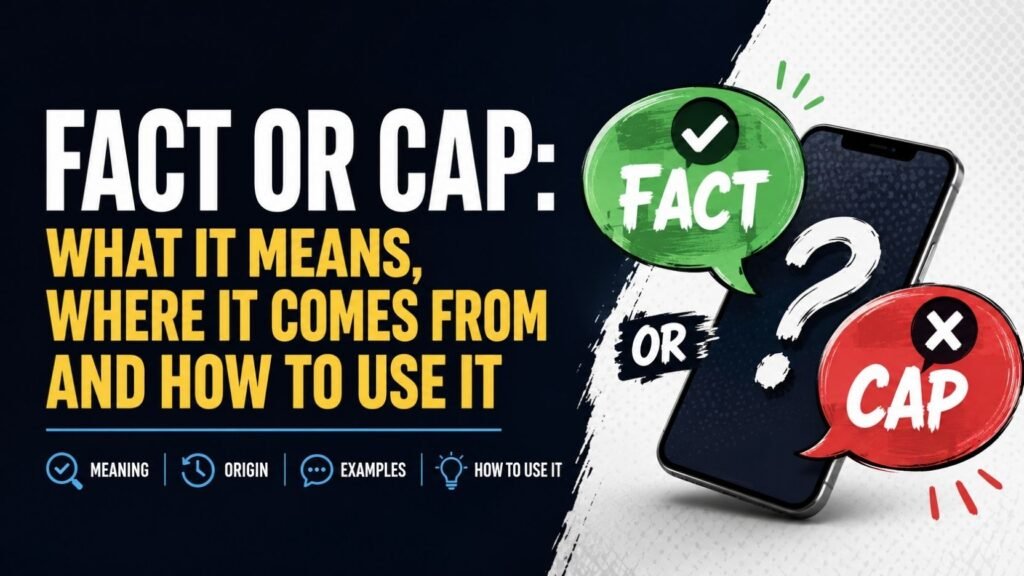
“Fact or cap” is a slang question that asks whether a statement is true or false. Someone says a claim, and the listener has to decide: is this real, or is it a lie? “Fact” means the statement checks out. “Cap” means it does not. You will see the phrase most often as a caption, a comment, or a video title on TikTok and Instagram.
The phrase matters because it shows how internet slang borrows from older street language and turns it into a game. “Cap,” meaning “lie,” comes from African American Vernacular English (AAVE) and has been around for decades. “Fact or cap” took that existing word and paired it with “fact” to build a simple two-word prompt that works for jokes, myth-busting, and casual fact-checking. Understanding it helps you follow a huge slice of current online conversation.
What Does Fact Or Cap Mean?
In plain English, “fact or cap” means “true or false?”
- Fact: the statement is true, real, or accurate.
- Cap: the statement is a lie, an exaggeration, or made up.
So when someone posts “I trained a squirrel to bring me snacks. Fact or cap?” they are asking readers to guess whether the claim is genuine or fabricated. It works the same way as “true or false,” “fact or fiction,” or “real or fake,” just with a slangier feel.
See More: Cringy Or Cringey
Fact Or Cap Grammar And Part Of Speech
“Fact or cap” is not a single grammatical unit like a normal phrase. It is really two nouns joined by “or” to form a question, similar in structure to “heads or tails.”
| Word | Part of speech | Meaning here |
| Fact | Noun | A true statement |
| Or | Conjunction | Connects the two choices |
| Cap | Noun (slang) | A lie or false statement |
A few related grammar notes:
- Cap can also work as a verb. “Stop capping” means “stop lying.”
- Capping is the gerund form, used for the act of lying or exaggerating: “He be capping.”
- No cap is a separate, very common phrase that means “no lie” or “I’m serious.” It is the opposite structure from “fact or cap”: it is a statement, not a question.
- In writing, “fact or cap” is almost always informal. It rarely appears with capital letters unless it starts a sentence or is used as a title.
Where Does “Cap” Come From? Origin And History
The slang sense of “cap” is much older than TikTok. Language references trace “capping,” meaning boastful lying or exaggeration, in African American Vernacular English back to the early 1900s. According to a Dictionary.com explainer, the term likely grew out of a social ritual of exchanging exaggerated insults called “capping,” where “cap” referred to the “top,” and participants tried to outdo each other’s put-downs.
The phrase gained new life through hip-hop. In a 2019 interview about its origins, rapper Willie D described “no cap” as an updated version of the older “high capping,” explaining that capping could mean insulting someone or simply being boastful. “No cap” became widely used in music and everyday speech well before “fact or cap” existed as its own phrase.
“Fact or cap” itself is the newer addition. It took the established meaning of “cap” (a lie) and built a question format around it, similar to how “truth or dare” or “this or that” work as social media prompts. It became especially common as a caption for videos that test whether a claim, hack, or rumor is actually true.
The word “fact” is much older and comes from Latin. It developed from factum, meaning “a thing done,” which is why “fact” refers to something that actually happened or can be proven.
How Fact Or Cap Is Used
“Fact or cap” shows up in a few overlapping ways online.
As a question after a claim. Someone states something surprising, then adds “fact or cap?” to invite a guess or a debate in the comments.
Example: “This phone battery lasts two weeks. Fact or cap?”
As a video format. On TikTok in particular, “fact or cap” became a label for videos that test a claim, hack, or rumor to see if it holds up: testing a kitchen trick, checking a viral safety tip, or verifying a piece of trivia on camera. Many of these videos duet or stitch an original clip and then show the real result.
As a general challenge phrase. People attach “fact or cap” to almost any topic to turn it into a guessing game: a claim about a game, a workout trend, a trivia fact about a country, a reality TV storyline, or a rumor about a celebrity. The topic changes, but the format stays the same: state something, then ask the audience to judge it.
As a one-word reply. In a comment section, someone might just write “cap” under a claim they don’t believe, without spelling out the full question. That single word carries the same meaning as “that’s not true.”
Example sentences
- “He said he ran a marathon without training. Fact or cap?”
- “That’s cap. Nobody finishes a marathon with zero training.”
- “No cap, I actually saw it happen.”
- “Stop capping, you weren’t even there.”
Fact Or Cap As An Internet Game And Meme
Beyond single posts, “fact or cap” grew into a recognizable content genre. Creators built entire accounts and video series around the format, testing viral claims and asking viewers to guess the outcome before revealing it. It sits in the same family as “myth or fact” and older debunking shows, but built for short-form video and comment-section engagement rather than a television format.
Because the phrase is so flexible, it also spread into meme templates. “Welcome to fact or cap, where we test…” became an opening line that creators reused as a recognizable, slightly exaggerated intro before presenting a claim, similar to how other catchphrases get copied and remixed across unrelated videos.
A note On The “lawsuit” story
If you search “fact or cap,” you will likely run into posts claiming that Mythbusters, the television show, sued a “Fact or Cap” creator or account, sometimes with dramatic details like bankruptcy or a specific settlement figure.
This storyline circulates mainly through TikTok captions and comment threads, not through news reporting, court records, or any statement from the Mythbusters franchise or its network.
Treat it as an unverified internet rumor, or possibly a joke narrative told for entertainment, rather than a documented legal case. If you need the real story behind it, look for reporting from an established news outlet rather than relying on captions alone.
See More: Witness’s or Witness’
Fact Vs. Cap Vs. No Cap: Quick Comparison
| Term | Meaning | Example |
| Fact | A true, verifiable statement | “That’s a fact: water boils at 100°C.” |
| Cap | A lie or false claim | “That’s cap, he never said that.” |
| No cap | No lie, I’m serious | “No cap, this is the best pizza in town.” |
| Fact or cap? | Asking whether a claim is true or false | “I taught my dog to open doors. Fact or cap?” |
Common Mistakes With Fact Or Cap
⚠️ Mixing up “cap” with a literal hat. Traditionally, a cap is something you wear on your head. Context tells you which meaning is intended: a sentence about lying will not usually mention wearing anything.
❌ Incorrect: “No cap” means someone forgot their hat.
✅ Correct: “No cap” means “I’m not lying.”
⚠️ Using it in formal writing. “Fact or cap” is slang, so it does not belong in a report, an email to a client, or academic writing.
❌ Incorrect (formal): “Please confirm whether the following is fact or cap.”
✅ Correct (formal): “Please confirm whether the following statement is true or false.”
⚠️ Assuming there’s only one accepted spelling. The phrase is consistent: “fact or cap,” not “facts or caps”: since both words function as general categories, not countable items in this expression.
Formal Vs. Informal Usage
“Fact or cap” belongs firmly in casual, spoken-style writing: texts, captions, comments, and conversation with friends. In a formal or professional setting: emails, reports, interviews, academic papers: replace it with “true or false,” “accurate or inaccurate,” or “verified or unverified.”
There is no British versus American spelling difference for “fact” or “cap,” but the slang sense of “cap” is rooted in American internet and hip-hop culture, even though it is now used worldwide.
See More: Buying Puts Vs Selling Puts
Frequently Asked Questions
What does “fact or cap” mean?
It means “true or false?” You are asking whether a statement is real or made up.
What does “cap” mean by itself?
“Cap” means a lie or a false statement. If something is “cap,” it isn’t true.
What is the opposite of “cap”?
“Fact” or “no cap” both work as opposites, though they function differently: “fact” answers the question, while “no cap” is used to assert honesty.
Is “cap” a noun or a verb?
Both. As a noun, “cap” means a lie (“that’s cap”). As a verb, it means to lie or exaggerate (“stop capping”).
Where did “cap” come from?
It comes from African American Vernacular English, where “capping” originally referred to a tradition of exchanging exaggerated insults, and later came to mean lying or bragging.
Is “fact or cap” the same as “fact or fiction”?
They mean nearly the same thing. “Fact or fiction” is the more traditional phrase; “fact or cap” is the slang, internet-culture version.
Can I use “fact or cap” in formal writing?
No. Use “true or false” or “accurate or inaccurate” instead in formal contexts.
Is “fact or cap” only used on TikTok?
It started and remains most common on TikTok, but it has spread to Instagram, YouTube comments, and everyday text conversation among younger speakers.
Did Mythbusters really sue a “Fact or Cap” creator?
There’s no verified news reporting or legal record confirming this. It appears mainly as an unverified story shared in TikTok captions, so it’s best treated as unconfirmed rather than fact.
Conclusion
“Fact or cap” is internet slang for “true or false,” built from the older AAVE term “cap,” which means a lie or exaggeration. It works as a quick way to question a claim, challenge a rumor, or turn a surprising statement into a guessing game, and it has grown from a comment-section phrase into a full video format on social media.
If you run into the phrase online, you now know exactly what’s being asked: is this fact, or is it cap? Keep it for casual conversations and captions, swap in “true or false” for anything formal, and treat viral side-stories: like the Mythbusters lawsuit claim: with a healthy dose of skepticism until a reliable source confirms them.

Abdul Rehman Jutt is the author behind Grammar Wordz, with 4 years of experience researching and writing about English grammar, words, meanings, and language rules. Their goal is to make grammar simple, clear, and easy to understand through accurate and useful explanations.