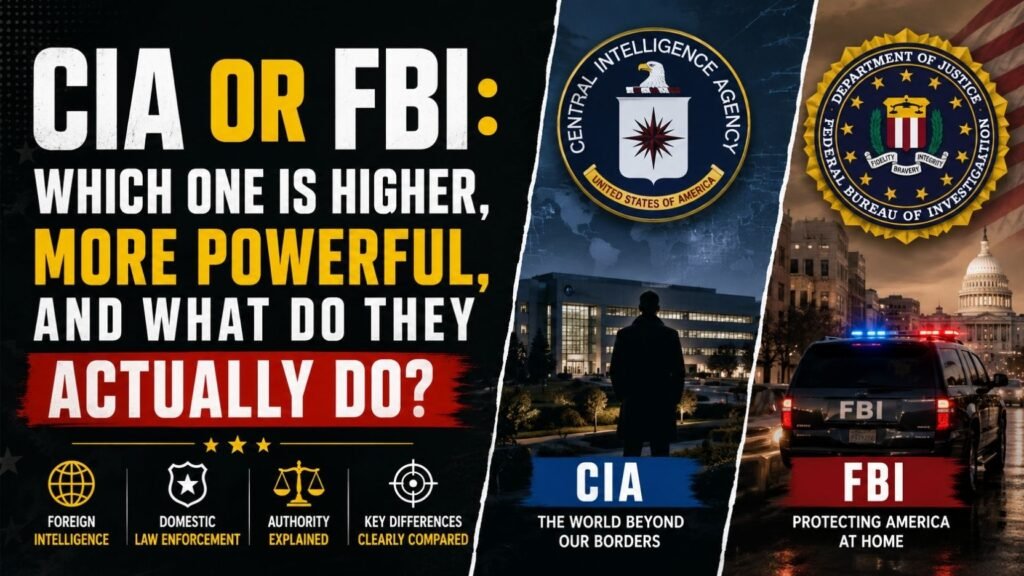
When people search “CIA or FBI,” they are usually trying to sort out one simple confusion: these are two different United States government agencies with two different jobs, and neither one technically ranks above the other. The CIA handles foreign intelligence outside the United States. The FBI handles federal law enforcement and domestic security investigations inside the United States. They do not report to each other, and neither director outranks the other on an organizational chart.
That said, the confusion is fair. Both agencies deal with spies, threats, and national security. Both show up constantly in movies and TV shows. Both recruit from similar backgrounds. And both get compared endlessly online, especially in questions about power, authority, salary, and how hard each one is to join. This article breaks down what CIA and FBI actually mean, how their authority differs, and how to think clearly about the “which is higher” question once and for all.
Quick Answer: CIA Or FBI, Which Is More Powerful?
Neither agency is officially “more powerful” than the other, because they operate in separate lanes.
- The CIA is a foreign intelligence agency. It gathers intelligence overseas and generally cannot make arrests or operate as a police force inside the United States.
- The FBI is a domestic law enforcement and internal security agency. It can investigate crimes, gather evidence, and make arrests inside the United States, and it also leads domestic counterintelligence and counterterrorism work.
If “powerful” means legal authority to arrest, prosecute, and use force inside the United States, the FBI has that authority and the CIA generally does not. If “powerful” means global reach, covert operations abroad, and influence over foreign events, the CIA operates in a space the FBI does not. Neither one sits above the other in the federal chain of command.
See More: Fact Or Cap
CIA Meaning: What Does CIA Stand For?
CIA stands for Central Intelligence Agency. It is an independent agency of the United States federal government responsible for collecting, analyzing, and acting on foreign intelligence.
Quick facts about the CIA:
| Detail | Information |
| Full name | Central Intelligence Agency |
| Founded | 1947, under the National Security Act |
| Headquarters | Langley, Virginia |
| Focus | Foreign intelligence, espionage, covert action, analysis |
| Reports to | The President, through the Director of National Intelligence |
| Domestic arrests | Generally not authorized |
| Current Director | John Ratcliffe |
The CIA grew out of the World War II era Office of Strategic Services. Congress created it in 1947 to give the president a single agency focused on collecting and evaluating foreign intelligence, rather than relying on scattered military and diplomatic sources. Its mission centers on understanding what is happening outside U.S. borders: foreign governments, militaries, terrorist networks, and emerging threats.
FBI Meaning: What Does FBI Stand For?
FBI stands for Federal Bureau of Investigation. It is the primary domestic security and law enforcement agency of the United States, operating within the Department of Justice.
Quick facts about the FBI:
| Detail | Information |
| Full name | Federal Bureau of Investigation |
| Founded | 1908 (as the Bureau of Investigation, renamed FBI in 1935) |
| Headquarters | Washington, D.C. |
| Focus | Federal crimes, domestic terrorism, counterintelligence, cybercrime |
| Reports to | The Attorney General, within the Department of Justice |
| Domestic arrests | Yes, agents are sworn federal law enforcement officers |
| Current Director | Kash Patel |
The FBI began as a small investigative force inside the Department of Justice in 1908 and became known nationally under J. Edgar Hoover, who led it for decades. Today it investigates federal crimes ranging from organized crime, cybercrime, and public corruption to domestic terrorism and counterintelligence against foreign spies operating inside the United States.
CIA Vs FBI: The Core Difference In One Sentence
The simplest way to remember the difference: the CIA watches the world, and the FBI watches the country.
- CIA: foreign intelligence, mostly outside the United States, no general arrest power domestically.
- FBI: domestic law enforcement and security, mostly inside the United States, agents can arrest and carry firearms as federal officers.
This split exists on purpose. After World War II, lawmakers were wary of creating a single agency with both spying power abroad and police power at home, since that combination looks like the kind of secret-police model the United States wanted to avoid. Keeping foreign intelligence and domestic law enforcement in separate agencies was a deliberate check on power.
Is The CIA Or FBI Higher? Understanding “Rank” Between Them
People often ask “who is higher, CIA or FBI” as if one agency sits above the other. It does not work that way.
- The CIA director reports to the President and coordinates with the Director of National Intelligence, who oversees the wider U.S. intelligence community.
- The FBI director reports to the Attorney General and operates inside the Department of Justice, though the FBI also contributes to the intelligence community.
Both directors are presidential appointees confirmed by the Senate. Neither one outranks the other. They are peers who lead separate agencies with separate missions, and in practice they are expected to cooperate rather than compete for authority.
If you are asking about authority within their own domain, the comparison looks like this:
| Question | CIA | FBI |
| Can investigate crimes inside the U.S.? | No, this is not its role | Yes, this is a core function |
| Can arrest people? | No general arrest authority | Yes, agents are federal law enforcement officers |
| Can operate covertly abroad? | Yes, this is central to its mission | Limited, mainly through legal attaché offices |
| Can conduct domestic counterintelligence? | No, this belongs to the FBI | Yes, this is a core FBI mission |
| Oversees other intelligence agencies? | No, that role belongs to the Director of National Intelligence | No |
So “higher” depends entirely on the context. Inside the United States, the FBI has broader legal authority. Outside the United States, the CIA has broader reach. Neither has authority over the other.
See More: Cringy Or Cringey
Is The CIA Or FBI More Powerful? A Closer Look
“More powerful” usually means one of three things: legal authority, budget and size, or influence on national security decisions. Here is how the two compare on each.
Legal Authority
The FBI has clear domestic law enforcement power. Agents can obtain warrants, make arrests, seize evidence, and testify in criminal court. This kind of authority does not exist for the CIA inside the United States. By law and by long-standing policy, the CIA’s mission is foreign intelligence, and it is not built or authorized to police American citizens on U.S. soil.
Budget And Size
Exact intelligence budgets are classified, but both agencies are large by any standard. Congress funds the FBI’s law enforcement mission through published appropriations bills, while overall intelligence spending across the CIA and other intelligence agencies is disclosed only as a combined total, without a public breakdown by agency. Because of this, precise agency-by-agency budget comparisons are not something the public can verify with certainty.
Influence On National Security
Both directors regularly brief the President and Congress. The CIA typically leads on foreign threat assessments, while the FBI typically leads on domestic threats, cyber intrusions originating from abroad but affecting the U.S., and counterintelligence against foreign spies operating inside American borders. On major national security issues, the two agencies often work side by side rather than in competition.
CIA Vs FBI Vs NSA: Where Does The NSA Fit In?
Search data shows many people also want to know how the NSA compares. The National Security Agency (NSA) is a third major piece of the puzzle, and it has a different job again.
| Agency | Main Focus | Type Of Work |
| CIA | Foreign intelligence | Human intelligence, analysis, covert action abroad |
| FBI | Domestic law enforcement and security | Criminal investigation, domestic counterintelligence, arrests |
| NSA | Signals intelligence | Electronic surveillance, code-breaking, cybersecurity, communications intercepts |
The NSA sits under the Department of Defense and focuses on intercepting and analyzing electronic communications and signals, both foreign and, under strict legal limits, in some cases involving U.S. persons. None of the three agencies outranks the others. They are separate members of the wider U.S. intelligence community, which is coordinated by the Director of National Intelligence.
Do The CIA And FBI Work Together?
Yes. Despite having separate missions, the CIA and FBI regularly share information and coordinate, especially on:
- Counterterrorism investigations that involve both foreign networks and domestic plots
- Counterintelligence cases involving foreign spies operating on U.S. soil
- Cybersecurity threats that originate overseas but target American systems
This cooperation was strengthened significantly after the September 11, 2001 attacks, when investigations found that better information-sharing between agencies could have connected the dots earlier. Since then, joint task forces and shared intelligence centers have become a normal part of how the two agencies operate, even though they remain legally and organizationally separate.
CIA Or FBI: Which Is Harder To Get Into?
Both agencies have selective, multi-stage hiring processes, but they screen for somewhat different things.
Typical CIA hiring process:
- Application and resume review
- Extensive background investigation, often taking many months
- Polygraph examination
- Medical and psychological evaluation
- Security clearance at the Top Secret level or higher
Typical FBI Special Agent hiring process:
- Application and written exams
- Physical fitness test
- Structured interviews
- Extensive background investigation
- Polygraph examination
- New agent training at Quantico, Virginia
Both processes are long, competitive, and involve rigorous background checks. Neither is simply “easier.” The CIA process tends to place heavy weight on discretion, language skills, and overseas adaptability, since many roles involve working abroad under a cover identity.
The FBI process places heavy weight on physical fitness, investigative skills, and eligibility to carry firearms and make arrests as a federal law enforcement officer. Applicants who prefer fieldwork on U.S. soil and traditional law enforcement often lean FBI, while applicants drawn to overseas assignments and intelligence analysis often lean CIA.
CIA Vs FBI Salary
Public salary data for federal law enforcement and intelligence roles generally follows the federal government’s General Schedule (GS) pay scale, with additional locality pay and special law enforcement pay adjustments.
Entry-level FBI Special Agents and CIA case officers tend to start within a broadly similar range on this federal pay scale, with actual pay varying by location, experience, and specific role.
Because many CIA positions and some sensitive FBI roles involve classified compensation details, exact figures are not always fully public, and any specific number should be checked against current official government pay tables rather than assumed.
“Are Nuns CIA Or FBI?” Where This Question Comes From
This unusual search likely comes from internet jokes and viral social media posts poking fun at the idea that ordinary-looking people, including nuns, could secretly be government agents.
It is not based on any real CIA or FBI program, and there is no factual basis for nuns being undercover agents of either agency. If you saw this phrase somewhere, it is almost certainly humor or internet meme culture rather than a real intelligence question.
CIA And FBI In Pop Culture: TV Shows
Both agencies are the subject of long-running television franchises, which is part of why “CIA” and “FBI” show up so often in entertainment searches.
- FBI is a CBS drama that premiered in 2018, following agents in the FBI’s New York field office. It has spawned spinoffs including FBI: Most Wanted and FBI: International, and by 2026 the flagship series has run for multiple seasons.
- CIA as a television title has appeared in various regional and international productions using agents and espionage plots as their premise, though naming and availability vary by country and streaming platform.
- Other well-known fictional depictions of the agencies include shows and films built around FBI investigative work and CIA espionage plots, such as Quantico, which is set at the FBI’s training academy in Virginia and follows recruits through the same real-world location referenced above.
It is worth remembering that television dramatizations often blur or simplify the real legal boundaries between the CIA and FBI for the sake of storytelling. In real life, the jurisdictional split between foreign intelligence and domestic law enforcement is much stricter than most shows portray.
Common Mistakes People Make About CIA And FBI
✅ Correct: The FBI can arrest people inside the United States; the CIA generally cannot.
❌ Incorrect: Thinking the CIA can arrest U.S. citizens on American soil the same way the FBI does.
✅ Correct: The CIA and FBI are separate agencies with separate directors, neither outranking the other.
❌ Incorrect: Assuming one agency is the “boss” of the other.
✅ Correct: The CIA focuses on intelligence gathered outside the United States.
❌ Incorrect: Assuming the CIA is simply “the bigger version” of the FBI.
✅ Correct: The NSA, CIA, and FBI are three separate agencies with three separate roles.
❌ Incorrect: Treating “CIA,” “FBI,” and “NSA” as interchangeable terms for the same kind of work.
CIA World Factbook: A Related But Different Topic
Some readers searching “CIA” are actually looking for the CIA World Factbook, a well-known public reference published by the agency that provides country-by-country data on geography, population, government, and economy.
It is a public, unclassified resource used by students, researchers, and journalists worldwide, and it is unrelated to the agency’s covert intelligence work. If your goal was country data rather than a comparison between CIA and FBI, the World Factbook is the resource to look for.
See More: Lucas’s or Lucas’
Frequently Asked Questions
What does CIA stand for?
CIA stands for Central Intelligence Agency, the U.S. agency responsible for foreign intelligence collection and analysis.
What does FBI stand for?
FBI stands for Federal Bureau of Investigation, the primary domestic law enforcement and security agency of the United States.
Is the CIA or FBI higher in rank?
Neither is higher. They are separate federal agencies with separate directors and separate missions, and one does not outrank the other.
Who has more power, CIA or FBI?
It depends on context. The FBI has domestic arrest and law enforcement authority that the CIA does not. The CIA has foreign intelligence and covert operations authority that the FBI does not.
Is the CIA or FBI more powerful than the NSA?
None of the three outranks the others. The CIA, FBI, and NSA are separate agencies with separate missions inside the wider U.S. intelligence community.
Do the CIA and FBI work together?
Yes, they regularly share intelligence and coordinate, especially on counterterrorism and counterintelligence cases that cross both domestic and foreign lines.
Is the CIA or FBI harder to get into?
Both have long, competitive, multi-stage hiring processes involving background checks and polygraphs. Neither is simply “easier” than the other; they screen for different skill sets.
Is CIA American?
Yes. The Central Intelligence Agency is an agency of the United States federal government.
Who is the current CIA director?
As of 2026, John Ratcliffe serves as CIA Director.
Who is the current FBI director?
As of 2026, Kash Patel serves as FBI Director.
Conclusion
“CIA or FBI” is not really a question with a single winner, because the two agencies were built to do different jobs. The CIA exists to understand and act on threats and events outside the United States, while the FBI exists to investigate crimes and protect national security inside the United States. Neither director reports to the other, and neither agency sits above the other in the federal government’s structure.
If you take one thing away from this comparison, let it be this: instead of asking which agency is “higher,” it helps more to ask which agency handles the situation you are actually curious about. For anything happening on foreign soil, the CIA is the relevant agency. For anything happening inside the United States, from federal crime to domestic counterintelligence, the FBI is the one with legal authority to act.

Abdul Rehman Jutt is the author behind Grammar Wordz, with 4 years of experience researching and writing about English grammar, words, meanings, and language rules. Their goal is to make grammar simple, clear, and easy to understand through accurate and useful explanations.