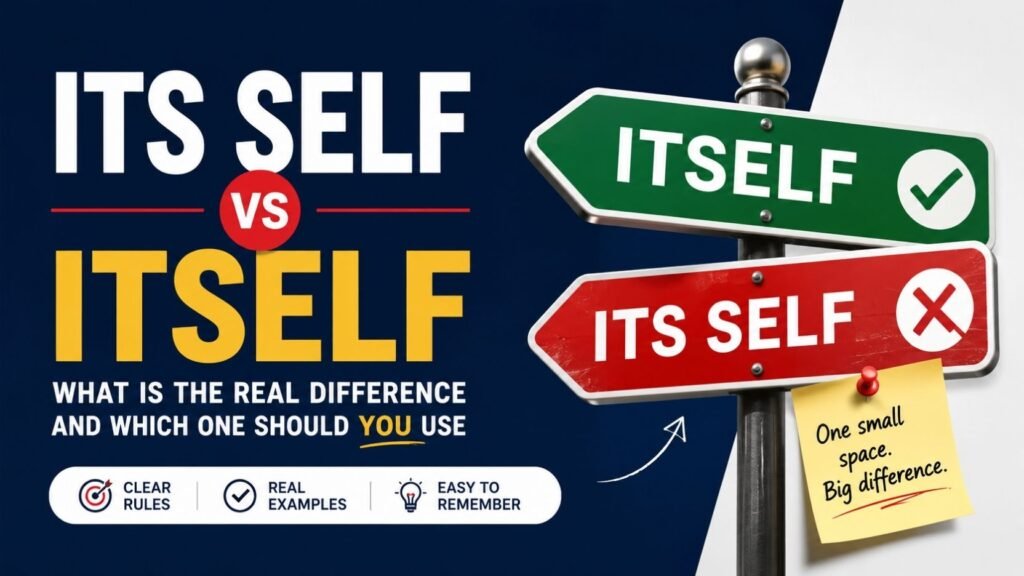
Itself is the correct word almost every time you mean “the thing did it to itself” or “the thing on its own.” It is one word, and it works as a reflexive or intensive pronoun. Its self is not standard English. It only shows up as two separate words in rare cases where “self” is being used as its own noun, and even then, most writers still choose a different phrasing.
Confusing its self vs itself is one of the most common small grammar mix-ups in English. It happens because “its” already looks like it belongs with “self,” and because the words sound almost identical when spoken quickly. Once you understand the simple rule behind them, you will never second guess this choice again.
Itself Meaning
Itself is a single word. It refers back to a thing, an animal, an idea, or a situation that was already mentioned in the same sentence.
It does two main jobs in English grammar.
- Reflexive pronoun: it shows that the subject of a sentence is also receiving the action. Example: The cat cleaned itself.
- Intensive pronoun: it adds emphasis to a noun that was already named. Example: The house itself was beautiful, even though the garden was a mess.
In both uses, itself always refers back to something singular and non-personal, such as an object, an animal, an organization, or an abstract idea. For people, English uses himself, herself, or themselves instead.
Its Self Meaning
Its self is not a standard grammatical unit in modern English. It is two separate words placed next to each other by mistake, almost always where the writer meant itself instead.
There is one narrow situation where its self can appear correctly. This happens when self is being used as a standalone noun, referring to a person’s or a thing’s core identity, and its is the possessive word attached to that noun. Example: The company tried to protect its self image.
Even in that example, most careful writers today write “self-image” as one hyphenated word, so the phrase becomes “its self-image.” That turns the confusing two-word “its self” into a possessive plus a compound noun, which is much clearer and far more common in edited writing.
Outside of this narrow noun use, its self is considered incorrect. If you are describing an action a thing does to itself, or emphasizing a thing on its own, the correct word is always itself.
Its Self Vs Itself: The Core Difference At A Glance
| Term | Word Count | What It Is | When To Use It |
| Itself | One word | Reflexive or intensive pronoun | The subject acts on itself, or you are emphasizing the subject alone |
| Its self | Two words | Possessive word “its” plus the noun “self” | Only when “self” is used as a standalone noun meaning identity, and even then, “its self-image” or similar hyphenated forms are more common |
If you are not sure which one fits your sentence, try this quick test. Read the sentence and ask if you are talking about a psychological “self” as a noun. If not, the answer is itself.
Grammar: What Type Of Word Is Itself
Itself belongs to a small group of English pronouns that end in “self” or “selves.” These are called reflexive and intensive pronouns.
The full group looks like this: myself, yourself, himself, herself, itself, oneself, ourselves, yourselves, themselves.
Itself is the only one in this list used for things that are not people. That includes animals, objects, companies, ideas, weather, and abstract concepts.
Itself As A Reflexive Pronoun
A reflexive pronoun shows that the subject and the object of a verb are the same thing. The action goes out from the subject and comes right back to it.
- The washing machine shuts itself off after the cycle ends.
- The virus copies itself inside the host cell.
- The company reorganized itself after the merger.
In each example, the subject is doing something, and the same subject is receiving that action.
Itself As An Intensive Pronoun
An intensive pronoun does not receive an action. Instead, it adds emphasis to a noun that was already mentioned, usually to highlight that the thing itself, and not something related to it, is the focus.
- The plan itself was fine, but the timing was wrong.
- The building itself survived the storm, even though the roof was damaged.
You can often remove an intensive pronoun without changing the basic meaning of the sentence. “The plan was fine” still makes sense without itself. That is a useful test to tell the two uses apart.
Is Itself One Word
Yes. Itself is always written as a single word in modern English. There is no standard version that splits it into “it self” or “its self” when you mean the reflexive or intensive pronoun.
How To Pronounce Itself
Itself is pronounced with two syllables: it-SELF. The stress falls on the second syllable.
In the International Phonetic Alphabet, American English pronunciation is written as /ɪtˈsɛlf/.
There is no difference in pronunciation between American and British English for this word. Both regions stress the second syllable and pronounce the vowels the same way.
Origin Of Itself
Itself comes from Old English. It formed from the combination of the pronoun “hit” or “it,” meaning the thing itself in a neuter sense, and “self,” a very old Germanic word meaning “same” or “own person.”
Reflexive pronouns like himself, herself, and itself developed gradually in Old and Middle English as writers needed a clear way to show that a subject was acting on its own identity, rather than on someone or something else. Over centuries, the possessive-plus-self pattern used for people, such as “his self,” faded from standard use, and English settled on the fixed forms we use today: himself, herself, itself, themselves.
This history explains a lot of the modern confusion. “His self” and “her self” once existed as two-word phrases in older English, which is part of why “its self” still feels plausible to some writers today, even though standard English replaced these forms with the single words himself, herself, and itself long ago.
When Its Self Is Actually Correct
Its self is only defensible when self functions as a noun on its own, usually in a psychological, philosophical, or identity-related sense, and its is simply the possessive form attached to that noun.
Example: A newborn animal has not yet developed a clear sense of its self.
Here, “self” means the animal’s core identity or consciousness, similar to how you might say “its identity” or “its personality.” This is a specific, fairly formal use, and it appears far less often than people searching for “its self vs itself” might expect.
In almost every everyday sentence, including the ones people usually search for, the correct word is itself, not its self.
Common Mistakes: Its Self Vs Itself
Here are real examples of the confusion, corrected and explained.
Incorrect: The snake was eating its self.
Correct: The snake was eating itself.
Why: this describes an action the snake does to its own body. That is the reflexive use, so it needs the single word itself.
Incorrect: Can a UTI go away by its self?
Correct: Can a UTI go away by itself?
Why: “by itself” is a fixed phrase meaning “without help” or “on its own.” It always uses the single word itself.
Incorrect: Why does my volume keep going down by its self?
Correct: Why does my volume keep going down by itself?
Why: same pattern as above. “By itself” describes something happening automatically, without outside action.
Incorrect: Is water its self wet?
Correct: Is water itself wet?
Why: this is the intensive use. The sentence is emphasizing water as a substance, apart from anything wet that touches it.
Incorrect: The AI kills its self.
Correct: The AI shuts itself down, or the AI destroys itself.
Why: reflexive use again. The subject and the object of the action are the same thing.
A Related Trap: It’s Vs Its Vs Itself
Some of the confusion around its self vs itself actually comes from a nearby mix-up: it’s versus its.
| Word | What It Means | Example |
| It’s | Contraction of “it is” or “it has” | It’s raining outside. |
| Its | Possessive form, showing ownership | The dog wagged its tail. |
| Itself | Reflexive or intensive pronoun | The dog scratched itself. |
This matters for a search like “is it murder if its self defense.” The correct phrasing is “Is it murder if it’s self-defense?” Here, it’s means “it is,” and self-defense is a compound noun describing a legal concept, not the pronoun itself at all.
💡 Quick tip: If you can replace the word with “it is” and the sentence still makes sense, use it’s. If you are showing ownership, use its. If the subject is acting on its own body or identity, use itself.
Itself With Self-Checkout, Self-Defense, And Other Compound Words
Several common searches, such as its self checkout, its self service, and its self driving policy, are not really about the reflexive pronoun at all. They are about compound nouns built with “self-,” including self-checkout, self-service, self-defense, self-driving, and self-check.
In these cases, its is correct, because its is simply showing possession over a noun.
- Walmart updated its self-checkout policy.
- The store expanded its self-service counters.
- The company tested its self-driving software.
- The kiosk ran an instant scratch its self-check feature.
Standard style hyphenates these compounds: self-checkout, self-service, self-defense, self-driving, self-check. Writing them as two separate words, such as “self checkout,” is common in casual writing, but the hyphenated form is more correct in edited text.
So the underlying rule is simple. If “self” is attached to another word to form a compound noun, its is correct, because you are showing possession of that noun. If “self” stands alone as a reflexive or intensive pronoun, itself is correct.
Itself In Everyday Sentences
These examples show itself doing real work in natural sentences.
- The printer jammed itself again this morning.
- History repeats itself more often than people expect.
- The liver can heal itself over time if the damage is not too severe.
- A brain bleed does not usually heal itself without treatment; most cases need medical care.
- The ending of the story practically writes itself once you know how it begins.
- The plan insists upon itself, even when the details keep changing.
Each sentence uses itself to point back to something already named: the printer, history, the liver, the brain, the story, the plan.
Itself In Well Known Phrases And Expressions
Itself appears in several set phrases that native speakers use often. Knowing these makes the word feel much more natural.
In And Of Itself
This phrase means “considered alone, without anything else attached.” Example: The idea, in and of itself, is not a bad one, but the timing is wrong.
Some people also write this as “in it of itself,” which is a common spoken variation. The standard written form is “in and of itself.”
Fear Itself
This phrase became famous through Franklin D. Roosevelt’s 1933 inaugural address, where he said the country had nothing to fear but fear itself. Here, itself emphasizes fear as the subject on its own, separate from any real external threat.
Life Itself
This phrase points to existence or living in the broadest sense, apart from any single event or circumstance. Example: Life itself is unpredictable, no matter how carefully you plan.
The Tree That Owns Itself
This is a real, well documented example from Athens, Georgia, in the United States. Local legend says a white oak tree was deeded the land immediately around it, so that, informally, the tree owns itself. Arborists have since replaced the original tree, but the story remains a popular piece of local history and a memorable example of the phrase “owns itself” in action.
The Blade Itself Incites To Violence
This is a well known line often associated with Homer’s Odyssey, used to suggest that a weapon’s mere presence can provoke harm. Writers often reference it when discussing the influence of tools or technology on behavior.
Snake Eating Itself
This image describes the ouroboros, an ancient symbol of a snake or dragon eating its own tail. It represents cycles, renewal, or endless repetition, and appears across many cultures, including ancient Egyptian and Greek traditions. When people search “snake eating itself meaning,” they are usually asking about this symbol rather than an actual animal behavior.
Similar And Confusing Words
Itself belongs to a family of reflexive and intensive pronouns. Here is how the related forms differ.
| Word | Used For | Example |
| Himself | A male person | He blamed himself for the delay. |
| Herself | A female person | She taught herself to code. |
| Themselves | Plural people or things | The students organized themselves into groups. |
| Itself | A single non-person thing | The engine restarted itself. |
| Oneself | A general, unspecified person | It helps to remind oneself to stay calm. |
Itself Plural
Itself does not have its own plural form. When you are referring to more than one non-person subject acting on itself, English switches to themselves.
Example: The two companies each blamed themselves for the failed deal.
Itself Meaning In Urdu
In Urdu, itself is generally translated as خود (khud) or اپنے آپ (apne aap), depending on the sentence. Khud is a common, everyday equivalent, while apne aap leans slightly more formal or reflective, closer to “on its own” in English.
As with most pronoun translations, the exact word a translator chooses depends on context and sentence structure, so these are general equivalents rather than a single fixed translation.
Frequently Asked Questions
Is it itself or its self?
It is itself in almost every situation. Its self is only correct in the rare case where self is used as a standalone noun meaning identity, and even then, many writers prefer a hyphenated compound like self-image instead.
Is itself one word?
Yes, itself is always one word when used as a reflexive or intensive pronoun.
What part of speech is itself?
Itself is a pronoun. Specifically, it functions as a reflexive pronoun or an intensive pronoun, depending on the sentence.
How do you use itself in a sentence?
Use itself when the subject of a sentence acts on itself, such as “the dog hurt itself,” or when you want to emphasize the subject alone, such as “the movie itself was excellent.”
What is the difference between its and itself?
Its shows possession, as in “its tail.” Itself is a reflexive or intensive pronoun, as in “the cat groomed itself.”
Can a liver heal itself?
The liver has a notable capacity to regenerate and repair mild to moderate damage over time, though the extent of healing depends heavily on the cause and severity of the injury, and serious or ongoing damage usually needs medical treatment.
Does itself have a plural form?
No. For plural non-person subjects, English uses themselves instead of itself.
Is “in and of itself” grammatically correct?
Yes. “In and of itself” is a standard, correct phrase meaning “considered alone.” The spoken variation “in it of itself” is common but not the standard written form.
Why do people write its self instead of itself?
Mostly because its already resembles a piece of the word itself, and because older forms of English once used two-word possessive constructions like “his self.” Modern standard English has settled on the single word itself for this meaning.
Is self-checkout one word or two?
Standard style hyphenates it as self-checkout. Some casual writing uses two words, self checkout, but the hyphenated form is more widely accepted in edited text.
Conclusion
Its self vs itself comes down to one simple test. If you are describing something acting on its own body, identity, or existence, or emphasizing a subject by itself, the correct word is always itself, written as one word. Its self only has a narrow, correct use when self stands alone as a noun meaning identity, and even then, most modern writing prefers a hyphenated compound instead.
Once this rule clicks, the confusion tends to disappear for good. Whether you are writing about a snake eating itself, a plan that insists upon itself, or a company protecting its self-image, checking whether “self” is acting as a pronoun or as a noun will always point you to the right choice.

Abdul Rehman Jutt is the author behind Grammar Wordz, with 4 years of experience researching and writing about English grammar, words, meanings, and language rules. Their goal is to make grammar simple, clear, and easy to understand through accurate and useful explanations.