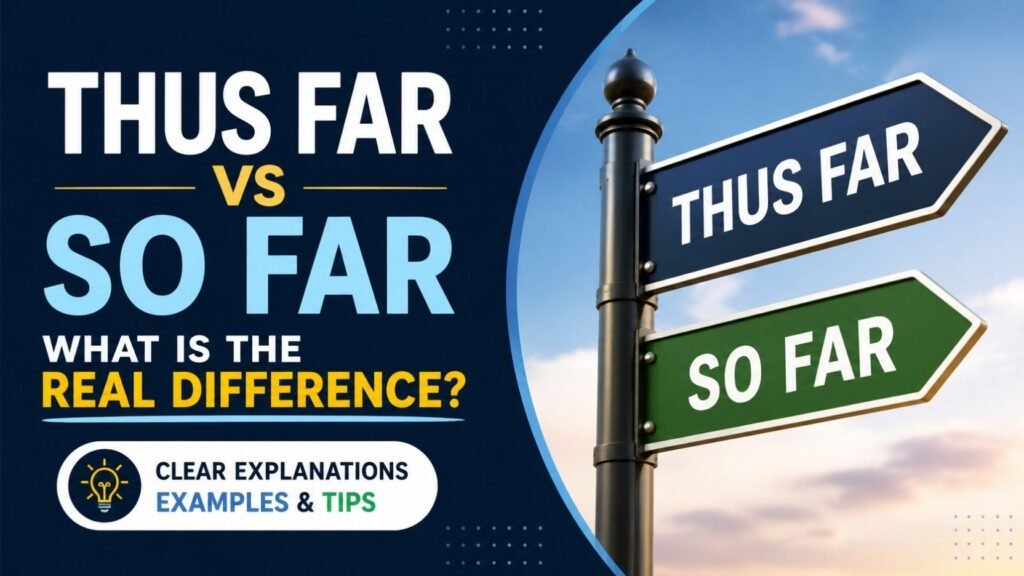
Thus far and so far both mean “up to this point in time,” and in most everyday sentences, you can swap one for the other without changing the meaning. The real difference is tone and formality, not meaning. So far is the natural choice in conversation, texting, and casual writing. Thus far belongs in formal writing, official reports, and situations where you want a more serious or polished voice.
This distinction matters more than people realize, especially in workplace emails, academic papers, and public speaking. Choosing the wrong tone can make a casual message sound stiff, or make a formal report sound too relaxed. Understanding when each phrase fits naturally will make your writing sound more confident and appropriate for the situation. The good news is that once you understand the tone difference, the choice becomes easy.
Thus Far vs So Far: Quick Answer
Both phrases describe progress or a situation that continues up to the present moment. Neither one refers to distance, despite how “far” might sound. The core meaning is: everything that has happened, or been true, until now.
| Phrase | Tone | Best Used In |
| So far | Casual, everyday | Conversation, texting, blogs, emails to friends or colleagues |
| Thus far | Formal, elevated | Reports, academic writing, legal documents, speeches |
Here is the simplest way to remember it: if you would say “thus” instead of “so” anywhere else in your writing, use thus far. If your writing sounds relaxed and conversational, so far will always feel more natural.
What Does Thus Far Mean?
Thus far means “up until now” or “up to this point.” It is used to describe a situation, process, or result that has been true from the start of something until the present moment.
For example:
- Thus far, the project has stayed on schedule.
- The evidence presented thus far supports the original theory.
- Thus far, no errors have been found in the report.
Notice that thus far usually appears in writing that already sounds formal. It fits naturally in business updates, scientific papers, legal writing, and news reporting because it carries a slightly more serious, measured tone than its everyday counterpart.
What Does So Far Mean?
So far carries the exact same core meaning as thus far: “up to now.” The difference is that it sounds natural in everyday speech and casual writing.
For example:
- So far, everything looks good.
- We haven’t heard back from them so far.
- So far so good.
So far is the version most native English speakers reach for automatically, whether they are talking, texting, or writing a quick note. It requires no special context to sound correct, which is exactly why it dominates in spoken English.
Thus Far vs So Far: Side-by-Side Comparison
| Feature | Thus Far | So Far |
| Meaning | Up to this point in time | Up to this point in time |
| Formality | Formal, elevated | Neutral to casual |
| Common settings | Reports, essays, speeches, legal writing | Conversation, texts, emails, blogs |
| Frequency in everyday speech | Rare | Very common |
| Sounds natural in casual chat? | Not really | Yes |
| Sounds natural in academic or business writing? | Yes | Sometimes, depending on tone |
Both phrases are grammatically correct in nearly every context. The real decision comes down to the voice you want your sentence to have.
Are Thus Far and So Far Interchangeable?
In terms of meaning, yes. In terms of tone, not always.
You can technically use either phrase in almost any sentence and be understood correctly. However, swapping them can shift how the sentence feels to the reader.
Compare these two sentences:
- So far, the team has finished three of the five tasks.
- Thus far, the team has finished three of the five tasks.
Both are correct. The first sounds like a quick spoken update. The second sounds like a line from a formal status report. Neither is wrong, but each fits a different kind of writing.
💡 Tip: When you are unsure which one to use, imagine reading your sentence out loud to a friend. If thus far feels stiff in that moment, so far is probably the better fit.
Why Thus Far Sounds More Formal
The word “thus” itself is a formal word. It usually means “in this way” or “as a result,” and it shows up mostly in academic, legal, and professional English. Because thus already carries a formal tone on its own, any phrase built around it, including thus far, inherits that same elevated feel.
So, when you use thus far, you are not just describing time. You are also signaling a certain level of formality to your reader, even if you do not intend to.
Why So Far Feels More Natural in Everyday English
So is one of the most common, flexible words in English. It appears constantly in casual speech: so good, so far, so what, and so on. Because so is such an ordinary word, so far blends easily into relaxed conversation without drawing attention to itself.
This is why so far dominates in text messages, casual emails, social media captions, and daily conversation. It simply matches how people naturally speak.
Grammar of Thus Far And So Far
Both thus far and so far function as adverbial phrases of time. They describe when something has happened, specifically, from an earlier point up until now.
- Part of speech: Adverb phrase
- Function: Modifies a verb, usually indicating an ongoing or unfinished action or situation
- Typical position in a sentence: Beginning, middle, or end
Here is how the position can shift the emphasis slightly, using so far as the example:
- So far, we have made good progress. (Sets the stage at the start)
- We have, so far, made good progress. (Mid-sentence, slightly more formal placement)
- We have made good progress so far. (Most common, neutral placement)
The same flexibility applies to thus far.
Tense Usage
Both phrases are most often used with the present perfect tense, because they describe something that started in the past and continues to be relevant now.
- Correct: So far, she has completed two chapters.
- Correct: Thus far, the results have remained consistent.
- Incorrect: So far, she completed two chapters. (mixing past simple tense with “so far” is not standard usage)
This present perfect connection is one of the most important grammar patterns to remember with both phrases.
Thus Far In A Sentence: Examples
- Thus far, the company has met every deadline.
- The findings thus far suggest a strong link between the two variables.
- Sales figures thus far have exceeded expectations for the quarter.
- Thus far, there has been no official response from the agency.
So Far In A Sentence: Examples
- So far, we have not run into any major problems.
- The weather has been great so far this summer.
- I’ve read three books so far this year.
- So far, nobody has complained about the new schedule.
Thus Far Vs This Far
These two phrases look similar but mean different things, and mixing them up is a common mistake.
Thus far refers to time. It means “up until now.”
This far refers to distance or progress in a more physical or figurative sense. It often appears in expressions about reaching a certain point, especially with effort or struggle involved.
- We have never come this far before. (progress or distance)
- Thus far, we have never faced this issue. (time)
A helpful way to separate them: if you could replace the phrase with “up to now,” use thus far. If you could replace it with “to this point” in a spatial or effort-based sense, this far usually fits better.
⚠️ Common mistake: Writing “this far” when you actually mean “up until now” in time. This mix-up is easy to make because both phrases sound similar and both involve the idea of reaching a point.
Thus Far Vs By Far
These phrases are unrelated in meaning, even though they share the word “far.”
Thus far means “up to now.”
By far means “by a large margin” or “clearly,” used to emphasize a comparison.
- Thus far, no one has broken the record. (time)
- She is by far the best candidate. (comparison, not time)
They are not interchangeable, and confusing them usually creates a sentence that does not make sense.
Common Mistakes With Thus Far and So Far
❌ Incorrect: So far, she went to three countries this year.
✅ Correct: So far, she has gone to three countries this year.
Why: So far and thus far typically pair with present perfect tense (“has gone”), not simple past (“went”), because the action is treated as ongoing or relevant to the present.
❌ Incorrect: Thus far so good.
✅ Correct: So far so good.
Why: “So far so good” is a fixed, well-known expression. Thus far does not fit naturally into this specific phrase because it is an established idiom, not a flexible grammar pattern.
❌ Incorrect: We have never traveled thus far.
✅ Correct: We have never traveled this far.
Why: This sentence is about physical distance, not time, so this far is the correct choice.
Origin Of Thus Far And So Far
The word “thus” comes from Old English “þus,” meaning “in this way.” It has been part of English for centuries and has always carried a slightly formal, literary tone, especially as everyday English shifted toward simpler, more casual vocabulary over time.
“So,” on the other hand, is one of the oldest and most frequently used words in English, tracing back to Old English “swā.” Because “so” has always been a flexible, everyday word, phrases built around it, like so far, naturally settled into casual, spoken English.
Over time, thus became associated with formal writing, while so remained the word of everyday speech. This history explains exactly why thus far and so far split into two different tones, even though their core meaning never changed.
Pronunciation
Thus far Pronounced: thuhs far The “th” sound is soft and voiced, similar to the “th” in “this” or “that.”
So far Pronounced: soh far The “so” sounds exactly like the everyday word “so,” as in “so good” or “so what.”
Neither phrase has an unusual or difficult pronunciation. Both are straightforward once you know the correct stress, which typically falls slightly on “far” in both phrases.
Thus Far vs So Far: Which One Should You Use?
Ask yourself these three questions before choosing:
- Is this formal writing, such as a report, academic paper, or legal document? If yes, thus far usually fits better.
- Is this a conversation, text message, or casual email? If yes, so far is almost always the natural choice.
- Am I unsure? When in doubt, so far is the safer, more universally natural option, since it works well in both semi-formal and casual writing.
✅ Use thus far when you want your writing to sound polished, professional, or academic.
✅ Use so far when you want your writing to sound natural, friendly, or conversational.
Synonyms and Related Phrases
| Phrase | Meaning | Typical Tone |
| Up to now | Same core meaning as thus far and so far | Neutral |
| Until now | Same core meaning, slightly more formal than so far | Neutral to formal |
| As of yet | Often used in negative statements | Neutral to formal |
| To date | Common in business and reports | Formal |
| So far as | Different meaning, related to extent or degree, not always time | Varies |
These phrases are useful alternatives when you want variety in your writing, especially if you are repeating “so far” or “thus far” too often within the same piece of writing.
Thus Far the Lord Has Helped Us
This phrase carries specific religious significance. It comes from a well-known biblical reference (1 Samuel), where the phrase is used to mark a moment of gratitude for guidance and support received up to that point. Because of this origin, “thus far the Lord has helped us” is still used today in religious speech, sermons, and hymns to express thankfulness for help received so far in a spiritual or life journey.
This is a good example of how thus far, despite being less common in casual English, remains firmly established in specific formal and traditional contexts, including religious and ceremonial language.
Frequently Asked Questions
What does thus far mean?
Thus far means “up to this point in time.” It describes something that has been true or has happened from an earlier point until now.
Is thus far the same as so far?
Yes, in meaning. Both phrases mean “up until now.” The difference is tone: thus far is more formal, while so far is more casual and common in everyday speech.
How do you use thus far in a sentence?
Place it at the beginning, middle, or end of a sentence, usually with present perfect tense. Example: Thus far, the results have been consistent.
Is thus far grammatically correct?
Yes. Thus far is a standard, grammatically correct adverbial phrase used in formal English writing and speech.
What is the difference between thus far and this far?
Thus far refers to time, meaning “up until now.” This far refers to distance or progress, often used in a physical or figurative sense, such as reaching a certain point after effort.
Can I use so far in formal writing?
Yes, so far can appear in semi-formal writing, though thus far often sounds more polished in highly formal contexts like academic papers or legal documents.
Is thus far a noun, verb, or adverb?
Thus far functions as an adverbial phrase. It modifies a verb by describing a period of time up to the present.
Why do people use thus far instead of so far?
Writers often choose thus far to create a more formal, serious, or professional tone, especially in reports, essays, and official communication.
Does thus far always need present perfect tense?
Not always, but it is the most natural and common pairing, since thus far usually describes an ongoing or unfinished situation connected to the present moment.
What is a simple synonym for thus far?
“Up to now” and “until now” are simple, natural alternatives that carry a similar meaning.
Final Thoughts
Thus far and so far share the exact same core meaning: everything that has happened or been true up to this present moment. The real difference between them is not grammar or accuracy, but tone. Thus far carries a formal, polished feel suited to reports, academic writing, and professional communication, while so far fits naturally into everyday conversation, casual writing, and relaxed communication.
Once you understand this distinction, choosing between them becomes simple. Think about your audience and the tone you want to set, then let that guide your choice. Whether you write “thus far” in a formal report or “so far” in a quick text message, you can now use both phrases correctly and confidently in any situation.

Abdul Rehman Jutt is the author behind Grammar Wordz, with 4 years of experience researching and writing about English grammar, words, meanings, and language rules. Their goal is to make grammar simple, clear, and easy to understand through accurate and useful explanations.