
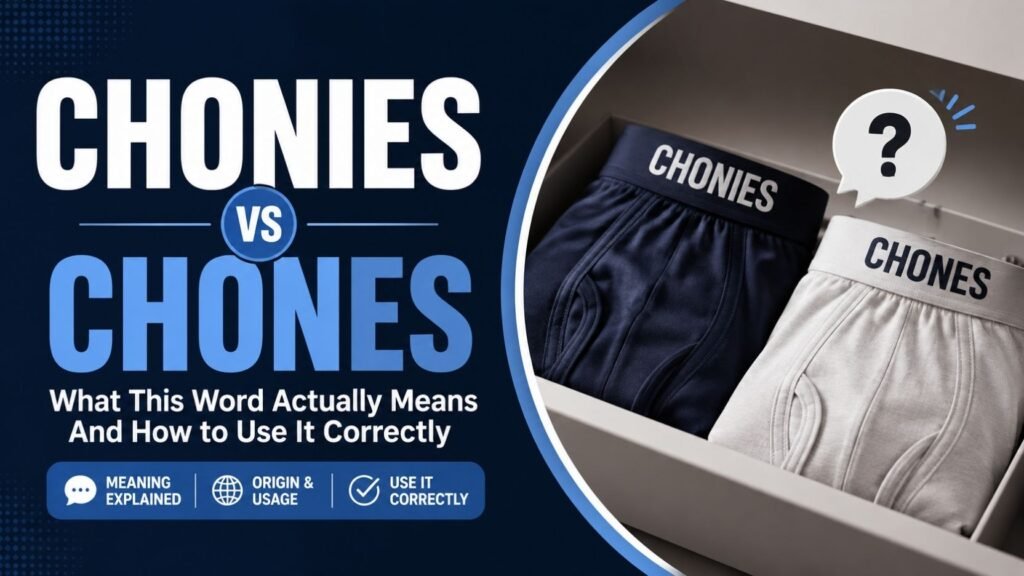
Chonies and chones both mean the same thing: underwear. They come from the same root, and most English and Spanish speakers use them interchangeably depending on region, family, and personal habit. Neither spelling is officially wrong, since this is informal slang rather than a word with one fixed dictionary form.
Understanding the difference matters more than it seems, especially if you grew up hearing one spelling and never questioned it. This guide breaks down the meaning, grammar, pronunciation, and origin of both words, so you can use them with confidence and explain them clearly to anyone who asks.
What Does Chonies Mean?
Chonies is an informal English word for underwear. People use it for underpants, panties, briefs, or boxers, and it works for men’s and women’s underwear alike.
The word is casual and often affectionate. Parents use it with young kids. Friends use it as a joke. It rarely shows up in formal writing, and that is by design, since it belongs to everyday spoken language rather than professional or academic English.
A few quick facts about chonies:
- It functions as a plural noun, similar to “pants” or “shorts.”
- It is common in the southwestern United States and in Mexican American communities.
- It can refer to any type of underwear, not just one style.
- It is used mostly in casual conversation, not written documents.
What Does Chones Mean?
Chones is the Mexican Spanish slang word that chonies came from. It also means underwear, and it is the spelling you are more likely to encounter in Spanish sentences or among Spanish speakers.
Word researchers who track Mexican Spanish slang note that chones likely developed as a shortened, informal version of calzones, the standard Spanish word for underwear or shorts. Over time, calzones was clipped and reshaped in casual speech until chones became its own recognized slang term.
Chonies or Chones: Is There a Real Difference?
Not really. Both words describe the same item of clothing, and the difference comes down to spelling and language rather than meaning.
Here is a simple way to think about it:
| Word | Language | Typical Setting |
| Chones | Mexican Spanish slang | Spanish sentences, Spanish speaking households |
| Chonies | English, borrowed from Spanish | English sentences, especially in the southwestern United States |
Many bilingual families use both words without thinking twice, switching between them the same way they switch between Spanish and English mid conversation. If you have ever heard someone say “put your chones on” in one breath and “where are my chonies” in the next, that is exactly why. The spelling shifts with the language being spoken, not with the meaning of the word.
Chonies Definition At A Glance
For a fast answer, here is the short version.
Chonies (noun, plural, informal): Underwear, including underpants, panties, briefs, or boxers. Used mainly in casual American English, especially in communities influenced by Mexican Spanish.
Chones (noun, plural, informal Mexican Spanish): Underwear. The Spanish slang source of the English word chonies.
Neither word appears in most standard dictionaries, since slang terms like this are recorded more often in linguistic slang references than in formal dictionaries. That does not make the words less real. It simply means they belong to spoken and online language rather than textbook Spanish or textbook English.
Chonies Grammar: Part of Speech and Plural Form
Chonies is a plural noun. It does not have a singular form in everyday use, much like “pants,” “shorts,” or “scissors.” You would not say “one chony.” Instead, people describe a single pair the same way they would with pants: “a pair of chonies.”
A few grammar notes worth remembering:
- Chonies always takes a plural verb: “My chonies are in the wash,” not “my chonies is in the wash.”
- It is used as a mass or collective noun for the item as a whole, not for individual pieces of fabric.
- In Spanish, chones follows the same pattern. It is treated as plural, matching calzones.
Chonies or Chonies: Common Spelling Question
Some people search for “chonies or chonies,” unsure whether there is a silent variation. There is not. The standard English spelling is chonies, ending in “ies,” which follows the normal English pattern for pluralizing words that end in a “y” sound, the same pattern found in words like “cookies” or “goodies.”
How to Pronounce Chonies and Chones
Pronunciation is where a lot of confusion starts, since the word sounds slightly different depending on the speaker’s accent and language.
Chonies is pronounced “CHOH-neez,” rhyming with “phonies.” The stress falls on the first syllable.
Chones is pronounced closer to the Spanish “CHOH-nes,” with a short, clipped ending rather than the long “eez” sound used in English.
💡 Tip: If you already know how to pronounce “phonies,” you already know how to pronounce “chonies.” Just swap the first sound.
Where Does the Word Chonies Come From?
The origin traces back to Mexican Spanish. Linguists who study slang generally connect chones, and therefore chonies, to calzones, the everyday Spanish word for underwear or breeches.
Spoken Spanish often trims longer words down for convenience, and calzones is believed to have shortened over time into chones through casual, repeated use. English speakers who grew up around Spanish speaking communities, especially in the southwestern United States, picked up chones and adapted the spelling to fit English pluralization habits, which is how chonies came about as the English form.
Word history researchers have also traced older, unrelated appearances of a similar sounding word. An eighteenth century travel account once used a similar term to describe a poncho style garment, but researchers treat that as a separate, coincidental use rather than the true source of today’s slang word for underwear. The real story behind chonies is tied to calzones, not that unrelated historical mention.
Chonies in Spanish: How the Word Is Actually Used
In Spanish, chones is casual and understood almost everywhere Mexican Spanish is spoken. It is not vulgar, but it is not formal either. It sits in the same space as saying “undies” instead of “undergarments” in English.
A few context notes:
- In formal Spanish, the correct words are calzones, calzoncillos, or ropa interior.
- Chones is common in households, especially when talking to children.
- Regional variations exist. Some areas use chonis, choneys, or chonitas, a diminutive form that adds warmth or humor to the word.
Underwear In Spanish: Chonies and Other Common Words
If someone searches for the general Spanish word for underwear, chonies or chones is only one option among several, and it sits firmly on the informal end of the scale.
| Spanish Word | Formality | Typical Use |
| Ropa interior | Formal | General, neutral term for underwear |
| Calzoncillos | Neutral | Common word for men’s underwear |
| Calzones | Neutral to informal | General underwear, root of chones |
| Chones or chonies | Informal slang | Casual, everyday, often used with children |
Chonies in English: Everyday Usage
In English, chonies functions as a fun, informal stand in for “underwear.” It shows up most in spoken conversation, text messages, and casual social posts rather than professional writing.
Typical situations where you might hear it:
- A parent telling a child to put on clean chonies before bed.
- Friends joking about laundry day or a wardrobe mishap.
- Social media captions about comfortable or funny underwear.
- Regional slang used across Arizona, California, Texas, and other areas with strong Mexican American communities.
People sometimes describe learning as adults that chonies was never a made up family word but an actual, widely recognized piece of Mexican Spanish slang that spread into English through daily life in bilingual households and neighborhoods.
Chonies Examples in a Sentence
Seeing the word in real sentences makes the meaning click faster than any definition alone.
- “Grab clean chonies before your shower.”
- “I can’t find my favorite pair of chonies anywhere.”
- “Quita tus chones sucios del suelo” translates to “Pick your dirty underwear up off the floor.”
- “Her chonies were showing under that skirt, so I told her quietly.”
Notice that the word works the same way “underwear” or “undies” would work in a normal sentence. It follows regular grammar rules once you treat it as a plural noun.
Chonies Underwear: Is It a Specific Style?
Chonies underwear is not one specific cut or style. It is a general word, the same way “underwear” covers everything from boxers to thongs. Some people use chonies loosely to include swim trunks or gym shorts, but its core, everyday meaning stays focused on underwear worn beneath clothing.
Killdozer Chonies: A Pop Culture Note
If you searched for “killdozer chonies” and landed here, this section is for you. Killdozer refers to the nickname given to an armored bulldozer involved in a well known 2004 incident in Granby, Colorado. A social media page connected to that story later sold branded underwear, playfully named Killdozer Chonies, using the everyday slang word for underwear as part of the product name.
This is simply a modern example of chonies being used the way it usually is: casual, a little humorous, and instantly understood by anyone familiar with the slang term. It has no separate meaning of its own beyond that branding.
Not the Same: Jim Chones, the Basketball Player
Because “Chones” is also a surname, search engines often mix results for the underwear slang term with information about Jim Chones, a retired American professional basketball player. It’s worth separating the two clearly.
James Bernett Chones, born November 30, 1949, played center and power forward in both the ABA and NBA. He starred at Marquette University before turning professional, and he went on to play for teams including the New York Nets, Cleveland Cavaliers, Los Angeles Lakers, and Washington Bullets. He won an NBA championship with the Lakers in 1980 and later became a longtime radio analyst for the Cleveland Cavaliers.
His son, Kendall Chones, also played college and professional basketball and later became a youth basketball coach in Cleveland. His daughter, Kaayla Chones, played in the WNBA for the Washington Mystics and Seattle Storm after a standout college career at NC State.
None of this is connected to the Spanish slang word for underwear. The shared spelling, Chones, is a coincidence of surname and slang overlapping, nothing more.
Synonyms And Related Words for Chonies
Several other words overlap with chonies in meaning, though each carries a slightly different tone.
| Word | Meaning | Difference from Chonies |
| Undies | Underwear, informal | Neutral English slang, no Spanish origin |
| Panties | Women’s underwear specifically | More specific, gender focused |
| Drawers | Old fashioned term for underwear | Sounds dated compared to chonies |
| Tighty whities | Men’s white briefs | Refers to one specific style only |
| Calzones | Spanish word for underwear or shorts | The formal Spanish root of chones |
Common Mistakes with Chonies and Chones
A few small mix ups come up often enough to address directly.
❌ Incorrect: “One chony fell out of the drawer.”
✅ Correct: “One pair of chonies fell out of the drawer.”
Reason: Chonies has no singular form in casual use, so pair with “a pair of” when talking about one item.
❌ Incorrect: Using chonies in a formal Spanish essay or business document.
✅ Correct: Using ropa interior or calzoncillos in formal Spanish writing, and saving chonies or chones for casual conversation.
Reason: Both words are slang. Neither belongs in formal writing, whether in English or Spanish.
❌ Incorrect: Assuming chonies is offensive or rude.
✅ Correct: Treating chonies as playful, informal slang, similar in tone to “undies.”
Reason: The word is casual, not vulgar, and it is widely used in front of children in many households.
Frequently Asked Questions
What does chonies mean?
Chonies is informal slang for underwear, used mainly in casual American English influenced by Mexican Spanish.
What does chonies mean in Spanish?
In Spanish, the related word is chones, which also means underwear and is common in everyday, informal speech.
Is it chonies or chones?
Both are correct. Chones is the original Mexican Spanish slang term, and chonies is the English adapted spelling.
How do you pronounce chonies?
Say “CHOH-neez,” rhyming with “phonies,” with the stress on the first syllable.
What is chonies in English?
In English, chonies simply means underwear, used the same way people use “undies” in casual conversation.
Is chonies a formal Spanish word?
No. Formal Spanish uses ropa interior or calzoncillos. Chones is informal slang, not a textbook term.
Where did the word chonies come from?
It traces back to the Spanish word calzones, which was shortened and reshaped through everyday speech into chones, later adapted into English as chonies.
Is Jim Chones related to the slang word chonies?
No. Jim Chones is a former NBA player. His surname coincidentally matches the slang word chones, but the two are unrelated.
Can adults use the word chonies?
Yes, though it is more common among children, families, and casual conversation than in professional or formal settings.
Is chonies used outside the United States and Mexico?
It is mostly concentrated in the United States and Mexico, particularly in regions with strong Mexican American communities, and is less common elsewhere.
Final Thoughts
Chonies and chones both mean the same simple thing: underwear. The spelling changes depending on whether the word is being used in English or Spanish, but the meaning, the casual tone, and the friendly, familiar feel of the word stay exactly the same. Neither spelling is more “correct” than the other, since this is everyday slang shaped by bilingual communities rather than a term with one official form.
If you grew up hearing chonies or chones at home, you were speaking a small but genuine piece of Mexican Spanish that traveled into English through daily life. Whether you spell it with an “s” or an “ies,” you are using a word that has been passed down through families, neighborhoods, and generations, and that is exactly why it still feels so familiar today.

Abdul Rehman Jutt is the author behind Grammar Wordz, with 4 years of experience researching and writing about English grammar, words, meanings, and language rules. Their goal is to make grammar simple, clear, and easy to understand through accurate and useful explanations.