
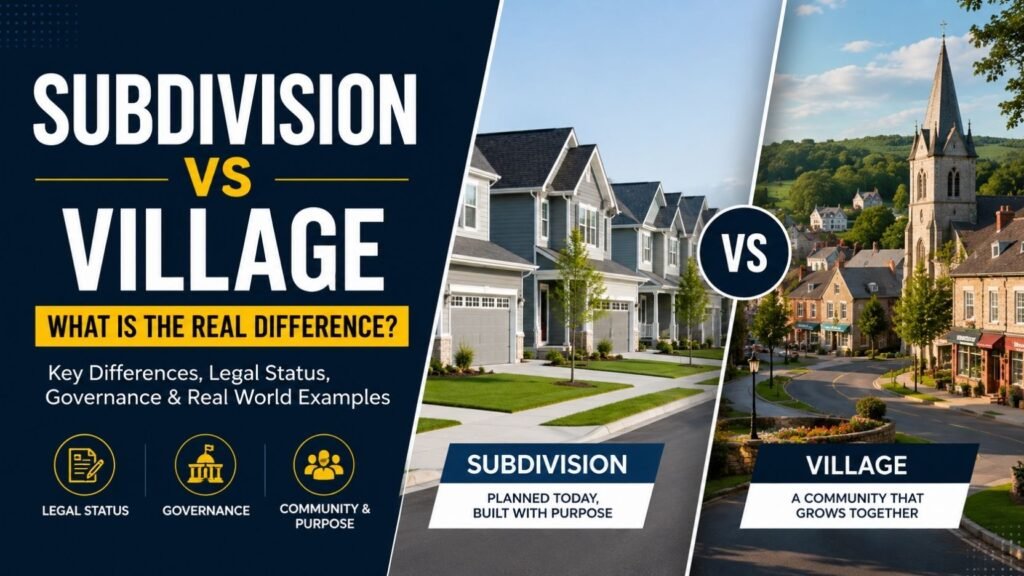
A subdivision is a piece of land that a developer splits into smaller lots for houses, usually built as one planned project. A village is a small settlement or a small unit of local government, often older and more organic in how it grew. The two words look similar in everyday speech, but they come from very different ideas: one is about land development, the other is about community and governance.
This confusion shows up everywhere, from real estate listings to school forms to conversations about where someone lives. Understanding the difference matters because a subdivision and a village can have different legal status, different rules, and different histories. Once you see how each word actually works, the mix-up disappears.
What Does Subdivision Mean?
At its core, subdivision means the act of dividing something larger into smaller parts. In real estate and urban planning, it specifically means dividing a piece of land into smaller lots so homes or buildings can be built on each one.
Simple definition: A subdivision is either the process of splitting land into smaller parcels, or the resulting neighborhood that comes from that process.
The word works in two related ways:
- As a process: “The county approved the subdivision of the farmland into 200 lots.”
- As a place: “We live in a subdivision called Maple Ridge.”
Most people use the second meaning in daily conversation. When someone asks, “What subdivision do you live in?” they mean the name of the planned residential neighborhood, not the legal act of dividing land.
See More: Sprats vs Sardines
Subdivision Meaning In Real Estate
In real estate, a subdivision is a residential development created when a builder or developer buys a large tract of land, gets approval from local government, and splits it into individual lots. Each lot gets its own address, and the development often shares:
- A common name (Green Meadows, Tuscany Village, Maple Ridge)
- Shared entrances or signage
- A homeowners association (HOA) in many cases
- Similar house styles or building rules
Subdivisions are almost always the product of deliberate planning. A developer draws a plot map, files it with local authorities, and builds infrastructure like roads, sewer lines, and sidewalks before homes go up.
What Is a Subdivision? (Legally)
Legally, a subdivision is a defined parcel of land that has gone through a formal subdivision process with a local planning or zoning authority. This process typically requires:
- A survey of the original land
- A plat map showing how the land will be divided
- Government approval based on zoning laws
- Recording of the new lots with the county or municipality
This is why the word subdivision often appears in legal and government documents, not just casual conversation.
What Does Village Mean?
A village is a small community of people living together, usually smaller than a town and larger than a hamlet. In many places, “village” is also an official term for a small unit of local government with its own elected officials.
Simple definition: A village is a small settlement, often with its own identity, history, and sometimes its own local government.
Village has a much older history than subdivision. It has been used for centuries to describe small, self-contained communities where people lived close together, often around farming, trade, or a central gathering place like a church or market square.
Village as a Place
In everyday use, a village usually means:
- A small town or settlement with a limited population
- A community that grew gradually over time, not through one planned project
- A place with a distinct center, such as a main street, square, or historic core
Village as a Legal or Governmental Term
In several countries, including parts of the United States, “village” is also a specific legal classification. A village can be an incorporated municipality with its own government, separate from the surrounding town or county. This is common in states like New York, Illinois, and Ohio, where villages have mayors, boards, and their own local laws.
This dual meaning, community and government unit, is one reason people sometimes confuse a village with a subdivision that happens to be named “village” as a marketing choice.
Subdivision vs Village: The Core Difference
The clearest way to understand subdivision vs village is to compare how each one comes into existence and what it represents.
| Feature | Subdivision | Village |
| How it forms | Created deliberately by a developer dividing land | Often grows gradually as a community |
| Legal status | A platted, recorded piece of land within an existing municipality | Can be its own incorporated municipality |
| Governance | Usually governed by an HOA and the surrounding city or county | May have its own elected government |
| Age | Often modern, built within recent decades | Can be centuries old |
| Purpose of the name | Marketing name for a housing development | Traditional name for a settlement |
| Example | “Green Meadows Subdivision” | “Greenwich Village” |
Subdivision vs Village Difference in Simple Terms
A subdivision is about land and lots. A village is about people and place.
- A subdivision is a real estate product.
- A village is a community, and sometimes a government unit.
A neighborhood can technically be both. A developer might build a subdivision and name it “something village” for a charming feel, even though it has no legal village status. This naming choice is common, and it is one of the biggest sources of confusion.
Subdivision vs Village in the Philippines
In the Philippines, this comparison has a very specific and important meaning, because it connects to how the country structures local government.
In the Philippines, a barangay is the smallest official unit of local government, similar to what English speakers might loosely call a village. A subdivision, on the other hand, is a private, gated or planned residential development that sits inside a barangay.
Here is how the relationship typically works:
- A barangay is a legal and administrative unit, like a small local government area.
- A subdivision is a private housing development located within a barangay.
- A single barangay can contain several subdivisions, along with non-subdivision neighborhoods.
So when Filipino residents search for village or subdivision in SIM registration, or ask which is a political subdivision of the other, they are often trying to figure out what to write on official forms. In most cases, the correct answer depends on the specific address:
- If you live inside a gated development with its own name, that is usually your subdivision.
- Your barangay is the official government unit above that subdivision.
- Many upscale subdivisions in the Philippines use the word “Village” in their name, such as Makati’s well known residential villages, even though they are technically private subdivisions, not separate government villages.
This is why the same property can correctly be described as being in a “village” by name and inside a specific barangay by law. The private development uses “village” as part of its identity, while the barangay is the actual political subdivision recognized by government.
Which Is a Political Subdivision of the Other?
This question causes confusion because of a specific legal term: political subdivision. A political subdivision is any official unit of local government, such as a province, city, municipality, or barangay.
In the Philippine context, a barangay is a political subdivision. A privately developed subdivision, even one branded as a “village,” is not automatically a political subdivision unless the government has formally recognized it as one. This is the core distinction behind that search question.
Subdivision vs Compound: A Related Comparison
People sometimes ask about subdivision vs compound as well, especially in international or expat contexts.
- A subdivision is typically an open or semi-gated development with individual homes on separate lots, often with public or shared roads.
- A compound usually refers to a more enclosed group of homes or buildings, often sharing one boundary wall, one entrance, and tighter security, common in some Middle Eastern and Asian housing markets.
The two overlap in concept, planned residential living, but a compound tends to be smaller, more enclosed, and sometimes shared among fewer families than a full subdivision.
See More: Quantify Vs Qualify
Subdivision vs Suburb
Another common point of confusion is subdivision vs suburb.
- A suburb is a broader term for a residential area outside a city center, often made up of many subdivisions, streets, and neighborhoods.
- A subdivision is one specific, defined development inside a suburb.
Think of it this way: a suburb is the wider region, and a subdivision is one planned neighborhood within it. You can live in a suburb without living in a named subdivision, especially in older suburban areas that grew organically rather than through a single development project.
Grammar: Part of Speech and Word Forms
Both subdivision and village are common nouns.
| Word | Part of Speech | Plural Form |
| Subdivision | Noun | Subdivisions |
| Village | Noun | Villages |
Subdivision can also function as part of a compound noun phrase, such as “subdivision plan,” “subdivision approval,” or “subdivision map.” In these cases, subdivision acts almost like an adjective, describing the noun that follows.
Village can also form compound nouns, such as “village council,” “village green,” or “village square.”
Neither word has an irregular plural. Both simply add “s” to form the plural, following standard English noun rules.
How to Pronounce Subdivision And Village
Pronunciation is straightforward for both words, but here is a simple breakdown.
Subdivision
- Pronunciation: sub-duh-VIZH-un
- Stress falls on the third syllable
- IPA: /ˌsʌb.dɪˈvɪʒ.ən/
Village
- Pronunciation: VIL-ij
- Stress falls on the first syllable
- IPA: /ˈvɪl.ɪdʒ/
Both words follow standard American English pronunciation patterns, and there is no significant difference between American and British pronunciation for either term.
Origin of the Words
Origin of Subdivision
Subdivision comes from the prefix “sub-,” meaning under or below, combined with “division,” from the Latin word dividere, meaning to divide or separate. Together, the word originally meant a division within a larger division, a smaller part of something already divided.
Over time, English speakers applied this general meaning specifically to land, since dividing land into smaller parcels is a very literal example of a “division within a division.”
Origin of Village
Village comes from the Old French “vilage,” which itself traces back to the Latin word “villa,” meaning a country house or farmstead. Villa originally described a single rural estate. Over centuries, as communities formed around these estates and farming settlements, the word evolved to describe the whole cluster of homes and people, not just one house.
This is why village carries a sense of community and history that subdivision does not. The word grew out of real, lived-in settlements, while subdivision grew out of legal and land-related language.
Subdivision Vs Village In NCAA Football
There is a completely different meaning of subdivision that appears often in searches: NCAA football classifications.
The NCAA divides Division I football into two subdivisions:
- NCAA Division I Football Bowl Subdivision (FBS): The top level of college football, home to major conferences and bowl games.
- NCAA Division I Football Championship Subdivision (FCS): A separate tier that uses a playoff format to determine its national champion.
Here, subdivision simply means a smaller classification within the larger Division I category. This use of the word matches its grammar meaning exactly, a division within a division, but it has nothing to do with land, housing, or villages. It’s a helpful reminder that subdivision is a flexible word used across very different fields.
Common Mistakes When Comparing Subdivision and Village
❌ Incorrect: Assuming every neighborhood with “Village” in its name is an official village government.
✅ Correct: Many neighborhoods use “Village” only as a marketing name for a subdivision. Check local government records to confirm actual legal status.
❌ Incorrect: Using subdivision and barangay as if they mean exactly the same thing in the Philippines.
✅ Correct: A barangay is a political subdivision recognized by government. A private housing subdivision sits inside a barangay but is not the same as it.
❌ Incorrect: Treating “political subdivision” as a totally different word from the everyday “subdivision.”
✅ Correct: Political subdivision is a specific legal term for any government unit, such as a state, county, or barangay. It uses the same root meaning, a smaller part within a larger whole, applied to government structure instead of land.
See More: Tuille Vs Tuile
Similar and Related Words
| Word | Meaning | How It Differs From Subdivision or Village |
| Suburb | A residential area outside a city center | Broader than a subdivision; can contain many subdivisions |
| Compound | An enclosed group of homes sharing one boundary | Usually smaller and more enclosed than a subdivision |
| Barangay | The smallest political subdivision in the Philippines | A government unit, not a private housing development |
| Hamlet | A very small settlement, smaller than a village | Smaller and less formal than a village |
| Municipality | An official urban or local government area | A broader legal category that can include villages, towns, or cities |
Frequently Asked Questions
What is the main difference between a subdivision and a village?
A subdivision is a planned residential development created by dividing land into lots. A village is a small community or, in many places, an official local government unit.
Is a subdivision the same as a village in the Philippines?
Not exactly. A barangay is the official political subdivision. A privately developed subdivision, even one branded as a “village,” sits within a barangay but is not automatically the same as it.
Is subdivision a noun or a verb?
Subdivision is a noun. The related verb form is “subdivide.”
How do you pronounce subdivision?
It is pronounced sub-duh-VIZH-un, with stress on the third syllable.
What does NCAA Football Bowl Subdivision mean?
It refers to the top tier of NCAA Division I college football, separate from the Football Championship Subdivision, which uses a playoff format instead of bowl games.
Which is bigger, a subdivision or a village?
This depends on context. In housing terms, a subdivision is usually one defined development, while a village, especially as a government unit, can include multiple subdivisions and other neighborhoods within its boundaries.
Is it correct to say “which is a political subdivision of the other”?
This phrasing usually appears in questions comparing government units, such as a barangay compared to a city or province. A political subdivision is any officially recognized unit of local government, and the specific answer depends on the exact places being compared.
What is the difference between subdivision and compound?
A subdivision is typically an open or semi-gated area with individual home lots and shared public infrastructure. A compound is usually smaller and more enclosed, often with one shared wall and entrance for all residents.
Can a subdivision become an official village?
In some legal systems, yes. Communities can petition for incorporation as an official village, gaining their own local government, though the requirements vary by country and region.
Final Takeaway
Subdivision and village describe two different ideas that often overlap in everyday language. A subdivision is a planned, developer created neighborhood built by dividing land into individual lots. A village is a small community, and in many places, an official unit of local government with its own identity and history.
The confusion between subdivision vs village usually comes from marketing, developers naming their subdivisions “villages” to sound charming and established, or from legal systems, like the Philippines, where a private subdivision exists inside a much older, government-recognized barangay. Once you separate the real estate meaning from the community and government meaning, the difference becomes easy to remember: a subdivision is about land, and a village is about people and place.

Abdul Rehman Jutt is the author behind Grammar Wordz, with 4 years of experience researching and writing about English grammar, words, meanings, and language rules. Their goal is to make grammar simple, clear, and easy to understand through accurate and useful explanations.