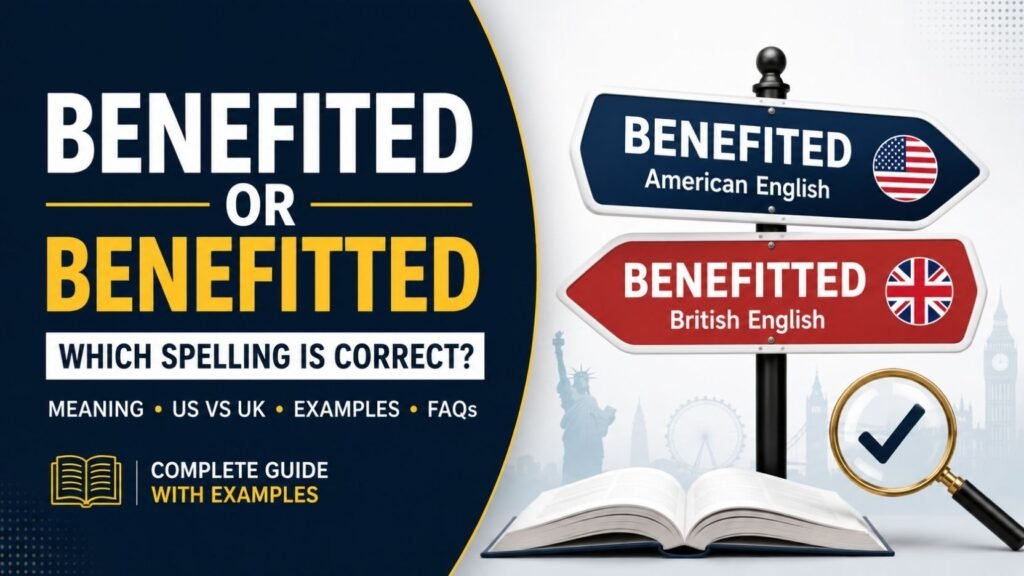
Benefited or benefitted, which one should you write? Both spellings are correct, and both appear in real published writing every day. The difference comes down to region, not accuracy. Benefited is the standard form in American English, while benefitted is common in British English and several other varieties.
This distinction matters more than it looks. Using the wrong spelling for your audience will not confuse anyone, but it can make your writing feel slightly out of place. A US reader expects benefited. A UK reader is used to seeing benefitted just as often. Once you know which one your audience expects, the choice becomes automatic.
Benefited or Benefitted: The Quick Answer
Here is the short version before the full explanation.
- Benefited (one t) is the preferred spelling in American English, and it is also accepted almost everywhere else.
- Benefitted (two t’s) is common in British English, along with other spellings such as Australian and Canadian English, though benefited also appears often in those varieties.
- Both spellings are listed in major dictionaries, and neither one is a typo.
- The same pattern applies to the present participle: benefiting versus benefitting.
- Most professional style guides used in the United States, including AP style, choose benefited.
If you only needed the answer, that covers it. The rest of this article explains why two spellings exist, how each major dictionary and region treats the word, and how to avoid mixing the two forms in the same piece of writing.
See More: Complains Or Complaints
What Does Benefited or Benefitted Mean?
Benefited and benefitted are both past tense forms of the verb benefit. To benefit means to receive an advantage, gain something useful, or be helped by a situation, action, or event.
When you say someone benefited or benefitted from something, you mean they gained a positive result from it. The meaning does not change based on spelling. Only the number of t’s changes.
Example:
- The students benefited from the extra tutoring sessions.
- The students benefitted from the extra tutoring sessions.
Both sentences mean exactly the same thing. A reader in New York and a reader in London would understand each version identically, even though each might expect a slightly different spelling from their own newspapers and textbooks.
Benefit can also work as a transitive verb, meaning something benefits someone else, not just the subject gaining something.
Example:
- The new policy benefited thousands of small business owners.
- The charity event benefitted local families who lost their homes in the flood.
In the first sentence, the policy is the cause, and the business owners are the ones who gained something. In the second, the event is the cause, and the families are the ones helped.
Benefited or Benefitted: Part of Speech and Verb Forms
Benefit is a regular verb, which means its forms usually follow a predictable pattern. Here is how the full verb works.
| Form | Spelling | Example |
| Base form | benefit | The plan will benefit everyone. |
| Present tense (he, she, it) | benefits | This diet benefits people with high blood pressure. |
| Past tense | benefited or benefitted | She benefited greatly from the mentorship program. |
| Present participle | benefiting or benefitting | Millions are benefiting from the new vaccine. |
| Past participle | benefited or benefitted | The team has benefited from strong leadership. |
Notice that the past tense and the past participle use the exact same spelling in English. There is no separate form for “has benefited” versus “she benefited.” Both use the same word.
The noun form of the word is benefit, which does not change with region. Only the verb forms create the spelling question, because adding -ed or -ing is where the doubling decision comes in.
Why Are There Two Correct Spellings?
This is the part most articles skip, but it explains everything. The confusion between benefited or benefitted comes from a real spelling rule in English, not from random inconsistency.
In English, when you add -ed or -ing to a short verb that ends in a single consonant after a single vowel, you often double that final consonant. This is why:
- Stop becomes stopped, not stoped.
- Plan becomes planned, not planed.
- Fit becomes fitted, not fited.
The rule traditionally applies most reliably to one syllable words. For longer words, English grammar adds another condition: the doubling usually only happens if the stress falls on the final syllable.
Benefit has three syllables: ben-e-fit. The stress falls on the first syllable, BEN-e-fit, not on the final syllable. Because the stress does not land on the last syllable, standard doubling rules say the final t should not be doubled. That gives you benefited.
British English, however, has historically been more flexible with this rule. British spelling conventions often double the final consonant in longer verbs regardless of where the stress falls, especially with words ending in l or t. This is the same pattern that gives British English words like travelled and cancelled, where American English prefers traveled and canceled.
So benefitted is not a mistake. It follows a slightly different, older, and still valid British spelling convention. Benefited follows the stricter modern rule based on syllable stress, which is the pattern most American dictionaries and style guides settled on.
Benefited or Benefitted in American English
In American English, benefited is the standard and by far the more common spelling. If you are writing for a US audience, whether that is a business email, a school essay, a news article, or a blog post, benefited is the safer and more expected choice.
This preference is connected to a broader pattern in American spelling. Noah Webster, the lexicographer behind the first major American dictionary, pushed for simplified spelling in the early nineteenth century. His influence helped separate American spelling from British spelling in many places, favoring shorter, more phonetic forms.
Other examples of this same American simplification pattern include:
- Traveled instead of travelled
- Canceled instead of cancelled
- Modeled instead of modelled
Benefited fits the same pattern. American dictionaries, including Merriam-Webster, list benefited as the primary spelling, with benefitted noted as a valid but less common variant.
In practice: if you search American newspapers, academic journals, and government documents, benefited appears far more often than benefitted. For US-based content, benefited is the recommended default.
Benefited or Benefitted in UK English
British English is more relaxed about this word than many guides suggest. Both benefited and benefitted appear in UK writing, and the double t version is widely accepted and commonly used in newspapers, books, and everyday communication.
The Oxford English Dictionary and other British reference sources list both benefited and benefitted as correct. Neither is flagged as incorrect. Many British style guides simply ask writers to pick one spelling and stay consistent throughout a single document.
That said, benefitted does tend to feel more natural to a British reader, in the same way that colour and favourite feel more natural than color and favorite. If you are writing specifically for a UK audience and want the text to feel regionally authentic, benefitted is a reasonable choice. Benefited will not look wrong to a British reader either, since it is a widely recognized alternative.
Benefited or Benefitted in Australia
Australian English generally follows British spelling conventions more closely than American ones, which shows up in words like colour, organise, and centre.
For benefited or benefitted, both spellings appear in Australian writing. Major Australian dictionaries, including the Macquarie Dictionary, list both forms. In practice, many Australian style guides and publications lean toward benefited as the more modern, widely used form, while benefitted still appears regularly, particularly in older or more traditional writing.
If you are writing for an Australian audience and are not sure which to choose, benefited is a safe, professional default, and benefitted will not read as wrong if it appears in a British-influenced document.
Benefited or Benefitted in Canada
Canadian English sits between American and British conventions, and this word is a good example of that mix. Canadian dictionaries and style guides accept both benefited and benefitted.
In everyday Canadian writing, benefited is common, especially in business, government, and digital content that follows North American conventions. Benefitted also appears, particularly in more formal or British-influenced writing.
Because Canadian English does not enforce one strict rule here, the best approach is the same one that applies everywhere: pick one spelling and use it consistently within the same document.
What Do Major Dictionaries Say?
Dictionaries are the most reliable place to settle a spelling question, so here is what the main ones say about benefited or benefitted.
Merriam-Webster, the leading American dictionary, lists benefited as the standard spelling. Benefitted appears as a recognized variant, meaning it is not incorrect, but it is not the primary entry.
Oxford English Dictionary and other British dictionaries list both benefited and benefitted without marking either one as more correct, reflecting the flexibility of British usage.
Cambridge Dictionary similarly lists both spellings, noting the American versus British pattern.
The consistent theme across every major dictionary is the same: neither spelling is wrong. The difference is regional preference, not correctness.
Is Benefited or Benefitted Correct? A Simple Table
| Question | Answer |
| Is benefited correct? | Yes, in every major English-speaking region. |
| Is benefitted correct? | Yes, especially in British, Australian, and some Canadian writing. |
| Which is correct in American English? | Benefited |
| Which is correct in British English? | Both, though benefitted feels more traditional |
| Which does AP style use? | Benefited |
| Which does Merriam-Webster list first? | Benefited |
| Can I use either one in casual writing? | Yes, but stay consistent |
Benefited or Benefitted: AP Style
For anyone writing news content, marketing copy, or professional US-facing material, AP style is a useful reference point, since it is the standard many American publications and companies follow.
AP style guidance is clear: use benefited and benefiting, not benefitted and benefitting. This puts AP style firmly in line with the broader American English preference for the single t spelling.
If your writing needs to follow AP style, or if you simply want to match the convention used by most American newsrooms, businesses, and content platforms, benefited is the correct choice, along with benefiting for the present participle form.
How to Pronounce Benefited or Benefitted
The pronunciation does not change based on spelling. Both benefited and benefitted are pronounced the same way.
Pronunciation: BEN-uh-fit-id
Break it down like this:
- BEN as in the name Ben
- uh as a soft, quick vowel sound
- fit as in the word fit
- id as a light ending sound, similar to the end of the word rabbit
The stress falls on the very first syllable, BEN, and the rest of the word is spoken more quickly and softly. This is true whether you are reading benefited or benefitted on the page. Since spelling does not affect sound here, you never need to worry about mispronouncing one version versus the other.
Origin and Etymology of Benefit
Understanding where the word benefit comes from helps explain why the spelling debate exists in the first place.
Benefit traces back to the Latin word beneficium, which meant a favor, a kindness, or a good deed. This Latin root itself combines bene, meaning well or good, with facere, meaning to do or to make. Put together, the original sense was something close to a good deed done for someone.
The word passed into English through Old French, where it appeared in a form closer to benefit, carrying a similar meaning of a favorable or advantageous act. By the time it settled into Middle English, benefit was already used as a noun describing something helpful or advantageous.
Later, English speakers began using benefit as a verb as well, following a common pattern where nouns naturally shift into verb use over time. Once benefit became a verb, writers needed a past tense form, which is where the doubling question first came into play, centuries before American and British spelling split into separate conventions.
See More: Bachelor Vs Bachelorette
Examples of Benefited and Benefitted in Real Sentences
Seeing the word in different contexts makes the meaning and usage clearer than definitions alone.
Everyday examples:
- She benefited from getting extra sleep before the exam.
- The garden benefitted from the heavy rain last week.
- His credit score benefited after he paid off his old debt.
Business and workplace examples:
- The company benefited from the merger within its first year.
- Employees benefitted from the new health insurance plan.
- Small businesses in the area benefited from the tax break.
Academic and formal examples:
- The study concluded that patients benefited from the new treatment.
- Researchers found that students benefitted more from active learning than passive lectures.
- The community has long benefited from access to the public library.
Each of these sentences works correctly with either spelling, depending on which regional convention the writer follows. Swapping benefited for benefitted, or the reverse, does not change the meaning of any sentence above.
Benefiting or Benefitting: The Present Participle Version
Since benefit is a full verb, the same one t versus two t spelling question applies to its -ing form.
- Benefiting is standard in American English and matches the benefited pattern.
- Benefitting is more common in British English and matches the benefitted pattern.
Example:
- Thousands of families are benefiting from the new food assistance program.
- Thousands of families are benefitting from the new food assistance program.
The same rule of consistency applies here. If you chose benefited earlier in your writing, use benefiting later on. If you chose benefitted, stick with benefitting. Mixing the one t past tense with the double t present participle, or the other way around, is the kind of inconsistency that makes writing look careless, even though neither spelling is technically wrong on its own.
Common Mistakes With Benefited or Benefitted
Most mistakes with this word are not about choosing the wrong spelling. They are about inconsistency or confusion with related forms.
Mistake 1: Mixing spellings in the same document
❌ Incorrect: The team benefited from new equipment, and staff are now benefitting from shorter shifts.
✅ Correct: The team benefited from new equipment, and staff are now benefiting from shorter shifts.
Pick one spelling convention and use it throughout the entire piece of writing.
Mistake 2: Confusing benefit as a noun with benefited as a verb
❌ Incorrect: She received many benefited from the program.
✅ Correct: She received many benefits from the program.
Benefits, with an s, is the noun form. Benefited is only correct as a verb, describing an action that already happened.
Mistake 3: Treating benefitted as automatically wrong
❌ Incorrect assumption: Benefitted is a misspelling.
✅ Correct understanding: Benefitted is a recognized, correct spelling, especially outside the United States.
Mistake 4: Using benefitted in AP style content
If your writing needs to follow AP style, benefitted is inconsistent with that guide, even though it is not wrong in general English. Use benefited instead to match AP conventions.
Synonyms Related to Benefited or Benefitted
Depending on the context, several words can work in place of benefited or benefitted. Choosing the right synonym depends on tone and precision, not just meaning.
| Synonym | Meaning | Best Used When |
| Gained | Received something valuable | Talking about a specific, measurable advantage |
| Profited | Gained financially or otherwise | Business or financial contexts |
| Helped | Received assistance | Everyday, informal writing |
| Advanced | Moved forward or improved | Describing progress over time |
| Improved | Became better | Focusing on quality or condition |
Example replacements:
- The company benefited from the new contract. → The company profited from the new contract.
- Students benefited from the workshop. → Students gained from the workshop.
These synonyms are not always interchangeable, so choose based on what fits the sentence naturally, rather than swapping words purely for variety.
Benefited or Benefitted: Which Should You Use?
If you want one simple rule to follow going forward, use this:
- Writing for a US audience, an American company, or anything that follows AP style: use benefited and benefiting.
- Writing for a UK, Australian, or general international audience where British spelling feels more natural: benefitted and benefitting are perfectly acceptable, though benefited also works.
- Writing something formal, academic, or professional: check whether your institution or publication has a specific style guide, and follow that guide’s preference.
- Unsure or writing for a mixed audience: default to benefited, since it is understood everywhere and is the more universally recognized spelling.
The most important habit is not memorizing which region prefers which spelling. It is choosing one spelling and staying consistent with it across an entire document, email, essay, or article.
See More: Missus Or Misses
Frequently Asked Questions
Is it benefited or benefitted?
Both are correct. Benefited is standard in American English, while benefitted is common in British English and other varieties. Neither is a spelling mistake.
Which is correct, benefited or benefitted?
There is no single universally correct answer, since correctness depends on region. Benefited is correct for American audiences, and benefitted is correct for British and several international audiences.
What does benefited mean?
Benefited means gained an advantage from something, or was helped by an action, event, or situation. It is the past tense of the verb benefit.
Is benefitted a word?
Yes, benefitted is a real, dictionary recognized word. It is the British English spelling of the past tense of benefit.
Does Merriam-Webster prefer benefited or benefitted?
Merriam-Webster lists benefited as the standard American spelling, with benefitted included as a recognized variant.
Does Oxford Dictionary prefer benefited or benefitted?
Oxford and other British dictionaries list both spellings without marking one as more correct than the other.
Is benefited or benefitted used in Australia?
Both appear in Australian English. Benefited is common in modern usage, while benefitted still appears, particularly in more traditional or British-influenced writing.
Is benefited or benefitted used in Canada?
Both spellings are accepted in Canadian English, with benefited being common in North American style writing and benefitted appearing in more formal or British-leaning contexts.
What is the AP style spelling, benefited or benefitted?
AP style uses benefited, along with benefiting for the present participle form.
How do you spell benefited?
B-E-N-E-F-I-T-E-D, with a single t before the ed ending.
How do you spell benefitted?
B-E-N-E-F-I-T-T-E-D, with a double t before the ed ending.
Do benefited and benefitted have different meanings?
No. Both spellings carry the exact same meaning. The only difference is regional spelling preference.
Is benefiting or benefitting also correct both ways?
Yes. Benefiting matches the American, single t pattern, and benefitting matches the British, double t pattern, following the same logic as benefited and benefitted.
Conclusion
Benefited or benefitted is not a question of right versus wrong. It is a question of which regional spelling convention fits your audience. Benefited is the standard, expected spelling in American English and in AP style, while benefitted remains common and correct in British English, along with other varieties like Australian and Canadian English. Every major dictionary recognizes both forms, and the underlying meaning never changes between them.
The only real mistake to avoid is inconsistency. Choose one spelling, whether that is benefited or benefitted, and use it throughout your writing, including the matching present participle form, benefiting or benefitting. Once you settle on one version for your audience, this word stops being confusing and simply becomes another normal part of clear, natural English writing.

Abdul Rehman Jutt is the author behind Grammar Wordz, with 4 years of experience researching and writing about English grammar, words, meanings, and language rules. Their goal is to make grammar simple, clear, and easy to understand through accurate and useful explanations.