
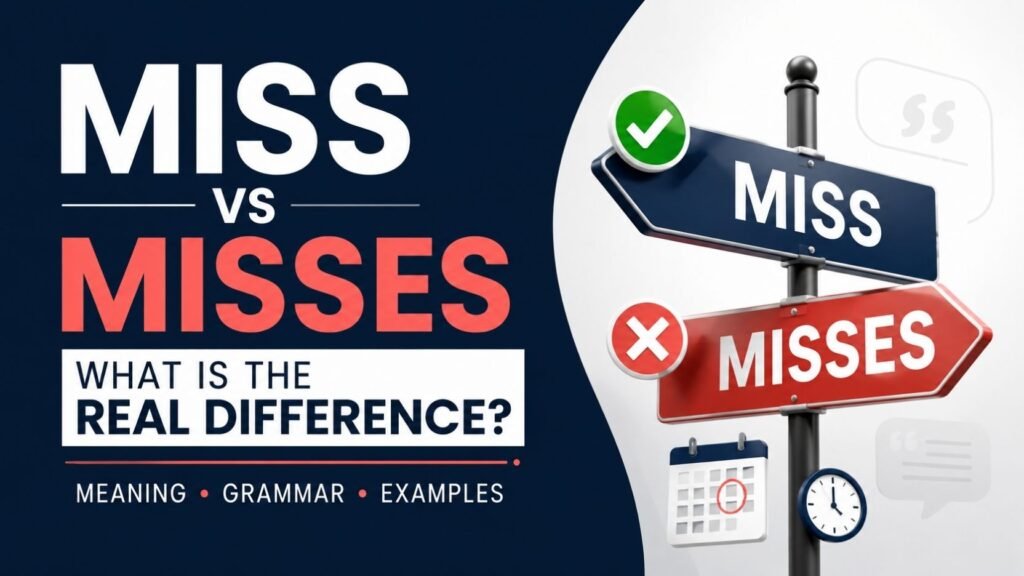
“Miss” is a title used before the name of a girl or an unmarried woman, and it is also a verb meaning to fail to hit, catch, attend, or notice something. “Misses” is simply what happens to that same word when it changes form: it becomes the third person singular verb, as in “she misses the bus,” or, far less commonly, an old-fashioned plural title, as in “the Misses Bennet.” The two words are not really rivals. They are the same root word doing different jobs.
Understanding when to use miss and when to use misses matters more than it looks. Getting the verb form wrong (“she miss him” instead of “she misses him”) is one of the most common grammar mistakes for English learners. Mixing up the title “Miss” with “Mrs” or “Ms” can also feel awkward in formal writing, letters, or introductions. This guide breaks down the meaning, grammar, pronunciation, and origin of both words so you can use them correctly and confidently.
Quick Answer: Miss Vs Misses At A Glance
| Word | What It Is | Example |
| Miss | Title for an unmarried woman or girl; also the base form of the verb “to miss” | Miss Johnson will see you now. / I miss my dog. |
| Misses | The verb “miss” with he, she, or it; an old, rarely used plural title | He misses his flight every time. / The Misses Carter arrived. |
The short version: if you are talking about one person doing the action right now (he, she, it), you use “misses.” If you are using it as a title before someone’s name, or as the plain form of the verb after I, you, we, or they, you use “Miss.”
See More: Missus Or Misses
What Does Miss Mean?
Miss has two everyday meanings in English, and they work in completely different ways grammatically.
Meaning 1: Miss As A Title
As a title, Miss is placed before the name of a girl or a woman who is not married, or whose marital status is not being specified. It is written with a capital letter and, in American English, is not usually followed by a period, unlike Mr. or Mrs.
- Miss Rodriguez teaches third grade.
- Please welcome Miss Chen to the stage.
- Is Miss Patel available this afternoon?
This use of Miss is a noun, specifically a title or honorific. It always comes directly before a surname or full name, never before a first name alone in formal contexts (though “Miss Sarah” does appear informally, especially in the American South, as a respectful way to address a woman by her first name).
Meaning 2: Miss As A Verb
As a verb, miss means to fail to hit, reach, catch, attend, notice, or experience something. It can also mean to feel sad about someone’s absence.
- I always miss the first bus in the morning.
- Don’t miss the season finale tonight.
- I miss you when you travel for work.
In this verb form, “miss” is the base form. It is used after I, you, we, and they, and after modal verbs like will, can, or should.
- I miss my hometown.
- They miss their old apartment.
- You should not miss this opportunity.
Meaning 3: Miss As An Informal Term Of Address
Miss is also used on its own, without a name, as a casual way to get a woman’s attention, particularly in service settings.
- Excuse me, miss, is this seat taken?
- Miss, you dropped your scarf.
This use is polite in tone but informal in register. It is common in restaurants, shops, and public spaces, though some women find it overly casual or prefer not to be addressed this way by strangers.
What Does Misses Mean?
“Misses” is not a separate word with its own meaning. It is a form of the same word “miss,” and it appears in two distinct situations.
Meaning 1: Misses As A Verb (Third Person Singular)
The most common use of misses is as the present tense verb form that goes with he, she, it, or a singular noun. English adds an “-es” to verbs ending in certain sounds, including “-ss,” when the subject is third person singular.
- He misses his family during the holidays.
- She misses the deadline almost every month.
- The dog misses its owner when she is at work.
- My brother misses his old job.
Notice the pattern: I miss, you miss, we miss, they miss, but he/she/it misses. This is standard subject-verb agreement, the same rule that turns “walk” into “walks” or “watch” into “watches.”
Meaning 2: Misses As An Old-Fashioned Plural Title
Less commonly, “the Misses” is used as the plural of the title Miss, referring to two or more unmarried sisters or young women who share a surname. This usage was standard in the eighteenth and nineteenth centuries and still appears in older literature, period dramas, and formal historical writing.
- The Misses Bennet were known throughout the neighborhood.
- An invitation arrived for the Misses Carter.
In modern English, this construction is rare and sounds distinctly old-fashioned. Today, most speakers would simply say “the Miss Bennets” informally, or refer to the sisters by their individual names.
Meaning 3: Misses As A Historical Variant Of “Missus”
In some older or regional English, “misses” was also written or spoken as a casual pronunciation of “missus,” an informal version of “Mrs” used to refer to one’s wife. This use has largely faded from standard English but survives in some dialects and older texts, where “the missus” means “my wife.”
Miss Vs Misses Vs Mrs Vs Ms
A lot of confusion around this topic actually comes from mixing up “Miss” and “Misses” with “Mrs” and “Ms,” which look and sound similar but mean something different. Here is how all four compare.
| Title | Meaning | Marital Status Implied | Example |
| Miss | Title for a girl or unmarried woman | Unmarried | Miss Thompson |
| Mrs | Title for a married woman, from “mistress” | Married | Mrs Thompson |
| Ms | Neutral title that does not state marital status | Not specified | Ms Thompson |
| Misses | Verb form (he/she/it misses) or old plural of Miss | Not applicable | She misses him. / The Misses Thompson |
A simple way to remember the difference: Miss, Mrs, and Ms are all titles you put before a name. Misses is almost always a verb, describing an action, not a title.
Miss Vs Ms
Miss states that a woman is unmarried. Ms does not state marital status at all, which is exactly why it became popular starting in the 1970s, as a parallel to “Mr,” which never reveals whether a man is married. Many professional and formal documents today default to Ms unless a woman has specifically stated a preference for Miss or Mrs.
Miss Vs Mrs
Miss and Mrs sit on opposite sides of marital status: Miss for unmarried women, Mrs for married women. Both trace back to the same historical root, the word “mistress,” but split into separate meanings over time.
Miss Vs Misses Vs Miz
“Miz” is an informal spelling that represents the pronunciation of “Ms” in casual American English, particularly in the Southern United States, where it is often used as a respectful way to address any woman, married or not (for example, “Miz Johnson”). It is not a standard written abbreviation outside of dialogue or informal writing, and it should not be confused with “misses,” which is a verb form.
Grammar Breakdown: Part Of Speech
| Form | Part Of Speech | Used With |
| Miss (title) | Noun | Before a surname |
| Miss (verb, base form) | Verb | I, you, we, they, or after “to” |
| Misses (verb) | Verb | He, she, it, or a singular subject |
| Missed | Verb (past tense) | Any subject, past time |
| Missing | Verb (present participle) / Adjective | Continuous tenses, or describing something absent |
💡 Tip: If you can replace the subject with “he” or “she” and the sentence still makes sense, the verb needs the “-es” ending. “I miss her” becomes “He misses her.” “They miss the train” becomes “She misses the train.”
See More: Tweak Or Tweek
How To Pronounce Miss And Misses
Miss is pronounced with one syllable: “miss,” rhyming with “kiss” and “this.” The vowel sound is a short “i,” and the word ends with a clean “s” sound.
Misses is pronounced with two syllables: “MISS-iz.” The stress falls on the first syllable, and the second syllable is a soft, unstressed “iz” sound, similar to the ending in “boxes” or “kisses.” It does not rhyme with “kisses” spelled the same way by coincidence, since “kisses” follows the identical pattern for the same grammatical reason.
⚠️ Common mistake: Learners sometimes pronounce “misses” as “miss-EZ” with equal stress on both syllables. In natural spoken English, the first syllable carries the stress, and the second syllable is reduced.
Origin And Etymology Of Miss
Both “Miss” and “Mrs” come from the same root word: “mistress.” Historically, mistress was a broad title of respect, applied to women of authority or social standing, without necessarily indicating marital status at all. Miss is almost as old as Mrs as an abbreviation of mistress and, like Mrs, it was originally applied only to women of higher social status.
The word first appeared in written form as “mis,” likely a shortened version of “mistris,” and the noun is first recorded in a text from 1606. Miss was originally used mainly for children rather than adults, and it was only during the 1700s that its use widened to include grown women as well. Before the eighteenth century, Miss was reserved for girls, and a young woman was expected to become a “Mrs” upon reaching adulthood, regardless of whether she had married.
Interestingly, referring to an adult woman as “Miss” before this shift carried unflattering associations, at times connected to prostitution, which is part of why the word’s respectable use for adult women took time to become standard.
The verb “miss,” in the sense of failing to hit or reach something, developed separately in Old English from a different root related to the idea of going wrong or wanting something. It is a coincidence of English spelling and sound change that the title “Miss” and the verb “miss” ended up looking identical, though both did eventually pick up the same rule for forming the third person singular: adding “-es” after the double “s.”
Miss Vs Misses In A Sentence: Examples
Using Miss as a title:
- Miss Alvarez will lead the meeting on Thursday.
- I received an email from Miss Whitfield this morning.
Using Miss as a verb (base form):
- I miss the way things used to be.
- We miss having you around the office.
- Please don’t miss your connecting flight.
Using Misses as a verb (third person singular):
- She misses her sister every single day.
- He misses at least one deadline per quarter.
- Grandpa misses the neighborhood he grew up in.
Using Misses as an old-fashioned plural title:
- The Misses Whitmore hosted the annual garden party.
Common Mistakes With Miss And Misses
❌ Incorrect: She miss her old friends.
✅ Correct: She misses her old friends.
Why: The subject “she” is third person singular, so the verb needs the “-es” ending.
❌ Incorrect: I misses him a lot.
✅ Correct: I miss him a lot.
Why: “I” always pairs with the base form “miss,” never “misses.”
❌ Incorrect: Mrs. Carter is not married.
✅ Correct: Miss Carter is not married.
Why: “Mrs” specifically implies a married woman. If a woman is unmarried, “Miss” or the neutral “Ms” is the accurate title.
❌ Incorrect: The misses arrived at the party. (meaning two unmarried women, with a lowercase, unclear “the misses”)
✅ Correct: The Misses Carter arrived at the party.
Why: When used as a plural title, “Misses” is capitalized and paired with a surname, similar to how “the Smiths” refers to a family.
Similar And Related Words
| Word | Meaning | How It Differs From Miss/Misses |
| Missed | Past tense of the verb miss | Refers to an action that already happened |
| Missing | Present participle of miss, or an adjective meaning absent | Used in continuous tenses (“I am missing you”) or to describe something not present (“the missing report”) |
| Missus | Informal spoken version of Mrs, especially meaning “wife” | A casual, spoken title, not a verb |
| Mademoiselle | French title equivalent to Miss | Used specifically in French, not English, contexts |
See More: Kneck Or Neck
Frequently Asked Questions
What does miss vs misses mean?
Miss is a title for an unmarried woman or girl, and also the base form of the verb “to miss.” Misses is the same verb used with he, she, or it, and occasionally an old-fashioned plural title for two or more unmarried women.
Is miss or misses correct in a sentence like “he ___ his mom”?
“Misses” is correct: “He misses his mom.” Third person singular subjects like he, she, and it require the “-es” ending.
How do you use miss vs misses in a sentence?
Use “miss” with I, you, we, and they, and use “misses” with he, she, it, or any singular subject. As a title, “Miss” always goes before a woman’s surname.
What is the difference between Miss and Mrs?
Miss is used for an unmarried woman or a girl. Mrs is used for a married woman. Both words developed from the historical title “mistress.”
What is the abbreviation for misses?
“Misses” is not typically abbreviated, since it is usually a verb form rather than a title. The title “Miss” itself is already short and is not commonly abbreviated further, unlike “Mister” (Mr) or “Mistress” (Mrs).
Is Miss a noun or a verb?
Miss can be either. As a title before a name, it functions as a noun. As in “I miss you,” it functions as a verb.
Do you use a period after Miss?
In American English, “Miss” is not typically followed by a period, since it is not a shortened form of another word in modern usage. “Mr.” and “Mrs.,” by contrast, are usually written with a period in American English because they are treated as abbreviations.
Why do some people prefer Ms instead of Miss or Mrs?
Ms does not reveal whether a woman is married, which many people prefer for privacy, professionalism, or personal reasons. It became widely used starting in the 1970s as a parallel to “Mr,” which has never indicated marital status.
Can Miss be used for a married woman?
Traditionally, no. Miss specifically signals that a woman is not married. If her marital status is unknown or she prefers not to state it, “Ms” is the appropriate neutral choice.
Is “the Misses” still used today?
Rarely. It survives mainly in older literature, formal historical writing, and period settings. In everyday modern English, most people would refer to a group of women by their individual names or use “the Miss Bennets” informally rather than “the Misses Bennet.”
Final Thoughts
Miss and misses are two forms of the same word, and once you separate their two different jobs, the confusion disappears. Miss works as a title before a woman’s name and as the plain form of the verb “to miss.” Misses steps in only when the subject is he, she, or it, following the same grammar rule that applies to countless other English verbs ending in a hissing or buzzing sound.
The next time you are unsure which one to use, ask a simple question: is this a title in front of a name, or is it a verb describing what someone does? If it is a title, reach for Miss. If it is a verb and the subject is a single person other than yourself, reach for misses. That one distinction covers nearly every situation you will run into with these two words.

Abdul Rehman Jutt is the author behind Grammar Wordz, with 4 years of experience researching and writing about English grammar, words, meanings, and language rules. Their goal is to make grammar simple, clear, and easy to understand through accurate and useful explanations.