
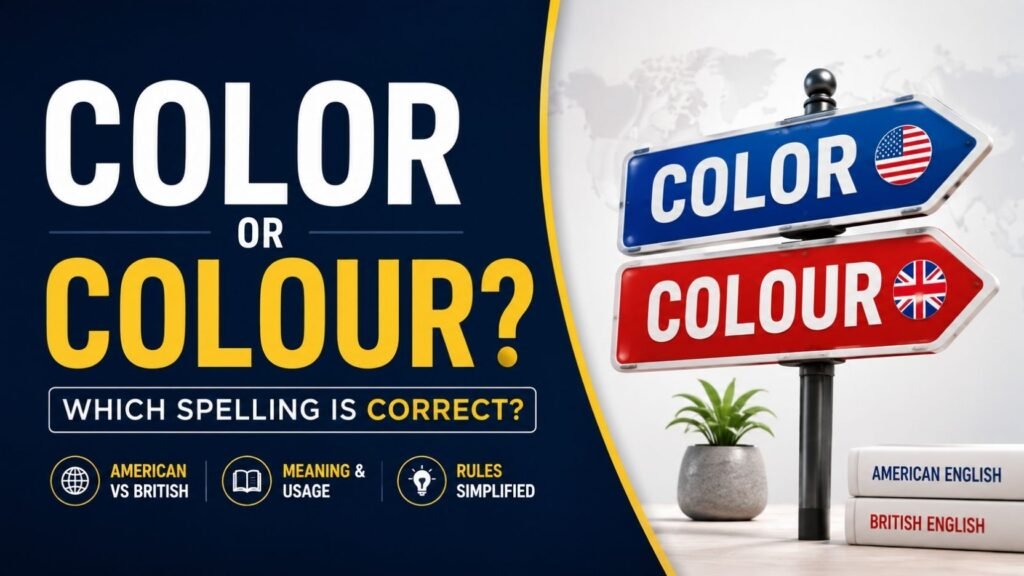
Both color and colour are correct spellings of the same word. Color is the American English spelling, while colour is the British English spelling. The word refers to the property of light that lets us see red, blue, green, and every other shade around us. Neither spelling is wrong. The one you should use simply depends on which version of English your reader expects.
This small spelling difference confuses a lot of people, especially online, where American and British writing mix constantly. Understanding why two spellings exist makes the choice much easier. It also helps with everyday writing, school assignments, business documents, and even search engine habits. Once you know the pattern, you will never second guess this word again.
What Does Color or Colour Mean?
Color, or colour, is a noun that describes what your eyes see when light reflects off an object. Red, yellow, blue, green, and purple are all examples of color. The word can also work as a verb, meaning to add color to something, as in “color the picture” or “colour the picture.”
At its core, the meaning does not change between the two spellings. Only the letters differ. A red apple is red whether you write color or colour. A rainbow still has the same seven bands of color in both spelling systems. The concept, the pronunciation, and the everyday use are identical.
Dictionaries in both American and British English list the word with the same core definition:
- The quality of an object that comes from the way it reflects light
- A pigment, dye, or paint used to add this quality to something
- A general mood, feeling, or character, as in “local color”
- A verb meaning to apply color or to influence something, as in “the story colored her opinion”
Color or Colour: Which Spelling Is Correct?
Both spellings are correct English. There is no single “correct” answer that applies worldwide. Instead, correctness depends on the variety of English you are writing in.
| Spelling | Correct In | Typical Use |
| Color | American English | United States, and countries that follow American conventions |
| Colour | British English | United Kingdom, and most Commonwealth countries |
If you are writing for an American audience, a US company, or an American publication, color is correct. If you are writing for a British, Australian, Canadian, or Commonwealth audience, colour is correct. Style guides on both sides agree that the two forms are equally valid within their own regions.
The confusion usually comes from global media. Movies, books, software, and websites mix American and British spelling constantly, so readers see both forms often. That exposure makes the word feel unstable, even though each spelling is perfectly stable within its own English variety.
💡 Tip: If you are unsure which spelling to use, check your target audience first. Match your spelling to your reader’s country, not to personal habit.
Color Vs Colour: American English and British English
The split between color and colour is part of a much larger pattern. Many English words that end in “-our” in British English drop the “u” in American English.
| British English | American English |
| Colour | Color |
| Favour | Favor |
| Honour | Honor |
| Neighbour | Neighbor |
| Labour | Labor |
This pattern is not random. It comes from spelling choices made in the early nineteenth century, which are explained in more detail in the origin section below. Once you learn this pattern, other similar word pairs become much easier to predict.
Outside of this “-our” versus “-or” pattern, American and British English share almost all other spelling and grammar for this word family. Words like colorful and colourful, or coloring and colouring, follow the same regional split as the base word.
Do Canadians Spell It Color or Colour?
Canadians generally spell it colour, following British spelling conventions. Canadian English blends American and British influences, but for this particular word, the British form is the standard choice in Canadian newspapers, government documents, and schools.
That said, because Canada sits next to the United States, American spelling appears often in casual writing, marketing, and everyday online content. Many Canadians see both spellings regularly and may use color in informal contexts, especially when writing for American platforms or software that defaults to American English.
- Official Canadian style guides recommend colour
- Canadian newspapers typically use colour
- Everyday informal writing sometimes uses either spelling, depending on habit and exposure
Do Australians Spell It Color or Colour?
Australians spell it colour. Australian English closely follows British spelling rules, and colour is the standard form used in Australian schools, newspapers, government writing, and everyday communication.
You will rarely see color used in formal Australian writing. It may appear in product names, American software interfaces, or content copied directly from American sources, but the accepted Australian standard remains colour.
Color or Colour in India, South Africa, and Other English-Speaking Countries
Colour is the standard spelling across most English-speaking countries outside the United States. This includes India, South Africa, Ireland, New Zealand, and the wider Commonwealth. These countries generally adopted British spelling conventions through historical ties to the United Kingdom, and colour remains the accepted form in schools, government documents, and news media.
| Country | Standard Spelling |
| United States | Color |
| United Kingdom | Colour |
| Canada | Colour |
| Australia | Colour |
| India | Colour |
| South Africa | Colour |
| New Zealand | Colour |
| Ireland | Colour |
In short, color is really the exception, used mainly in the United States, while colour is the more widely used spelling across the rest of the English-speaking world.
Grammar: Part of Speech and Word Forms
Color, or colour, can function as a noun or a verb.
As a noun, it names a quality:
- The color of the sky changed at sunset.
- Her favourite colour is teal.
As a verb, it describes an action:
- Please color inside the lines.
- The children coloured the drawing carefully.
Word Forms
Both spellings follow the same grammar rules once you apply the correct regional pattern. The table below shows how common forms shift depending on the spelling system.
| Form | American English | British English |
| Base noun/verb | color | colour |
| Adjective | colorful | colourful |
| Present participle | coloring | colouring |
| Past tense | colored | coloured |
| Plural noun | colors | colours |
| Related noun | colorist | colourist |
Notice that the “-ing” and “-ed” forms simply add the standard endings to whichever base spelling you are using. Colored and coloured both mean the same thing, just as coloring and colouring do.
⚠️ Common mistake: Mixing spelling systems within the same document, such as writing colour in one sentence and colored in the next, looks inconsistent. Pick one spelling system and use it throughout your writing.
How to Pronounce Color or Colour
Color and colour are pronounced the same way. The spelling difference does not change how the word sounds.
- Simple pronunciation: KUHL-er
- IPA: /ˈkʌlər/ (American), /ˈkʌlə/ (British, non-rhotic)
The main difference in pronunciation comes from accent, not spelling. American speakers usually pronounce the final “r” clearly, since American English is rhotic. British speakers, particularly those with a standard Received Pronunciation accent, often soften or drop the final “r” sound, since British English is largely non-rhotic. This is a feature of regional accent, not a rule tied to the spelling itself.
Origin And Etymology Of Color Or Colour
The word traces back to the Latin word “color,” which referred to the hue or tint of something. From Latin, it passed into Old French as “colour,” and Middle English borrowed the French spelling directly. This is why colour, with the “u,” was actually the original English spelling used for centuries in both Britain and early America.
The American spelling, color, came later. It was popularized by the American lexicographer Noah Webster in the early nineteenth century. Webster believed American English should have simpler, more logical spelling that matched pronunciation more closely. In his dictionaries, he intentionally dropped the “u” from words like colour, favour, and honour, creating the American standard we use today.
Britain, meanwhile, kept the older French-influenced spelling with the “u.” Over time, this created the lasting divide between American and British English that still exists for this word and many others like it.
So in a sense, colour is historically the older form, while color is the newer, reformed American version.
Color Or Colour In Different Contexts
The word appears in many everyday phrases and compound terms. The spelling always follows the same regional pattern, whether American or British.
- Color wheel or colour wheel: A visual tool that shows the relationships between colors, often used by artists and designers to understand contrast, harmony, and mixing.
- Color palette or colour palette: A selected set of colors used together in design, art, branding, or home decorating.
- Color picker or colour picker: A digital tool, often found in design software or search engines, that lets users select an exact shade using sliders, codes, or a visual spectrum.
- Hex color or hex colour: A six-digit code used in web design and digital design to represent a precise shade, such as #FF5733.
- Hair color or hair colour: A general term for the natural or dyed shade of a person’s hair, as well as the products used to change it.
- Color blind test or colour blind test: A test used to check whether a person can distinguish between certain colors, often used to detect red-green color blindness.
- Living colour or living color: A phrase, often used in music and media, describing something shown vividly and clearly, as if in full and vibrant detail.
- Trooping the Colour: A specific, fixed British term for the annual military ceremony celebrating the British monarch’s official birthday. This phrase always uses the British spelling, colour, regardless of the writer’s usual spelling preference, because it is a proper name.
📌 Note: Some brand names, ceremony titles, or product names use a fixed spelling that does not change based on region. Trooping the Colour is one clear example.
Similar Words And Related Terms
Several related words follow the same base word but describe slightly different ideas. Understanding these differences helps you choose the right word, not just the right spelling.
| Word | Meaning | How It Differs |
| Colorful / Colourful | Full of bright colors, or lively and vivid | Describes richness or vibrancy, not just the presence of color |
| Coloring / Colouring | The act of applying color, or a person’s natural skin and hair tone | Can describe an activity or a physical trait |
| Discolor / Discolour | To change color, usually in a negative or unwanted way | Implies fading, staining, or damage |
| Multicolored / Multicoloured | Having many different colors | Focuses on variety rather than intensity |
| Colorless / Colourless | Lacking color entirely | Can also describe something dull or lifeless in tone |
These related words all shift their spelling the same way the base word does. If you are writing in American English, use color, colorful, coloring, and colorless. If you are writing in British English, use colour, colourful, colouring, and colourless.
Common Mistakes With Color or Colour
Even confident writers slip up with this word, especially when switching between American and British content, or when using spell checkers set to the wrong region.
Incorrect: He coloured the drawing, but he prefers color over colour when writing formally. Correct: He coloured the drawing, and he prefers colour over color when writing formally in British English.
Mixing both spellings in one document is one of the most common mistakes. It usually happens when a writer copies text from multiple sources or forgets to check their word processor’s language setting.
Incorrect: The colour of the shirt is grey, but her favorite color is blue.
Correct (American English): The color of the shirt is gray, but her favorite color is blue. Correct (British English): The colour of the shirt is grey, but her favourite colour is blue.
⚠️ Common mistake: Assuming one spelling is more “correct” than the other. Neither spelling is a grammar error. The mistake only happens when spellings are mixed inconsistently within the same piece of writing.
✅ Correct approach: Choose either American or British English at the start of your document, then stay consistent with every related word, including favor/favour, honor/honour, and gray/grey.
Color or Colour on Search Engines and Software
Search engines, browsers, and design tools often default to American spelling, since many major technology companies are based in the United States. This is why terms like color wheel, color picker, and color palette generator appear so frequently online, even for users who normally write colour.
This does not mean colour is incorrect in these contexts. It simply reflects the American origin of many popular digital tools. Google’s built-in color picker, for example, uses the American spelling in its interface, regardless of where the user is searching from.
Frequently Asked Questions
Is it color or colour?
Both are correct. Color is standard American English, and colour is standard British English. The choice depends on which variety of English you are writing in.
Which spelling is more common worldwide?
Colour is used by more English-speaking countries overall, including the UK, Canada, Australia, India, and South Africa. Color is standard mainly in the United States.
Do Canadians spell it color or colour?
Canadians generally use colour, following British spelling conventions, although American spelling appears often in informal or American-influenced writing.
Do Australians say color or colour?
Australians use colour in both speech and writing, following British English standards used throughout Australian schools and media.
Is color or colour used in the UK?
The UK uses colour exclusively in formal writing, education, and media. Color is considered the American spelling and is not standard in British English.
Does the pronunciation change between color and colour?
No. Both spellings are pronounced the same way. Any difference in sound comes from regional accent, not from the spelling itself.
Is colour older than color?
Yes. Colour, based on the Old French and Latin roots, was the original English spelling. Color became standard in the United States after Noah Webster’s spelling reforms in the early nineteenth century.
Is color or colour a noun or a verb?
It can be both. As a noun, it names a visual quality, such as “the color of the sky.” As a verb, it describes an action, such as “color the picture.”
Which spelling should I use for a global audience?
If your audience is unknown or mixed, choose one spelling system and remain consistent throughout the piece. Many international brands use American spelling by default, but this is a style choice, not a rule.
Is it wrong to use color and colour in the same document?
Yes, in the sense that it looks inconsistent. Neither spelling is grammatically wrong on its own, but mixing them within one piece of writing is considered a style mistake.
Conclusion
Color and colour are both correct spellings of the same word, separated only by regional English conventions. Color belongs to American English, while colour belongs to British English and most other English-speaking countries, including Canada, Australia, India, and South Africa. The meaning, pronunciation, and grammar stay exactly the same no matter which spelling you choose. The only real decision is matching your spelling to your audience and staying consistent throughout your writing.
Whether you are writing a school essay, a business email, or a product description, the safest approach is simple: pick one spelling system based on your reader’s location, and apply it consistently to every related word, from colorful to favorite, or colourful to favourite. Once you understand the American and British split, color or colour stops being a confusing choice and becomes an easy, natural part of clear writing.

Abdul Rehman Jutt is the author behind Grammar Wordz, with 4 years of experience researching and writing about English grammar, words, meanings, and language rules. Their goal is to make grammar simple, clear, and easy to understand through accurate and useful explanations.