
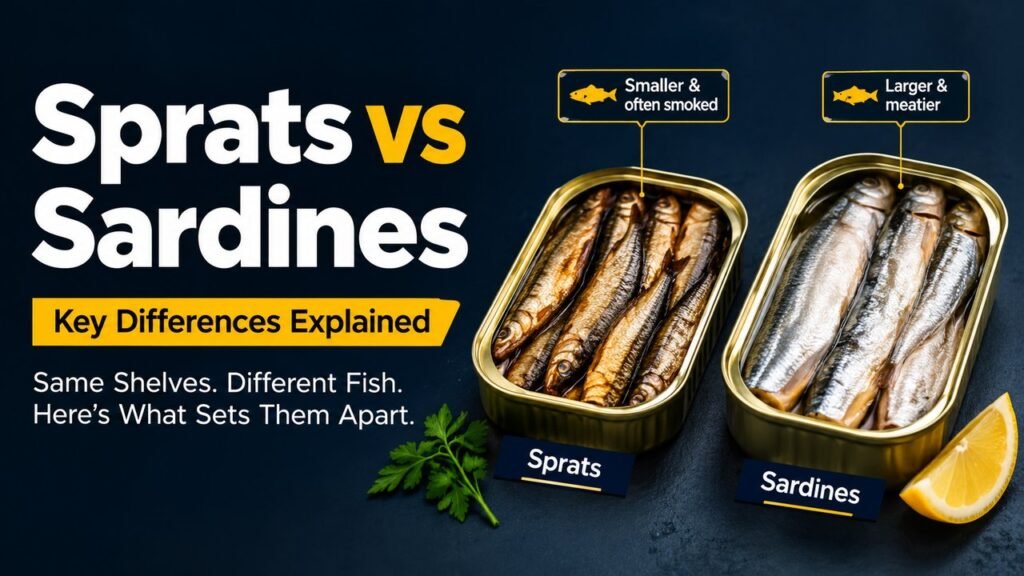
Sprats vs sardines is a question that trips up even experienced seafood shoppers, and for good reason. Both are small, silvery, oily fish from the herring family, both show up in tins on the same grocery shelf, and both get labeled in ways that blur the line between them even further. The short answer is that sprats and sardines are different species entirely. Sprats belong to the genus Sprattus, while sardines are a broad commercial name covering more than twenty species from several different genera.
That difference matters more than it seems. It shapes how each fish tastes, how it is caught and packed, and even which one shows up in a Baltic breakfast versus a Portuguese tin. Sardines have a firmer bite and a milder flavor that has made them a pantry staple across the United States and Southern Europe. Sprats are smaller, softer, and often smoked, which gives them a deeper, more intense taste that is beloved across Northern and Eastern Europe. Once you know what sets them apart, the confusing labels on canned fish start to make a lot more sense.
Sprats vs Sardines: The Core Difference
The confusion between these two fish is not accidental. It comes from how the seafood industry uses the word “sardine.”
Sardine was never meant to describe one species. It is a market term that food producers apply to any small, oily herring-family fish that gets canned or preserved a certain way. Sprats, on the other hand, refer to a specific group of fish in the genus Sprattus, with the European sprat (Sprattus sprattus) as the most common member.
Here is the simplest way to picture it:
| Sprats | Sardines | |
| Scientific classification | Genus Sprattus, five recognized species | Multiple genera, over 20 species considered “sardine” |
| Most common species | Sprattus sprattus, the European sprat | Sardina pilchardus, the European pilchard |
| Typical size | About 3.5 to 6 inches (9 to 15 cm) | About 6 to 10 inches (15 to 25 cm) |
| Main fishing regions | Baltic Sea, North Sea, parts of the Atlantic | Mediterranean, Atlantic, Pacific, worldwide |
| Common preparation | Often smoked, then canned in oil | Canned in oil, water, or tomato sauce; also grilled fresh |
So when someone asks “are sprats the same as sardines,” the honest answer is no. They are close relatives from the same fish family, Clupeidae, but they are not interchangeable species. What makes it trickier is that some sprats are legally sold as “brisling sardines” outside Europe, which is where a lot of the mix-up begins.
See More: Quantify Vs Qualify
What Are Sprats?
Sprats are small, slender, oily fish that belong to the herring family. The true sprat, Sprattus sprattus, is native to the cold waters of the North Sea and the Baltic Sea, though related sprat species also live off Australia and New Zealand.
A few defining traits of sprats:
- They rarely grow past 6 inches long.
- They have a pointed mouth and a single fan-shaped dorsal fin.
- Their backs show a blue or green sheen over silver sides.
- They feed mainly on plankton and floating fish eggs.
- They are frequently smoked before canning, which is where their deep, savory flavor comes from.
💡 Tip: If a tin says “brisling” or “brisling sardines,” you are looking at sprats, not true sardines. Brisling is simply the traditional Scandinavian name for Sprattus sprattus.
What Are Sardines?
Sardines are not one fish. The name is a commercial umbrella term for more than twenty species of small, oily herring-family fish caught around the world. The most recognized of these is Sardina pilchardus, the European pilchard, which is often credited as the origin of the word “sardine,” supposedly named after the island of Sardinia, where the fish were once abundant.
Because “sardine” is such a broad label, a tin bought in Portugal, Morocco, or California may contain a different species each time, even though every can says “sardines” on the front. Five genera are generally grouped under the sardine name: Dussumieria, Escualosa, Sardina, Sardinella, and Sardinops.
A few defining traits of sardines:
- They typically run larger than sprats, often 6 to 10 inches long, though some species grow much bigger.
- Their bodies are broader and meatier than a sprat’s slender frame.
- They are caught in the Mediterranean, the Atlantic, and the Pacific off Japan and California.
- They are packed in oil, water, or tomato sauce, and are also popular grilled fresh in Mediterranean cooking.
Sprats vs Sardines: Taste And Texture
This is usually the part people care about most, especially if they are deciding what to put on their next cracker or slice of toast.
Sardines have a firmer, meatier bite. Their flavor is often described as rich and slightly creamy, with a saltiness that holds up well against strong ingredients like mustard, chili, or tomato sauce. That robustness is part of why sardines are so common in Mediterranean and Portuguese cooking.
Sprats are softer and more delicate. Because they are smaller, their flesh flakes easily, almost melting on the tongue. Smoking is common in sprat production, which adds a savory, slightly smoky depth that many sardines simply do not have unless they are specifically smoked too. Some tasters describe sprats as tasting “richer” or “more intense” despite their smaller size, largely because of that smoking process.
Neither one is objectively better. It comes down to preference:
- Choose sardines if you want a firmer texture and a milder, more versatile flavor for salads, pasta, or sandwiches.
- Choose sprats if you want a smoky, concentrated flavor that works well on rye bread, crackers, or alongside eggs, which is a classic Baltic breakfast pairing.
Sprats vs Sardines vs Anchovies
Anchovies often get lumped into this comparison too, so it helps to separate all three.
| Fish | Family | Flavor | Typical Use |
| Sprats | Herring (Clupeidae), genus Sprattus | Smoky, rich, delicate texture | Smoked and canned, Baltic breakfasts, snacking |
| Sardines | Herring (Clupeidae), several genera | Milder, meatier, firm bite | Canned in oil or sauce, grilled fresh, sandwiches |
| Anchovies | Engraulidae family (a separate family) | Intensely salty and savory | Cured in salt or oil, used to season sauces and dressings |
Anchovies belong to a different family entirely, Engraulidae, not Clupeidae. That is the biggest distinction. While sprats and sardines are close cousins, anchovies are more like a neighboring branch of the small-oily-fish family tree. Anchovies are also almost always cured heavily in salt, which gives them a much sharper, saltier punch than either sprats or sardines typically have straight from the tin.
Sprats vs Sardines Nutrition Comparison
Both fish are nutritional standouts for their size, but the numbers do differ somewhat depending on species, preparation, and packing medium. The figures below reflect typical values for canned versions of each fish, drawing on USDA FoodData Central entries and commonly reported figures for European sprat products.
| Nutrient (per 100g) | Sprats (canned) | Sardines (canned in oil, with bone) |
| Calories | Roughly 155 to 210 | About 208 |
| Protein | Roughly 17 to 24g | About 24.6g |
| Total fat | Roughly 10 to 17g | About 11.5g |
| Omega-3 fatty acids | Roughly 1.0 to 1.4g | About 1.5g |
| Calcium | Roughly 200 to 300mg | About 382mg |
| Vitamin B12 | High, supports a full week’s needs in a small serving | About 9µg, well over 300% of daily value |
| Vitamin D | Present, supports bone health | Present, roughly 24% of daily value |
⚠️ Note: These numbers shift depending on whether the fish is canned in oil, water, or tomato sauce, and whether it is a whole fish with bones or a filleted product. Always check the nutrition label on your specific can for the most accurate count, since brand, origin, and packing liquid all change the final figures.
Sprats vs Sardines Nutrition Facts 100g: What Actually Stands Out
Looking at the table, sardines usually edge out sprats slightly in raw protein and calcium, mostly because sardines are often packed with slightly larger, denser bones that boost the calcium count. Sprats, though, are no slouch. Their vitamin D and B12 levels remain excellent, and because they are almost always eaten whole, bones and all, they deliver a similarly strong dose of minerals relative to their size.
Neither fish contains meaningful carbohydrates, and both are considered excellent low-carb, high-protein foods.
Sprats vs Sardines: Which Is Healthier?
This is one of the most searched questions on the topic, and the honest answer is that both are excellent choices, with only minor differences separating them.
Sardines generally offer:
- Slightly more protein per 100 grams
- Slightly higher calcium, especially useful for bone health
- A slight edge in vitamin B12
Sprats generally offer:
- A comparable, sometimes higher, selenium content
- Similar omega-3 levels, especially EPA and DHA
- Lower calorie counts in some canned preparations, depending on the packing liquid
Both fish are low on the food chain, which means both accumulate far less mercury than large predatory fish like tuna or swordfish. This makes either one a safer, more frequent seafood option for most adults, including pregnant women who are often advised to choose smaller, low-mercury fish over larger species.
If you are trying to decide which is healthier for your specific goals, use this quick guide:
- ✅ Want maximum calcium and protein: lean toward sardines, especially soft-bone canned varieties.
- ✅ Want a lower-calorie option with strong micronutrients: sprats packed in water or brine often come in lighter.
- ✅ Watching sodium: check labels on both, since brine and smoking can push sodium higher in either fish.
See More: Proove Or Prove
Riga Sprats Vs Sardines
Riga sprats deserve their own mention because they show up constantly in searches and on store shelves. Riga sprats are a specific style of canned sprat, traditionally smoked and packed in oil, originally associated with the Latvian city of Riga on the Baltic coast.
The Riga sprat tradition dates back over a century, with Baltic canneries perfecting a cold-smoking process before sealing the fish in oil. This gives Riga sprats their signature deep amber color and smoky aroma, distinct from the lighter, often unsmoked preparation used for most canned sardines.
Compared to standard sardines, Riga sprats tend to be:
- Smaller and more delicate in texture
- Noticeably smokier in flavor
- Often packed with the head and tail intact, unlike many filleted sardine products
If a recipe or a personal preference calls for that distinctive smoky bite, Riga sprats are the version to look for, and they are widely exported and sold in specialty grocery stores across the United States.
Brisling Sprats vs Sardines
Brisling is a name that causes a lot of the confusion in this whole topic, so it is worth clearing up directly.
Brisling is simply the traditional Norwegian and Scandinavian name for the European sprat, Sprattus sprattus. When you see a tin labeled “brisling sardines,” you are looking at actual sprats, legally permitted to use the word “sardines” on the label in certain markets because of long-standing labeling conventions, not because they are the same species as a true sardine.
This labeling quirk exists mostly for historical and marketing reasons. Scandinavian sprat canneries built a strong export reputation using the term “brisling sardines” decades ago, and the name stuck even as consumers became more aware of the species difference.
So to be direct: brisling sprats and sardines are not the same fish, even when the word “sardine” appears on the can.
Smoked Sprats vs Sardines
Smoking is far more common in sprat production than in sardine production, and this single step accounts for much of the flavor gap between the two fish.
Smoked sprats:
- Are cold-smoked over wood, often oak or alder, before canning
- Develop a deep amber color and a rich, savory aroma
- Are traditionally eaten on dark rye bread with butter, hard-boiled egg, or soft cheese
Sardines:
- Are far more commonly canned without smoking, though smoked sardine products do exist
- Retain a cleaner, more neutral fish flavor when unsmoked
- Take on flavor primarily from their packing liquid, whether that is olive oil, tomato sauce, or a mustard-based sauce
If you enjoy the taste of smoked fish generally, smoked sprats will likely appeal to you more directly than a standard tin of sardines, since the smoking step is baked into their identity as a product.
Baltic Sprats vs Sardines
Baltic sprats are essentially the primary source of the sprats found in most European supermarkets and specialty stores. The Baltic Sea, bordered by countries including Latvia, Estonia, Lithuania, Poland, Sweden, and Finland, is the historical heart of the sprat fishing and canning industry.
Because the Baltic Sea is a relatively enclosed, brackish body of water, it has also drawn some environmental attention. Reporting on the region has noted that pollutants such as PCBs, mercury, and dioxins can accumulate in marine life there due to industrial runoff and urban waste, which is a consideration some shoppers weigh when choosing between Baltic-caught sprats and sardines sourced from the more open waters of the Atlantic or Mediterranean. Reputable canneries test for these contaminants and follow food safety limits, but if this is a concern for you, checking the sourcing information on the label is a reasonable step.
Sardines, by contrast, are most often sourced from more open waters: the Atlantic off Portugal, Spain, and Morocco, the Mediterranean, or the Pacific off Japan and California, giving them a different environmental profile from Baltic sprats.
Sprats vs Sardines for Dogs
Both sprats and sardines are commonly given to dogs as a treat, and vets generally consider both safe in moderation, with a few shared precautions.
What holds true for both fish:
- Choose fish packed in water, not oil, brine, or sauce, since the added fat and sodium can upset a dog’s stomach or contribute to pancreatitis in sensitive dogs.
- Avoid any product with added salt, garlic, onion, or seasoning.
- Soft, cooked canned bones are generally fine for dogs, but check for any unusually hard or large bones before serving.
- Introduce either fish slowly and watch for signs of an upset stomach or allergic reaction.
- Keep portions small. Treats, including fish, should make up no more than about 10 percent of a dog’s daily calorie intake.
Because both fish sit low on the food chain, mercury is rarely a major concern for either one when fed in reasonable amounts. The bigger practical difference for dog owners is size and bone content: sprats are smaller and often have very soft, fully edible bones throughout, while larger sardines may need a closer check for bigger bones, especially in fresh or whole preparations.
If your dog has a history of pancreatitis, obesity, or a sensitive stomach, talk to your vet before adding either fish to their diet regularly.
Common Mistakes People Make
⚠️ Assuming “sardine” means one type of fish. It does not. Over twenty species can legally be sold under that name.
⚠️ Assuming brisling sardines are true sardines. They are sprats, sold under a name that includes the word “sardine” for historical labeling reasons.
⚠️ Assuming sprats and anchovies are the same. They are not. Anchovies come from an entirely separate fish family, Engraulidae, and are almost always cured in heavy salt.
⚠️ Assuming one fish is always healthier than the other. The nutritional gap between sprats and sardines is small, and both are excellent low-mercury protein sources.
✅ Correct approach: check the species name or country of origin on the label if you want to know exactly what fish is in the tin, since “sprat” and “sardine” both cover more ground than most shoppers expect.
See More: Frugal Vs Lavish
Origin Of The Words “Sprat” And “Sardine”
The word “sardine” entered English in the early 15th century. The most commonly cited explanation traces it to the Mediterranean island of Sardinia, where the fish were once caught in large numbers, though some language historians consider this origin story somewhat uncertain rather than fully settled fact.
The word “sprat” has older Germanic roots, related to words used across Northern European languages for small fish. It shows up in English well before the canning industry existed, originally just describing any small fish caught off the coast.
Sprat also survives in English through the nursery rhyme “Jack Sprat could eat no fat, his wife could eat no lean,” where “sprat” was used as a nickname implying someone small or slight, drawing directly on the fish’s tiny size.
Frequently Asked Questions
Are sprats the same as sardines?
No. Sprats belong to the genus Sprattus, while sardines are a commercial term covering more than twenty different species across several genera. They are related but not the same fish.
What is the difference between sprats and sardines in taste?
Sardines tend to have a firmer, meatier texture and a milder flavor. Sprats are smaller, softer, and often smoked, giving them a more intense, smoky taste.
Are brisling sardines the same as sprats?
Yes. Brisling is simply the Scandinavian name for the European sprat, Sprattus sprattus. The word “sardine” appears on the label for historical marketing reasons, not because it is a true sardine.
Which has more omega-3, sprats or sardines?
The two are very close, with sardines sometimes showing a slightly higher value depending on the specific product and packing liquid. Both are excellent omega-3 sources for their size.
Can dogs eat sprats and sardines?
Yes, both are generally considered safe for dogs in moderation, ideally packed in water with no added salt or seasoning. Always check with a vet if your dog has an existing health condition.
What are Riga sprats?
Riga sprats are a traditional style of smoked, oil-packed sprat associated with the Latvian city of Riga on the Baltic coast, known for their smoky flavor and amber color.
Do sprats and sardines have different mercury levels?
Both fish are low on the food chain and generally carry very low mercury levels compared to larger predatory fish like tuna, making either a safer regular seafood choice.
Is a sprat a baby sardine?
No. This is a common misconception. Sprats are a distinct species from birth to adulthood, not a juvenile stage of any sardine species.
Final Takeaway
Sprats and sardines will always sit close together on the same grocery shelf, and that closeness is exactly why so many people assume they are the same fish. They are not. Sprats come from the genus Sprattus, are typically smaller, and are often smoked before canning, giving them a deep, savory flavor especially popular across Northern and Eastern Europe. Sardines cover a much wider group of species, tend to run larger and meatier, and are enjoyed everywhere from Portugal to California in oil, water, or tomato sauce.
Neither fish beats the other outright when it comes to nutrition, taste, or everyday usefulness. The right choice simply depends on what you are making, how strong a flavor you want, and whether that smoky, Baltic-style richness appeals to you more than a firmer, milder bite. Once you understand what actually separates sprats vs sardines, choosing between the two tins in front of you becomes a much easier decision.

Abdul Rehman Jutt is the author behind Grammar Wordz, with 4 years of experience researching and writing about English grammar, words, meanings, and language rules. Their goal is to make grammar simple, clear, and easy to understand through accurate and useful explanations.