
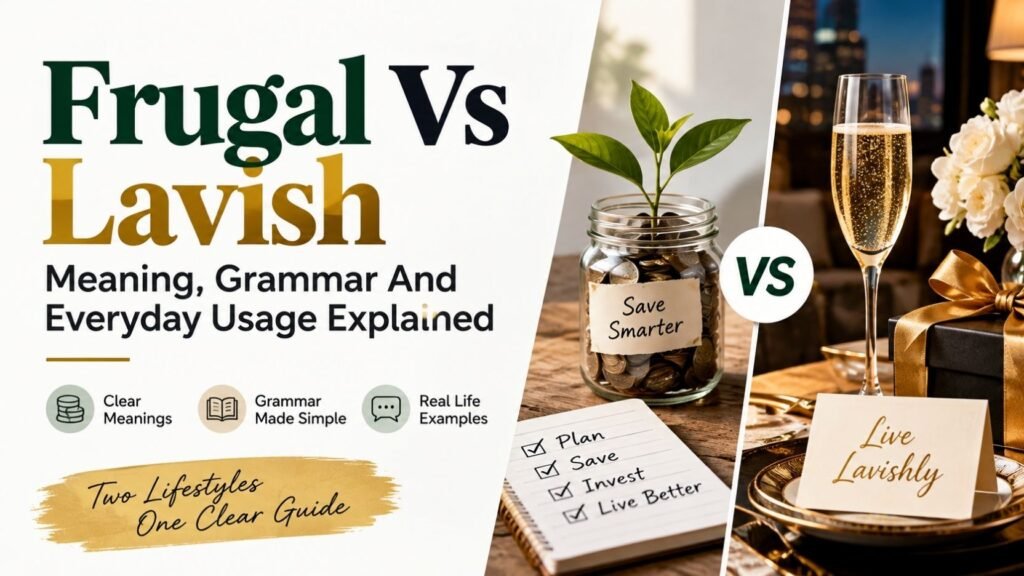
Frugal and lavish describe two opposite ways of spending money and living life. Frugal means careful, thrifty, and mindful of waste, while lavish means generous, extravagant, and rich in spending or style. Understanding frugal vs lavish helps you describe people, habits, events, and lifestyles more accurately in everyday English.
These two words show up constantly in conversations about money, personality, weddings, home decor, and daily habits. Knowing the difference helps you choose the right word when writing, speaking, or simply describing someone you know. This guide breaks down the meaning, grammar, and real-world usage of both words in plain, simple English.
What Does Frugal Mean?
Frugal is an adjective that describes someone who is careful with money. A frugal person avoids unnecessary spending and prefers to save rather than splurge.
The word carries a mostly positive tone in modern English. It suggests wisdom and self-control rather than stinginess, though the line between the two can sometimes blur depending on context.
Simple definition: Careful and sparing with money or resources; avoiding waste.
A few quick facts about the word:
- Part of speech: adjective
- Common noun form: frugality
- Common adverb form: frugally
- Tone: generally positive, sometimes neutral
Frugal In A Sentence
- She has always been frugal, choosing to cook at home instead of eating out.
- His frugal habits helped him pay off his student loans early.
- Being frugal doesn’t mean being cheap; it means spending wisely.
What Does Lavish Mean?
Lavish is also an adjective, and it describes something rich, extravagant, or produced in great abundance. It can describe spending, decoration, meals, gifts, or entire events.
Lavish can carry a positive tone when it suggests generosity and celebration, but it can also suggest excess or overspending depending on the context.
Simple definition: Extremely generous or luxurious, often involving large amounts of money.
Quick facts about the word:
- Part of speech: adjective (also used as a verb, meaning to give generously)
- Common adverb form: lavishly
- Tone: can be positive (celebratory) or slightly critical (excessive)
Lavish In A Sentence
- They threw a lavish wedding with a live band and a five-course meal.
- The hotel room felt lavish, with silk curtains and a private balcony.
- He lavished praise on the young chef after tasting the dish.
Notice that last example. Lavish can also work as a verb, usually followed by “on” or “upon,” meaning to give something generously.
Frugal Vs Lavish: The Core Difference
The simplest way to understand frugal vs lavish is to think of them as two ends of the same spectrum: how much a person spends and how they approach money or resources.
| Word | Core Meaning | Typical Feeling | Common Use |
| Frugal | Careful, sparing, avoids waste | Practical, disciplined | Describing spending habits, lifestyle, personality |
| Lavish | Extravagant, generous, abundant | Grand, indulgent | Describing events, gifts, decor, meals |
A frugal person tries to spend less than they have. A lavish event or gift tries to impress by spending more than what feels ordinary or expected.
Frugal Vs Lavish Personality Meaning
When people search for frugal vs lavish personality, they usually want to know how these words describe someone’s character rather than a single purchase or event.
A frugal personality shows up as a consistent pattern of behavior. This person plans purchases carefully, avoids impulse buying, and often finds satisfaction in saving rather than spending.
A lavish personality, on the other hand, enjoys spending on comfort, style, or experiences. This person may prioritize enjoying the moment, treating others generously, or surrounding themselves with quality or luxury.
Neither personality type is automatically better than the other. The right approach usually depends on someone’s financial goals, values, and life stage.
Common traits of a frugal personality:
- Compares prices before buying
- Prefers saving over spending
- Reuses and repairs instead of replacing
- Avoids unnecessary subscriptions or upgrades
- Plans a budget and tries to stick to it
Common traits of a lavish personality:
- Enjoys treating themselves and others
- Prioritizes experiences, comfort, or presentation
- Spends more freely on special occasions
- Values quality and appearance over saving
- May enjoy hosting or gift-giving generously
Grammar Breakdown: Frugal and Lavish
Both words are adjectives, so they follow standard adjective grammar rules in English. Here is how each one behaves in a sentence.
Frugal: Grammar Details
| Form | Word | Example |
| Adjective | frugal | She lives a frugal life. |
| Adverb | frugally | He spends frugally on groceries. |
| Noun | frugality | Frugality helped them save for a house. |
Frugal can be used before a noun (a frugal shopper) or after a linking verb (she is frugal). It does not have a comparative or superlative irregular form; instead, English typically uses “more frugal” and “most frugal.”
- Correct: He is more frugal than his brother.
- Incorrect: He is frugaler than his brother.
Lavish: Grammar Details
| Form | Word | Example |
| Adjective | lavish | They planned a lavish party. |
| Adverb | lavishly | The room was lavishly decorated. |
| Verb | to lavish | She lavished attention on her guests. |
Like frugal, lavish uses “more” and “most” for comparison rather than an irregular ending.
- Correct: This wedding is more lavish than the last one.
- Incorrect: This wedding is lavisher than the last one.
Frugal Vs Lavish In Different Contexts
The meaning of both words stays consistent, but the context can shape how strongly they apply.
In Personal Finance
Frugal describes a deliberate money-saving mindset, such as budgeting, couponing, or avoiding debt. Lavish describes spending well beyond necessity, such as buying designer items or funding expensive trips without much restraint.
In Events And Celebrations
A frugal wedding might involve a small guest list, a home-cooked meal, and simple decorations. A lavish wedding might include a large venue, professional catering, and elaborate décor.
In Everyday Habits
Someone frugal might reuse containers, cook in bulk, or wait for sales. Someone lavish might enjoy dining out often, buying premium brands, or upgrading gadgets frequently.
In Descriptions Of Places Or Things
Lavish is commonly used to describe interiors, meals, or gifts that feel rich and abundant. Frugal is less commonly used to describe objects directly; it usually describes the person or approach behind a purchase.
How to Pronounce Frugal and Lavish
Both words are short and easy to pronounce once broken into syllables.
- Frugal: FROO-gul (two syllables, stress on the first syllable)
- Lavish: LAV-ish (two syllables, stress on the first syllable)
Neither word has irregular or tricky pronunciation patterns in American English.
Origin Of Frugal And Lavish
Both words have roots in Latin, though they arrived in English through slightly different paths.
Frugal comes from the Latin word “frugalis,” related to “frux,” meaning fruit or value. Over time, it developed into a term describing someone who makes good, sensible use of resources.
Lavish comes from the Old French word “lavasse,” related to heavy rain or a flood, eventually tied to the idea of an overflowing or abundant amount. This connection to abundance is why the word later came to describe extravagant spending or generosity.
Synonyms And Related Words
Understanding related words can help you choose the right tone for a sentence.
| Word | Meaning | Difference from Frugal or Lavish |
| Thrifty | Careful with money, similar to frugal | Slightly more old-fashioned in tone |
| Economical | Efficient with money or resources | More neutral, often used for objects or systems |
| Stingy | Unwilling to spend, often negative | Carries a critical or negative tone |
| Extravagant | Spending beyond what is necessary | Very close to lavish, often interchangeable |
| Luxurious | Rich in comfort or quality | Focuses more on comfort than on spending behavior |
| Generous | Willing to give freely | Focuses on giving to others, not just spending |
Another Word For Frugal With Money
If you want an alternative to “frugal with money,” consider thrifty, economical, prudent, or budget-conscious. Each carries a slightly different shade of meaning, but all describe careful financial habits.
Another Way To Say Frugal
Depending on tone, you can say thrifty, economical, sparing, careful with money, or budget-minded. Choose the word that best fits the formality of your sentence.
Common Mistakes With Frugal and Lavish
Even fluent English speakers sometimes misuse these words. Here are a few common mistakes to avoid.
⚠️ Mistake 1: Using frugal to mean cheap in a negative sense
- Incorrect: He’s so frugal he never helps anyone. (This actually describes stinginess.)
- Correct: He’s frugal, always looking for the best deal before buying anything.
Frugal is generally a positive or neutral word. If you mean someone refuses to spend even when necessary, “stingy” or “cheap” fits better.
⚠️ Mistake 2: Confusing lavish with expensive
- Incorrect: This laptop is lavish. (Expensive does not automatically mean lavish.)
- Correct: The hotel suite was lavish, filled with fine furniture and fresh flowers.
Lavish usually applies to abundance, decoration, or generosity, not simply a high price tag.
⚠️ Mistake 3: Adding “-er” or “-est” directly to the words
- Incorrect: She is frugaler than me.
- Correct: She is more frugal than me.
- Incorrect: This is the lavishest party I’ve seen.
- Correct: This is the most lavish party I’ve seen.
Frugal Vs Lavish: Quick Comparison Table
| Feature | Frugal | Lavish |
| Meaning | Careful and sparing with money | Extravagant and abundant |
| Typical use | Personality, habits, lifestyle | Events, gifts, décor, spending |
| Tone | Mostly positive or neutral | Can be positive or excessive |
| Related noun | Frugality | (No direct noun form; “lavishness” is used) |
| Opposite word | Lavish, extravagant | Frugal, thrifty |
Frugal Vs Lavish Living: Which Lifestyle Fits You?
Many readers search for frugal vs lavish because they are thinking about their own lifestyle choices rather than just the dictionary definition.
A frugal lifestyle focuses on saving money, avoiding debt, and making intentional purchases. People who choose this path often prioritize long-term financial security over short-term comfort.
A lavish lifestyle focuses on comfort, presentation, and enjoyment in the present moment. People who lean toward this style often value experiences, quality, and generosity, even if it means spending more.
Some people naturally blend both styles, being frugal in daily habits like groceries or transportation, while being lavish for special occasions like anniversaries or holidays. This balance is common and often considered a healthy middle ground.
Frequently Asked Questions
What does frugal vs lavish mean?
Frugal means careful and sparing with money, while lavish means extravagant, generous, or abundant in spending or style. They represent opposite approaches to spending and lifestyle.
Is frugal a positive or negative word?
Frugal is generally seen as a positive trait, suggesting wisdom and self-control. It becomes negative only when it crosses into stinginess or refusing necessary spending.
Is lavish always a bad thing?
No. Lavish often describes something joyful, generous, or celebratory, like a lavish wedding or lavish praise. It can carry a critical tone only when the spending feels excessive or wasteful.
What is the noun form of frugal?
The noun form is frugality, meaning the quality of being careful and sparing with money or resources.
Is lavish a verb?
Yes. As a verb, “lavish” means to give something generously, often followed by “on” or “upon,” as in “She lavished gifts on her grandchildren.”
How do you use frugal in a sentence?
You can use frugal to describe a person’s habits or lifestyle, such as: “My grandmother was frugal, always saving a portion of her paycheck.”
How do you use lavish in a sentence?
You can use lavish to describe an event, gift, or setting, such as: “The company hosted a lavish dinner to celebrate its anniversary.”
What is the opposite of frugal?
The opposite of frugal is typically lavish or extravagant, describing generous or excessive spending rather than careful saving.
What is the opposite of lavish?
The opposite of lavish is typically frugal, modest, or simple, describing something plain or carefully limited rather than abundant.
Can a person be both frugal and lavish?
Yes. Many people are frugal in everyday spending but choose to be lavish for special occasions, holidays, or gifts for loved ones.
Conclusion
Frugal and lavish sit on opposite ends of how people handle money, style, and daily choices. Frugal points to a careful, intentional approach that avoids waste, while lavish points to generosity, abundance, and extravagance in spending or presentation. Both words carry mostly neutral or positive meanings in everyday English, and the right choice depends on the tone and situation you are describing.
Whether you are describing a person’s habits, an event, or a lifestyle, understanding frugal vs lavish gives you the vocabulary to communicate more clearly. The next time you write or speak about spending habits, you’ll know exactly which word captures the feeling you want to express.

Abdul Rehman Jutt is the author behind Grammar Wordz, with 4 years of experience researching and writing about English grammar, words, meanings, and language rules. Their goal is to make grammar simple, clear, and easy to understand through accurate and useful explanations.