
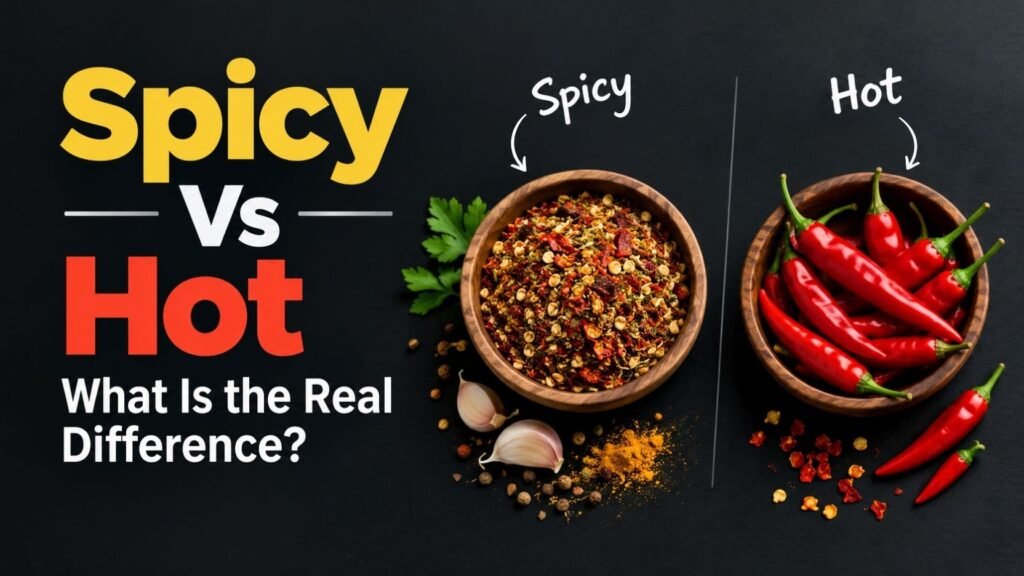
Spicy and hot are two words that most English speakers use interchangeably at the dinner table, yet they do not mean exactly the same thing. Spicy describes food that is heavily seasoned with spices, herbs, or aromatic ingredients, while hot specifically refers to the burning sensation caused by capsaicin or a similar irritant. A dish can be spicy without being hot, and a dish can be hot without being spicy in the traditional sense.
Understanding this difference matters more than it seems. It affects how you order food, how you talk to a chef or waiter, how you describe a recipe, and even how accurately you translate the idea into another language. Getting spicy and hot mixed up is one of the most common small mix-ups in everyday English, and clearing it up makes your communication sharper.
What Does Spicy Mean?
Spicy is an adjective that describes food containing a noticeable amount of spices. These spices might include cumin, cinnamon, cardamom, cloves, coriander, garlic, or ginger. The word focuses on flavor complexity rather than pain or burning heat.
A dish can be spicy and still be mild. Think of a curry loaded with cumin, turmeric, and garam masala. It tastes rich, warm, and layered, but it might not burn your mouth at all. This is the core reason people confuse the two words: many spicy dishes are also hot, so the terms blur together in casual conversation.
Simple definition: Spicy means seasoned with strong, aromatic spices that give food a bold, complex flavor.
See More: Traveling vs Travelling
What Does Hot Mean (in Food)?
Hot, when used to describe food rather than temperature, refers to the burning or stinging sensation caused by capsaicin, the active compound in chili peppers. This sensation is not really a taste. It is a pain response, triggered when capsaicin binds to receptors in your mouth that normally react to actual heat.
This is why a food scientist would say chili peppers are not truly “flavorful” in the traditional sense of sweet, salty, sour, bitter, or umami. Instead, they trigger a physical reaction that the brain interprets as heat, even though nothing about the food is thermally hot.
Simple definition: Hot means causing a burning sensation in the mouth, usually from chili peppers or capsaicin.
Spicy vs Hot: The Core Difference
| Term | What It Describes | Example |
| Spicy | Food with a strong mix of aromatic spices and complex flavor | A curry with cumin, coriander, and garam masala |
| Hot | Food with a burning, stinging sensation from chili peppers | A dish loaded with habanero or ghost pepper |
The clearest way to remember the difference: spicy is about flavor, hot is about burn.
A garam masala blend is spicy but not hot. A plain dish drenched in pure chili oil with no other seasoning is hot but not particularly spicy. Many popular dishes, like a fiery Thai curry, are both spicy and hot at the same time, which is exactly why the words get tangled together in everyday speech.
Why People Mix These Words Up
In casual American English, “spicy” has become the default word for any food that has heat, even when the dish is technically just hot from chili peppers and nothing else. Menus, food reviews, and everyday conversation almost always say “spicy” when they really mean “hot.” This is not incorrect in casual usage. Language evolves through common use, and “spicy” has broadened to cover both meanings for most people.
However, in cooking, food science, and more precise writing, the distinction still holds. A chef or a food writer aiming for accuracy will use “hot” specifically for chili heat and “spicy” for the presence of multiple seasoning spices.
Grammar of Spicy and Hot
Both words are adjectives, and both follow standard English adjective rules.
Spicy
- Part of speech: adjective
- Comparative form: spicier
- Superlative form: spiciest
- Example: “This salsa is spicier than the one we had last week.”
Hot
- Part of speech: adjective
- Comparative form: hotter
- Superlative form: hottest
- Example: “The ghost pepper sauce was the hottest thing I have ever tasted.”
Note that “hot” also has an entirely separate meaning related to temperature (a hot cup of coffee) and an informal meaning related to attractiveness or trendiness (a hot new restaurant). Context always tells you which meaning is intended. “Spicy” rarely causes this kind of confusion because its meanings stay closer together.
Common Mistakes
❌ Incorrect: “This dish is very spice.”
✅ Correct: “This dish is very spicy.”
Spice is a noun. Spicy is the adjective form used to describe food.
❌ Incorrect: “The soup was hotly seasoned.”
✅ Correct: “The soup was heavily seasoned” or “The soup was very hot.”
“Hotly” exists as an adverb, but it is used for emotional intensity, as in “she hotly denied the accusation,” not for describing food.
❌ Incorrect: “I like food that’s spicy hot.”
✅ Correct: “I like food that’s spicy and hot,” or simply “I like hot, spicy food.”
Stacking the words without a conjunction reads as unnatural in written English, even though it is common in spoken slang.
See More: Creater or Creator
Spicy vs Hot in Different Foods
Spicy vs Hot Ramen
Ramen broths often use a mix of miso, garlic, and chili oil. A shop offering “spicy” ramen usually means a broth built around complex seasoning, while “hot” ramen usually signals a spike in chili heat, sometimes adjustable by spice level. Many ramen shops let you choose a heat level from one to five, which is really a hot scale, not a spicy scale, since the base seasoning stays the same and only the chili content changes.
Spicy vs Hot Chicken
Dave’s Hot Chicken and similar Nashville-style chicken restaurants use “hot” specifically to describe the cayenne-based heat level of the chicken, ranging from mild to extra hot. This is a strong real-world example of “hot” being used correctly and precisely, since the seasoning blend stays similar across heat levels and only the chili intensity changes.
Spicy vs Hot Sauce
Hot sauce is almost always named for its burn, not its seasoning complexity. A bottle labeled “extra hot” promises capsaicin intensity. A sauce labeled “spicy” might promise a more rounded flavor from garlic, vinegar, and multiple peppers rather than pure heat.
Spicy vs Hot Mustard
Hot mustard gets its heat from mustard oil compounds released when mustard seeds are crushed and mixed with water, not from capsaicin. This is a useful example that shows “hot” is really a general word for any strong burning or sinus-clearing sensation, whether it comes from chili peppers, mustard oil, wasabi, or horseradish.
Spicy vs Hot: Measuring the Heat
The heat of chili peppers is measured using the Scoville Scale, developed by pharmacist Wilbur Scoville in 1912. This scale measures the concentration of capsaicin in Scoville Heat Units, or SHU.
| Pepper | Approximate Scoville Heat Units |
| Bell pepper | 0 |
| Jalapeño | 2,500 to 8,000 |
| Cayenne pepper | 30,000 to 50,000 |
| Habanero | 100,000 to 350,000 |
| Ghost pepper | Around 1,000,000 |
| Carolina Reaper | Over 2,000,000 |
The Scoville Scale measures “hot,” not “spicy.” There is no equivalent numeric scale for how “spicy” a dish is, because spiciness depends on flavor complexity, which is subjective and cannot be measured the way capsaicin concentration can.
Spicy vs Hot in Spanish
This distinction becomes especially important for Spanish speakers and English learners translating between the two languages. In Spanish, “picante” is the word used for the burning sensation caused by chili peppers, matching the English word “hot” in this specific food context. Spanish does not have a single widely used word that separates “seasoned with spices” from “burning hot” the way English theoretically does. “Picante” covers what English speakers usually mean by “spicy” in casual conversation. “Especiado” or “condimentado” are closer to the more technical English sense of “spicy” as seasoned, but these words are used far less often in everyday speech.
This is why many Spanish speakers learning English default to “spicy” for everything related to chili heat, since “picante” naturally translates that way in daily use.
Synonyms and Related Words
| Word | Meaning | Closest To |
| Fiery | Very intense burning heat | Hot |
| Pungent | Sharp, strong smell or taste | Spicy |
| Zesty | Lively, tangy flavor | Spicy |
| Peppery | Heat from pepper, mild to strong | Hot |
| Piquant | Pleasantly sharp or spicy flavor | Spicy |
None of these words are perfect substitutes. “Fiery” leans hardest toward pure chili burn, closest to “hot.” “Piquant” and “zesty” lean toward flavor complexity, closer to “spicy” in its more technical sense.
See More: Cosy Or Cozy
Frequently Asked Questions
What does spicy vs hot mean in food?
Spicy refers to food seasoned with a strong mix of spices, while hot refers to the burning sensation caused by capsaicin in chili peppers.
Is spicy the same as hot?
Not technically. Spicy is about flavor complexity from spices, and hot is about the physical burning sensation from chili peppers. In casual American English, though, people often use “spicy” to mean both.
Can a food be spicy but not hot?
Yes. A dish heavily seasoned with cumin, cinnamon, or garam masala can be spicy without containing any chili peppers, meaning it has no burning heat at all.
Can a food be hot but not spicy?
Yes. A plain dish with nothing but chili oil added has heat but lacks the layered seasoning that defines “spicy” in the technical sense.
Why do Americans say spicy instead of hot?
In everyday American English, “spicy” has broadened over time to cover both meanings, so most people use it as the default word for any food with noticeable heat.
What is the difference between spicy and hot ramen?
Spicy ramen usually points to a broth built on complex seasoning, while hot ramen usually points to added chili heat, often adjustable on a numbered spice level.
How is heat measured in hot food?
Chili heat is measured using the Scoville Scale, which tracks capsaicin concentration in Scoville Heat Units. There is no numeric scale for spiciness in the flavor sense.
Is hot mustard spicy or hot?
Hot mustard is hot, meaning it produces a sharp burning or sinus-clearing sensation, but this comes from mustard oil compounds rather than capsaicin.
What is the Spanish word for spicy vs hot?
Spanish typically uses “picante” for both meanings, since it does not commonly separate “seasoned with spices” from “chili hot” the way English does in careful usage.
Which is worse, hot or spicy?
This depends on personal tolerance. Hot food causes a physical burning reaction that can be uncomfortable for some people, while spicy food is generally about flavor intensity and is less likely to cause discomfort on its own.
Final Takeaway
Spicy and hot describe two different things, even though everyday English often treats them as one. Spicy points to the presence of strong, aromatic spices that build complex flavor, while hot points specifically to the burning sensation caused by capsaicin or similar compounds. Knowing this difference helps you describe food more precisely, order exactly what you want, and understand menus, recipes, and reviews with more confidence.
The next time you order food and want a specific result, it helps to ask directly: do you want bold, complex seasoning, or do you want the burn? That single question captures the entire difference between spicy and hot.

Abdul Rehman Jutt is the author behind Grammar Wordz, with 4 years of experience researching and writing about English grammar, words, meanings, and language rules. Their goal is to make grammar simple, clear, and easy to understand through accurate and useful explanations.