
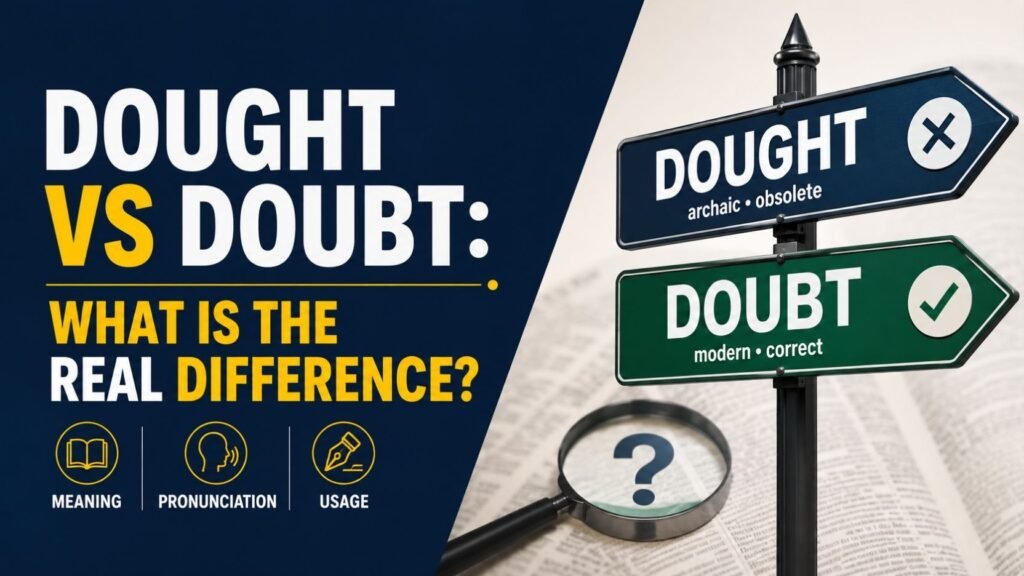
If you have ever typed “no dought” instead of “no doubt,” you already know how easy this mix-up is. Doubt is the correct, everyday word for uncertainty, hesitation, or a lack of full belief in something. Dought is not a common English word at all. It is an old, mostly forgotten form of the verb “dow,” and in modern writing it almost always shows up as a simple misspelling.
That single fact solves most of the confusion right away. But the story behind dought is more interesting than “just a typo.” It has a real history in Old and Middle English, it still appears in dictionaries as an archaic word, and it gets confused with two completely different words: doubt and dough. This guide walks through the meaning, grammar, pronunciation, and origin of both dought and doubt, so you never have to guess again.
Quick Answer: Dought vs Doubt
| Word | Status in modern English | Simple meaning | Typical use today |
| Doubt | Standard, everyday word | A feeling of uncertainty or a lack of confidence in something | Common in speech and writing, as both a noun and a verb |
| Dought | Archaic, rarely used | An old past-tense form of “dow,” meaning “was able to” or “thrived”; also an old noun for strength or worth | Almost never used correctly; usually a misspelling of doubt or dough |
The short version: if you are unsure which word to type, choose doubt. Dought will not be flagged by most spell-checkers because it is a real historical word, but it will confuse nearly every modern reader.
See More: Chonies vs Chones
What Does Dought Mean?
Dought is a genuine English word, just an extremely old and rarely used one. It comes from the same word family as “doughty,” meaning brave or valiant, and it has two related meanings from history.
Meaning 1: An archaic past tense of “dow.” “Dow” is an old verb still found in Scots and northern English dialects. It means “to be able” or “to thrive, prosper, do well.” Dought is its past-tense form. In this sense, “he dought” means roughly “he was able to” or “he managed to,” similar to how “could” works today.
Meaning 2: An old noun for strength, worth, or manhood. In Middle English, dought (sometimes spelled “duȝethe” in early texts) referred to power, ability, or a body of capable people, such as troops or retainers. This sense is directly related to “doughty,” the adjective still used today to describe someone brave or stouthearted.
Neither of these meanings has anything to do with uncertainty. That is worth repeating, because it is the single most useful fact in this whole comparison: dought and doubt are not variant spellings of the same idea. They are two different words that happen to look similar on a page.
Is Dought a Real Word?
Yes, technically. Dictionaries such as Wiktionary and the English Dialect Dictionary list dought as an archaic or dialectal term tied to Scotland and northern England. It is also a valid word in competitive Scrabble under some word lists.
However, “real” in the dictionary sense does not mean “usable” in the practical sense. Outside of historical fiction, dialect writing, or a linguistics discussion like this one, dought has no place in modern English.
What Does Doubt Mean?
Doubt is a live, everyday word. As a noun, it describes a state of uncertainty or a lack of full belief, the feeling you get when your mind cannot fully commit to one side of a question. As a verb, it describes the action of feeling that uncertainty toward something or someone.
- Noun example: She doubted whether the plan would work.
- Verb example: He doubted the accuracy of the report.
Doubt carries a specific emotional flavor: hesitation, skepticism, and a sense that something has not been fully proven or trusted. It is not the same as outright disbelief. Doubt sits in the middle ground, between full confidence and full rejection.
Doubt As A Noun
As a noun, doubt refers to the state or feeling itself.
- Countable use: “She raised a few doubts about the budget.”
- Uncountable use: “There was doubt in his voice.”
Doubt As A Verb
As a verb, doubt means to be uncertain about something, to question its truth, or to lack confidence in it.
- “I doubt that he will show up on time.”
- “She doubted her own judgment after the mistake.”
Doubt can also pair with “that,” “whether,” or “if” to introduce the thing being questioned: “I doubt that it will rain,” or “I doubt whether she remembers.”
Dought Vs Doubt: Meaning, Grammar And Usage Side By Side
| Category | Dought | Doubt |
| Part of speech | Archaic verb (past tense of “dow”); historical noun | Noun and verb in modern English |
| Core meaning | “Was able to” or “thrived” (verb); strength or worth (noun) | Uncertainty, hesitation, or lack of confidence |
| Modern status | Obsolete, dialect only | Fully active, standard English |
| Pronunciation | Rhymes with “thought” or “sought” | Rhymes with “out,” with a silent b |
| Common today because of | Misspelling of doubt or dough | Correct, widely used spelling |
| Appears in dictionaries | Yes, marked archaic or dialectal | Yes, as a core vocabulary word |
| Safe to use in writing | Only in deliberate historical or dialect contexts | Yes, in all standard writing |
Grammar: Part Of Speech Breakdown
Understanding the grammar of each word makes the difference even clearer.
Dought (Archaic Verb and Noun)
- As a verb, dought is the simple past tense of “dow.” It behaves the way “could” or “managed” behaves in a sentence: “He dought not speak against the king’s command.”
- As a noun, dought is uncountable and historical, referring to strength, valor, or worth: “The knight’s dought was legendary in old ballads.”
- Dought has no standard modern verb forms such as “doughting” or “doughts.” It essentially froze in time centuries ago.
Doubt (Noun And Verb)
Doubt is fully conjugated and flexible in modern English.
| Form | Example |
| Base verb | doubt |
| Third person singular | doubts |
| Past tense | doubted |
| Present participle | doubting |
| Noun (singular) | doubt |
| Noun (plural) | doubts |
| Adjective | doubtful |
| Adverb | doubtfully, doubtless |
This flexibility is one more sign that doubt is a living, working part of the English language, while dought is a linguistic fossil.
How To Pronounce Doubt And Dought
Pronunciation is where these two words split apart even more clearly, because they do not rhyme.
Doubt is pronounced /daʊt/, close to “dout.” The letter b is completely silent. Say it out loud: it should sound exactly like the word “out” with a d in front of it.
Dought, where it survives in dialect and historical texts, is generally pronounced to rhyme with “thought,” “sought,” or “bought,” closer to /dɔːt/. This makes sense once you remember it comes from the same root as “doughty,” not from “doubt” at all.
💡 Tip: If you say doubt and dought out loud, they do not sound alike. That is one more clue that they are unrelated words, not two spellings of one idea.
Why The Letter B Is Silent In Doubt?
Many learners ask why doubt has a b if nobody says it. The answer goes back to Latin. Doubt comes from the Old French “douter” or “doute,” which in turn traces back to Latin “dubitare,” meaning to waver or be uncertain.
Dubitare contains a hard b sound. When the word passed into English, scholars in the 1400s and 1500s deliberately added the silent b back into the spelling to show the word’s Latin ancestry, even though English speakers had already dropped the sound from pronunciation. Words such as “debt” and “subtle” went through the same process for the same reason.
So the silent b in doubt is not random. It is a spelling choice made centuries ago to honor the word’s Latin roots, even while the pronunciation kept moving forward without it.
Origin And Etymology Of Doubt
Doubt has a clear and well-documented history.
- It began with the Latin verb “dubitare,” meaning to waver, hesitate, or be uncertain.
- Dubitare is related to the Latin word for “two” or “double,” reflecting the idea of a mind pulled between two possibilities.
- The word passed into Old French as “douter” or “doute.”
- Middle English borrowed it as “douten” or “doute” around the 13th century.
- Later English spelling added the silent b to echo the Latin original, giving us “doubt.”
This is why doubt and double share a distant family connection. Both point back to the concept of “two,” whether that means two of something or a mind split between two possible answers.
Origin And Etymology Of Dought
Dought has a very different, and older, path.
- It traces back to the Old English verb “dugan,” meaning to avail, to be useful, or to be worthy.
- The Old English past-tense form was “dohte.”
- This developed into Middle English “doghte,” which became “dought” or “doucht” in Scots.
- Separately, dought also functioned as a noun through Middle English “duȝethe” or “duhethe,” from Old English “duguþ,” meaning manhood, host, or troops, ultimately from a Proto-Germanic root meaning power or competence.
- The word “doughty,” still used today to mean brave or stouthearted, comes from this same family.
Notice that this entire history runs on a completely different track from doubt’s Latin-and-French journey. The two words never crossed paths historically. Their modern collision is purely a coincidence of spelling.
See More: Color Or Colour
Why People Confuse Dought And Doubt?
If dought and doubt come from entirely different roots, why do so many people type one instead of the other? A few practical reasons explain it.
- Visual similarity. Both words share the letters d, o, u, and t in a similar order, so a quick typing mistake can turn “doubt” into “dought” without the writer noticing.
- Autocorrect gaps. Because dought is a real, dictionary-listed word, some spell-checkers do not flag it as an error, even though it is the wrong word for the sentence.
- Sound-based spelling guesses. Some writers, especially those still learning English spelling rules, try to sound out doubt and land on dought because it looks like it should be pronounced with a hard “t” sound at the end, closer to how it reads.
- Confusion with dough. A separate group of people are not thinking about doubt at all. They are trying to type “dough,” as in bread dough, and their fingers slip in an extra letter or their memory of the spelling gets tangled.
Both explanations are common, which is why “dought” shows up attached to two very different groups of search terms: uncertainty phrases like “no dought” and food phrases like “cookie dought.”
Common Mistakes: Incorrect vs Correct
Here are the most frequent real-world mix-ups, shown side by side.
❌ Incorrect: I have no dought about your ability.
✅ Correct: I do not doubt your ability.
❌ Incorrect: She was full of self dought after the interview.
✅ Correct: She was full of self doubt after the interview.
❌ Incorrect: Without a dought, this is the best option.
✅ Correct: Without a doubt, this is the best option.
❌ Incorrect: When in dought, ask a question.
✅ Correct: When in doubt, ask a question.
❌ Incorrect: I dought that he finished the report on time.
✅ Correct: I doubt that he finished the report on time.
In every one of these cases, the writer means uncertainty, so doubt is the correct choice. None of them are describing old-fashioned ability or strength, which is the only situation where dought would technically apply, and even then only in deliberately archaic writing.
Dought vs Dough: The Other Common Mix-Up
A large share of searches for “dought” are not about doubt at all. They are misspellings of dough, the soft mixture of flour, water, and other ingredients used to make bread, pizza, cookies, and pastry. This is a separate confusion from the doubt mix-up, but it is common enough to deserve its own explanation.
| Search term typed | What the writer almost always means |
| Cookie dought | Cookie dough |
| Pizza dought | Pizza dough |
| Sour dought | Sourdough |
| Play dought | Play dough |
| Edible cookie dought | Edible cookie dough |
| Self dought | Self doubt |
| No dought | No doubt |
Dough comes from the Old English word “dag,” related to the idea of kneading or shaping. It has nothing to do with doubt or dought in either meaning or origin. The only thing all three words share is a similar string of letters, which is exactly why they get typed interchangeably by mistake.
⚠️ Common mistake: Typing “sour dought starter” instead of “sourdough starter,” or “pizza dought recipe” instead of “pizza dough recipe.” Search engines and recipe sites will usually still understand the intent, but the correct spelling in any written recipe, blog post, or message should always be dough, not dought.
Common Phrases That Use Doubt
Doubt appears in many everyday expressions. Here are the ones people search for most.
- No doubt: Meaning “certainly” or “without question.” Example: “No doubt, she worked hard for this.”
- Without a doubt: A stronger version of the same idea, used to emphasize total certainty. Example: “He is, without a doubt, the best candidate.”
- Benefit of the doubt: Meaning to trust someone’s good intentions even when there is uncertainty about their actions. Example: “I’ll give him the benefit of the doubt this time.”
- When in doubt: A phrase used to introduce advice for uncertain situations, often followed by a recommended action, such as “when in doubt, ask” or “when in doubt, don’t.”
- Self doubt: A noun phrase describing a lack of confidence in one’s own abilities or decisions. Example: “Self-doubt kept her from applying for the job.”
- Reasonable doubt: A legal standard used in criminal trials. A jury must be convinced of guilt beyond reasonable doubt, meaning there is no logical, sensible reason to question the verdict. The phrase is also the title of a television legal drama, which is a separate, unrelated use of the same words in pop culture.
- No Doubt: Beyond the phrase itself, “No Doubt” is also the name of a well-known American rock band, fronted by Gwen Stefani, active from the late 1980s onward. This is simply a proper noun that borrows the everyday phrase.
Synonyms Of Doubt And How They Differ
Doubt has several near-synonyms, but each one carries a slightly different shade of meaning.
| Word | Meaning | How it differs from doubt |
| Uncertainty | Not knowing something for sure | Broader and more neutral; doubt often implies a leaning toward disbelief |
| Skepticism | A habitual, questioning attitude toward claims | Suggests a personality trait or stance, not just a single feeling |
| Suspicion | A feeling that something may be wrong or dishonest | Carries a stronger negative or distrustful edge than doubt |
| Hesitation | A pause before acting or deciding | Focuses on delayed action rather than belief |
| Distrust | A lack of confidence in a person’s honesty or reliability | Aimed specifically at people, not facts or ideas |
| Disbelief | A refusal to accept something as true | Stronger and more final than doubt, which allows for some uncertainty either way |
None of these words are true substitutes for dought, because dought is not part of this meaning family at all. If you are ever unsure whether to reach for a synonym of doubt, dought should never be on that list.
Dought And Doubt In Different Languages
Because “dought” and “doubt” appear together in search terms across regions, it is worth clarifying a related point: doubt is an English word, and its equivalents in other languages look and sound different.
- In Hindi, “doubt” is commonly translated as “sandeh” (संदेह) or “shak” (शक), depending on context.
- In Tagalog, “doubt” is often rendered as “duda,” borrowed from Spanish.
Dought does not have meaningful equivalents in other languages because it is not part of active, modern vocabulary anywhere, including in English.
Examples Of Doubt Used Correctly
A few clear, natural examples make the correct usage easy to remember.
- The scientist expressed doubt about the accuracy of the early results.
- I have serious doubts about this plan working out.
- She doubted whether the flight would leave on time.
- There is no doubt that practice improves performance.
- His doubt grew the longer he waited for a reply.
- Give her the benefit of the doubt; she may not have known the rule.
Is Dought Ever the Correct Choice?
There are exactly two situations where using dought is appropriate.
- Deliberate historical or dialect writing. If you are writing fiction set in medieval Scotland or northern England, or recreating an old English speech pattern, dought can add authenticity. Example: “He dought not defy the laird’s word.”
- Discussing the word itself. Linguistic articles, word-history discussions, or Scrabble strategy pieces may reference dought directly, exactly as this article does.
Outside of those two narrow cases, dought should not appear in modern writing. Emails, essays, articles, business reports, and everyday conversation should always use doubt when the meaning involves uncertainty, and dough when the meaning involves baking.
Frequently Asked Questions
What does dought mean?
Dought is an archaic English word. As a verb, it is the old past tense of “dow,” meaning “was able to” or “thrived.” As a noun, it once meant strength, worth, or valor, related to the word “doughty.”
Is dought a real word?
Yes, it appears in dictionaries as an archaic or dialectal term from Scotland and northern England. However, it is essentially unused in modern standard English.
Is dought the correct spelling of doubt?
No. Dought and doubt are two separate words with different origins and meanings. When you mean uncertainty, the correct spelling is always doubt.
Why do people write “no dought” instead of “no doubt”?
It usually happens because the words look similar when typed quickly, and because dought is a real dictionary word, so some spell-checkers do not flag it as wrong even though it is the wrong word for the sentence.
Is dought related to dough?
Not directly by origin, but the two words are often confused in spelling because they look alike. People typing “cookie dought” or “pizza dought” almost always mean “cookie dough” or “pizza dough.”
How do you pronounce doubt?
Doubt is pronounced /daʊt/, rhyming with “out.” The letter b is silent.
How do you pronounce dought?
Where it survives, dought is generally pronounced to rhyme with “thought” or “bought,” not with “doubt.”
Is doubt a noun or a verb?
Doubt can be both. As a noun, it means a feeling of uncertainty. As a verb, it means to feel that uncertainty toward something.
What is a synonym for doubt?
Common synonyms include uncertainty, skepticism, hesitation, and suspicion, though each carries a slightly different shade of meaning.
What does “benefit of the doubt” mean?
It means choosing to trust someone’s good intentions or honesty, even when there is some uncertainty about the full situation.
See More: No Difference Vs No Different
Conclusion
Doubt is the word you almost always want. It is a fully active part of modern English, used as both a noun and a verb to describe uncertainty, hesitation, or a lack of full confidence in something. Dought, by contrast, is a genuine but archaic word with roots in Old English, tied historically to ideas of ability and strength rather than uncertainty at all. The two words simply happen to look alike on the page, which is the entire reason the confusion exists.
The next time you type a sentence about uncertainty, reach for doubt. If you are writing about bread, pizza, or cookies, reach for dough. Save dought for historical fiction, dialect writing, or conversations about English word history, exactly like the one you just read.

Abdul Rehman Jutt is the author behind Grammar Wordz, with 4 years of experience researching and writing about English grammar, words, meanings, and language rules. Their goal is to make grammar simple, clear, and easy to understand through accurate and useful explanations.