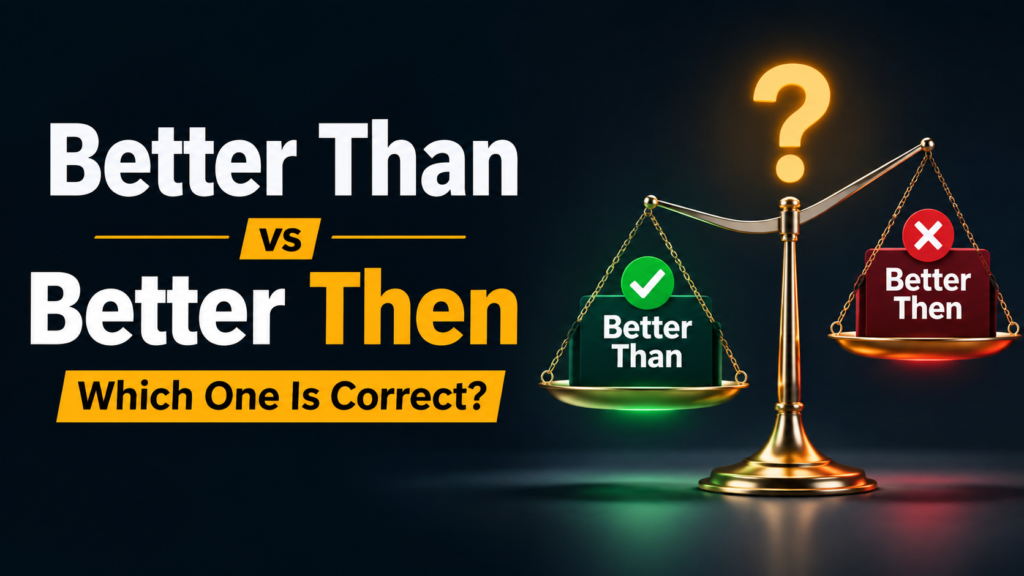
The correct phrase is better than, not better then. “Than” is used to compare two things, while “then” refers to time or sequence. So when you are comparing one thing to another, such as saying one option is more suitable, more effective, or more enjoyable than another, “than” is the word you need.
This mix-up is one of the most common spelling confusions in English. The two words sound almost identical when spoken quickly, and their spellings differ by only one letter. Understanding the difference matters for clear writing, whether you are texting a friend, writing a school essay, or publishing content online. Once you learn the simple trick behind them, you will never mix them up again.
Better Than or Better Then: The Quick Answer
If you remember only one rule, remember this: “than” compares, “then” tells time. “Better than” is a comparison between two people, things, or ideas. “Better then” is grammatically incorrect in almost every case, because “then” does not belong in a comparison at all.
Here is the simplest way to check your own sentence. Try replacing the word with “compared to.” If the sentence still makes sense, you need “than.” If it does not make sense, you likely need “then” instead, or the sentence needs a different word altogether.
| Phrase | Correct? | Why |
| This phone is better than that one | ✅ Correct | Comparing two phones |
| I felt sick, and then I felt better | ✅ Correct | Describing a sequence of events |
| This phone is better then that one | ❌ Incorrect | “Then” cannot be used for comparison |
| Better then ever | ❌ Incorrect | Should be “better than ever” |
Than vs Then: Understanding the Core Difference
What “Than” Means
“Than” is a conjunction, and sometimes a preposition, used specifically to introduce the second part of a comparison. It shows that two things are being measured against each other in terms of quality, quantity, degree, or preference.
Examples:
- She is taller than her brother.
- This laptop runs faster than my old one.
- Nothing tastes better than fresh bread.
In each example, “than” connects two things being compared. There is no sense of time involved at all.
What “Then” Means
“Then” is an adverb that relates to time, sequence, or consequence. It answers questions like “when” or “what happened next,” or it introduces a result based on a condition.
Examples:
- We had dinner, and then we watched a movie.
- If it rains, then bring an umbrella.
- Back then, phones did not have cameras.
Notice that none of these sentences involve comparing two things. “Then” is about order, timing, or cause and effect.
| Word | Part of Speech | Function | Example |
| Than | Conjunction/preposition | Comparison | Coffee is stronger than tea |
| Then | Adverb | Time, sequence, or result | I finished work, then I went home |
Why People Confuse Better Than and Better Then
The confusion happens for a few clear reasons, and understanding them can help the correct spelling stick in your memory.
- They sound alike. In fast, casual speech, “than” and “then” often blend together, especially in American English. Many people learn the phrase by ear before they learn to spell it, so the error carries over into writing.
- They differ by one vowel. The words look almost identical on the page. A quick typing mistake or a moment of not thinking can easily swap the “a” for an “e.”
- Autocorrect does not always catch it. Since both “than” and “then” are real, correctly spelled words, spell checkers usually will not flag the mistake. Grammar checkers catch it more often, but not always.
- Early learning habits stick. Many people learn “then” first, since it appears constantly in storytelling (“and then…”) from a young age. This familiarity can make “then” feel like the safer default, even when a comparison is happening.
How to Never Mix Them Up Again
Here are simple memory tricks that make the difference stick.
- “Than” has an A, like “compArison.” Both words contain the letter A, which can help you remember that “than” belongs in comparisons.
- “Then” has an E, like “timE” or “nExt.” This links “then” to sequence and timing.
- Try the swap test. Replace the word with “compared to.” If the sentence still works, use “than.” If it sounds odd, use “then,” or reconsider the sentence.
- Read the sentence aloud slowly. Slowing down often reveals which meaning you actually intend, comparison or sequence.
💡 Tip: If your sentence has two things being weighed against each other, such as two objects, two people, or two choices, “than” is almost always correct.
Better Than: Correct Usage and Examples
“Better than” is used constantly in everyday English, across writing styles from casual conversation to formal reports. It expresses that one thing is superior, preferred, or more effective compared to another.
Common Sentence Patterns
- [Something] is better than [something else]
- [Someone] is better than [someone else] at [activity]
- Better than nothing
- Better than expected
- Better than ever
Examples in Context
- Honey is often considered better than sugar for certain recipes because of its flavor and moisture content.
- Brown rice is generally seen as better than white rice for fiber content, since it retains the bran and germ layers.
- Getting a partial refund is better than getting nothing at all.
- The team performed better than expected this season.
- Sales this quarter were better than ever.
Each of these examples includes a direct comparison. Two options, outcomes, or time periods are being measured against one another, which is exactly when “than” belongs.
“Better Than” With Comparisons People Often Search For
Many comparison questions follow this exact pattern, comparing two products, ideas, or preferences. The grammar rule stays the same no matter what is being compared.
- Is DisplayPort better than HDMI for gaming monitors, depends on your specific resolution and refresh rate needs.
- Is platinum better than gold, depends on whether you value density and rarity over gold’s traditional appeal and lower price.
- Whether one AI assistant is better than another often depends on the specific task, since different tools have different strengths.
Notice that the grammar question (“than” not “then”) is separate from the opinion question (which option is actually better). This article focuses only on the grammar and does not rank specific products or brands, since that answer depends on personal needs and current, verified information.
Better Then: When Is It Ever Correct?
“Better then” is grammatically incorrect as a standalone comparison phrase. However, the words “better” and “then” can appear next to each other correctly in one specific situation: when “then” is doing its normal job of showing sequence, and “better” happens to sit beside it by coincidence of sentence structure.
Example:
- I felt sick on Monday. I felt better, then I relapsed again by Wednesday.
Here, “better” describes a state of health, and “then” introduces what happened next in time. The two words are not forming the phrase “better then” as a single unit. They are simply two separate words that happen to sit near each other. This is different from writing “This is better then that,” where “then” is being used incorrectly to mean “than.”
⚠️ Common mistake: Writing “our deals are better then ever” instead of “our deals are better than ever.” Since this phrase is a comparison to a previous state (no deal has ever been this good), it requires “than.”
Common Mistakes With Better Than and Better Then
| Incorrect | Correct | Why |
| This is better then that | This is better than that | Direct comparison needs “than” |
| Nothing better then this | Nothing better than this | Comparison, not sequence |
| Our deals are better then ever | Our deals are better than ever | Comparing to all previous deals |
| I feel better then I did yesterday | I feel better than I did yesterday | Comparing today to yesterday |
| Why are dogs better then cats | Why are dogs better than cats | Comparing two animals |
Quick Correct vs Incorrect Reference
❌ Incorrect: Bread tastes better then it did before.
✅ Correct: Bread tastes better than it did before.
❌ Incorrect: This method works better then tariffs.
✅ Correct: This method works better than tariffs.
❌ Incorrect: Is it better then or better than to ask first?
✅ Correct: Is it better than or better then to ask first? (Asking which spelling is correct, “than” is the right word for comparisons.)
“Better Than” in Idioms and Common Expressions
Several well-known expressions and phrases use “better than” specifically because they involve comparison.
- Better than nothing: Used when something is imperfect but still an improvement over having nothing at all.
- Better than expected: Used when an outcome exceeds what was predicted.
- Better late than never: A well-known saying meaning it is preferable to do something late rather than not at all. Note that this phrase specifically uses “than,” since it compares two situations, being late versus never happening.
- Obedience is better than sacrifice: A well-known phrase with biblical origins, found in the Book of Samuel, used to express that genuine compliance with instructions matters more than symbolic gestures.
Each of these idioms relies on comparison, which is exactly why “than” appears in every one of them.
Grammar Deep Dive: Than as a Conjunction vs Preposition
For readers who want a more precise grammar explanation, “than” can function in two slightly different ways.
As a conjunction, “than” connects two clauses:
- She runs faster than he does.
As a preposition, “than” connects to a noun or pronoun directly:
- She runs faster than him.
Both structures are widely used and accepted in everyday English, though some formal writing guides prefer the conjunction form with a full clause. Either way, the key point remains the same: “than” is doing comparison work, which “then” simply cannot do.
Pronunciation Note
Both words are pronounced very similarly in casual American English, which adds to the confusion.
- Than is typically pronounced with a short “a” sound, similar to “then” but slightly more open, roughly “th-an.”
- Then is pronounced with a short “e” sound, roughly “th-en.”
In relaxed speech, both often reduce to a quick, unstressed sound, which is part of why the written mix-up is so common even among fluent speakers.
Similar Word Pairs Readers Often Confuse
“Than” and “then” are not the only commonly confused word pair in English. A few others follow a similar pattern, where two words sound alike but serve different grammatical roles.
| Pair | Difference |
| Than / Then | Comparison vs time or sequence |
| Affect / Effect | Verb (to influence) vs noun (a result) |
| Its / It’s | Possession vs contraction of “it is” |
| Your / You’re | Possession vs contraction of “you are” |
Learning the “than for comparison, then for time” rule can also make it easier to remember similar distinctions elsewhere in English grammar.
Frequently Asked Questions
Is it “better than” or “better then”?
It is “better than.” Use “than” whenever you are comparing two things. “Then” is reserved for describing time or sequence.
Why do people write “better then” instead of “better than”?
The two words sound similar in casual speech, and they differ by only one letter, which makes the mistake easy to make, especially when typing quickly.
Is “then” ever correct near the word “better”?
Yes, but only when “then” is describing a sequence of events, such as “I felt better, then I got worse again.” In that case, “then” is not part of a comparison phrase.
Does spell check catch the “than” and “then” mistake?
Not always. Both words are spelled correctly on their own, so basic spell checkers often miss the error. Grammar-focused tools are more likely to catch it, though not in every case.
What is a simple trick to remember the difference?
Try replacing the word with “compared to.” If the sentence still makes sense, “than” is correct. If it does not, you likely need “then,” or a different word entirely.
Is “better than” a comparative phrase?
Yes. “Better” is the comparative form of “good,” and it is almost always followed by “than” when a direct comparison is being made.
Which is correct: “nothing better than this” or “nothing better then this”?
“Nothing better than this” is correct, since it compares “this” to everything else.
Is “better than” formal or informal?
“Better than” works in both formal and informal writing. It is a standard comparative structure used in everyday conversation, academic writing, and professional content alike.
Conclusion
The rule behind “better than or better then” comes down to one simple distinction. “Than” is used for comparisons between two things, while “then” is used for time, sequence, or consequence. Since “better” is a comparative word, it is almost always followed by “than,” not “then.” Keeping this one rule in mind, and using the quick “compared to” replacement test, will help you get it right every time.
Small grammar mistakes like this one are easy to fix once you understand the reasoning behind them, rather than just memorizing the correct spelling. Whether you are writing a casual message, a business email, or a piece of published content, using “better than” correctly in comparisons will make your writing clearer and more polished.

Abdul Rehman Jutt is the author behind Grammar Wordz, with 4 years of experience researching and writing about English grammar, words, meanings, and language rules. Their goal is to make grammar simple, clear, and easy to understand through accurate and useful explanations.