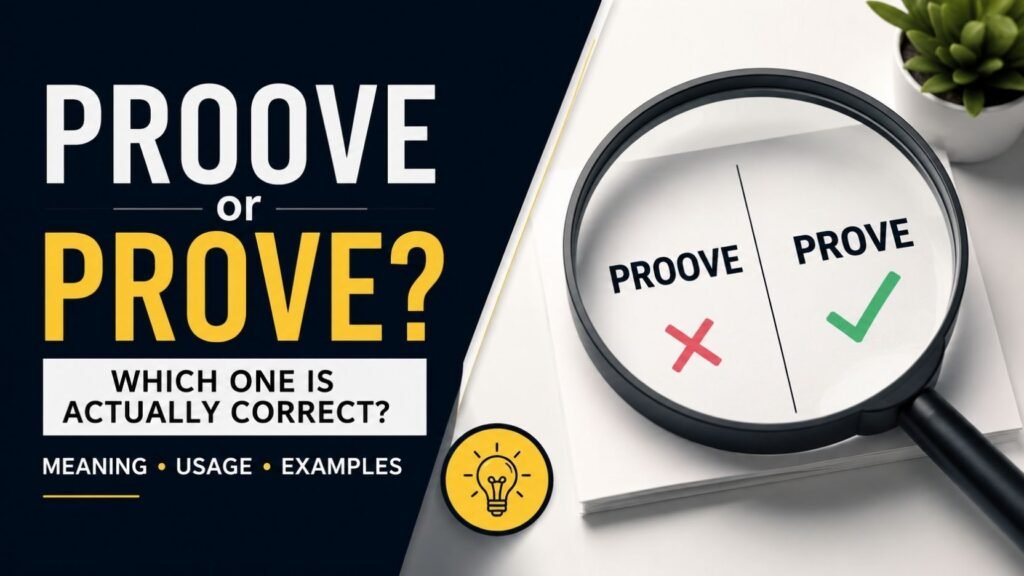
If you have ever paused mid-sentence wondering whether to write “proove” or “prove,” you are not alone. The correct spelling is prove. Proove is not a standard English word, no matter how often it shows up in comments, texts, or quick typing. Prove is the verb you use when you want to show that something is true.
This confusion is easy to understand. Many English words that sound similar to prove are spelled with a double vowel, like “loose” or “choose.” That pattern makes “proove” feel like it should be right, even though it isn’t. Getting this spelling correct matters for schoolwork, professional writing, and everyday messages, because a misspelled word can distract a reader from your actual point. Understanding why prove is correct also helps you spell related words like proved and proven with more confidence.
What Does Prove Mean?
At its core, prove means to show that something is true through evidence, facts, logic, or a demonstrated result. It is one of the most common verbs in English, used in conversation, science, law, mathematics, and everyday arguments alike.
Here are the main ways prove is used:
- To show something is true. “The test results prove the theory works.”
- To demonstrate a quality through action. “She proved her loyalty over many years.”
- To turn out to be, in a particular way. “The trip proved to be more expensive than planned.”
- In baking, to let dough rise. This use is more often spelled “proof,” though “prove” appears in British recipes too.
Each of these uses relies on the same idea: something becomes clear or confirmed, either through evidence or through the way events unfold.
Is It Proove Or Prove? The Simple Answer
Prove is the only correct spelling. Proove has never been an accepted spelling in standard English dictionaries, whether American or British. It is a common misspelling, not an alternate form.
The confusion usually comes from one of these patterns:
- Words like “groove,” “loose,” and “goose” use a double “o” for a similar-sounding vowel.
- Fast typing on a phone or keyboard can easily add an extra letter.
- Some brand names use “Proove” as a stylized spelling, which can make the word look more familiar than it should.
None of these reasons make “proove” correct in standard writing. If you are writing an email, an essay, a resume, or a social media post and want it to read as polished, prove is the spelling to use every time.
Prove: Part of Speech and Grammar
Prove is a verb. It is what grammarians call an irregular verb, which means its past tense and past participle do not simply add “-ed” the way regular verbs do.
| Form | Word | Example |
| Base form | prove | I will prove my point tomorrow. |
| Past tense | proved | She proved the theory last year. |
| Past participle | proved or proven | The claim has been proved. / The claim has been proven. |
| Present participle | proving | He is proving his skills every day. |
| Third person singular | proves | The evidence proves his innocence. |
The past participle is where prove gets slightly more interesting. Both “proved” and “proven” are correct in modern English, though they are used a little differently depending on context and region.
Proved Vs Proven: What Is the Difference?
Both words are grammatically acceptable as the past participle of prove, but usage tends to split along a few lines:
- Proved is more common directly after “have,” “has,” or “had,” especially in American English. Example: “He has proved his point.”
- Proven is more common as an adjective before a noun. Example: “a proven method,” “a proven fact.”
- Proven is also widely used in Scottish legal language, most famously in the verdict “not proven.”
- In British English, “proved” is generally preferred in verb form, while “proven” is still common as an adjective.
If you are ever unsure, “proved” is the safer default choice after have or has, and “proven” works well when describing a noun directly.
How to Pronounce Prove
Prove is pronounced the same way whether it appears in American or British English.
- Simple pronunciation: proov
- IPA: /pruːv/
- Rhymes with: move, groove, improve
This is actually part of why “proove” feels like a natural spelling. The long “oo” sound in prove matches words that are spelled with a double “o,” even though prove itself is not. Say the word out loud and you will notice it rhymes cleanly with “move” and “groove,” both of which happen to use different spelling patterns for the same vowel sound.
Where Does the Word Prove Come From?
Prove has roots going back to Old French “prover” and Latin “probare,” meaning to test, to approve, or to demonstrate the quality of something. That Latin root, “probare,” is also connected to the modern English words “probe” and “probable.”
Over centuries, the word entered English through Old French into Middle English, keeping its core meaning of testing or demonstrating truth. The idea of “testing” something to establish its truth is still present in modern usage, especially in phrases like “the proof is in the testing” or scientific contexts where a hypothesis is “proved” through experiment.
Prove In Different Contexts
The exact meaning of prove shifts slightly depending on where it appears. Here are some of the most common contexts.
Prove in Everyday Conversation
In daily speech, prove often means to show something is true through evidence or argument.
- “Can you prove that you were home last night?”
- “I don’t need to prove anything to you.”
Prove It
“Prove it” is a short, direct challenge. It is used when someone doubts a claim and wants evidence before believing it. This phrase is common in casual arguments, debates, and even memes, where it signals skepticism toward a bold statement.
Prove Me Wrong
“Prove me wrong” is a confident challenge, often used when someone is very sure of their opinion. It invites the other person to bring evidence or a strong argument that contradicts the original claim. This phrase is especially common online, in debates, and in viral video formats where someone states an opinion and invites public disagreement.
Prove In Law
In legal contexts, to prove something means to establish it as fact using accepted evidence, according to a required standard, such as “beyond a reasonable doubt” in criminal cases or “the preponderance of the evidence” in civil cases. Legal writing relies heavily on precise use of prove, since the entire outcome of a case can depend on what has or has not been proved.
Prove In Baking
In baking, letting dough rest so it can rise is sometimes called “proving,” particularly in British English recipes. In American English, “proofing” is the more common term for the same step. Both describe the process of letting yeast activate and expand the dough before baking.
Prove As A Business Or Brand Name
Some companies use “Proove” as a stylized brand name, often in fields like biosciences or consumer products. A stylized brand name does not change the standard spelling rule for the English verb. In ordinary writing, when you mean the action of showing something is true, prove remains the only correct choice.
Common Mistakes With Proove or Prove
Here are the most frequent mistakes people make, along with the correct version.
✅ Correct: I can prove my point with data.
❌ Incorrect: I can proove my point with data.
✅ Correct: She proved the theory correct.
❌ Incorrect: She prooved the theory correct.
✅ Correct: This has been a proven method for years.
❌ Incorrect: This has been a prooven method for years.
⚠️ Common mistake: Adding an extra “o” because prove rhymes with words like “groove” or “loose,” which really are spelled with a double vowel.
💡 Tip: If you’re unsure while typing quickly, say the word out loud. It sounds like “proove,” but remember it’s written as prove, with a single “o.”
Prove Vs Similar Words
It also helps to know how prove compares to a few related words that sometimes get mixed up.
| Word | Meaning | How It Differs From Prove |
| Proof | A noun meaning evidence that something is true | Proof is the evidence itself; prove is the action of demonstrating it |
| Approve | To officially agree to or accept something | Approve is about permission or agreement, not evidence |
| Improve | To make something better | Improve is about quality getting better, unrelated to evidence |
| Probe | To investigate or examine closely | Probe is about investigating, which may lead to proving something, but is a separate step |
Notice that “proof,” “approve,” “improve,” and “probe” all share the same Latin root as prove, which is part of why they can feel connected in meaning as well as sound.
Synonyms For Prove
Depending on context, these words can work as alternatives to prove:
- Demonstrate – often used in formal or technical writing
- Confirm – used when verifying something already suspected
- Verify – common in scientific or technical contexts
- Establish – often used in legal or academic writing
- Show – a simple, everyday alternative
Each of these carries a slightly different tone. “Demonstrate” and “establish” sound more formal, while “show” fits casual conversation better.
Examples Of Prove In A Sentence
- The lab results prove that the treatment works as expected.
- He wanted to prove himself capable of handling the new role.
- No one could prove where the missing files had gone.
- Time will prove whether this decision was the right one.
Each of these examples uses prove in a slightly different way, but the core meaning stays consistent: something becomes clear or confirmed through evidence or outcome.
Frequently Asked Questions
Is it proove or prove?
It is prove. Proove is a common misspelling and is not recognized as a standard English word in any major dictionary.
What does prove mean?
Prove means to show that something is true using evidence, facts, or a demonstrated result.
Is prove a noun or a verb?
Prove is a verb. The related noun form is “proof.”
What is the past tense of prove?
The past tense is “proved.” The past participle can be either “proved” or “proven,” depending on context.
Is proven or proved more correct?
Both are correct. “Proved” is more common right after have, has, or had, while “proven” is more common as an adjective, as in “a proven method.”
How do you pronounce prove?
Prove is pronounced “proov,” with a long “oo” sound, similar to “move” or “groove.”
Why do people spell it proove?
Because prove rhymes with words like “groove,” “loose,” and “goose,” which are spelled with a double “o.” That similarity in sound leads many people to spell prove the same way, even though the spelling rule is different.
Is proove ever correct in any dialect of English?
No. Proove is not accepted in American English, British English, or any other standard English dialect. It is considered a spelling error wherever it appears.
What is the difference between prove and proof?
Prove is a verb describing the action of demonstrating truth. Proof is a noun describing the evidence itself.
Can prove be used in baking?
Yes. In British English, letting dough rise before baking is often called “proving.” American English more commonly uses “proofing” for the same process.
Final Thoughts
Between proove or prove, only one spelling belongs in standard English: prove. It comes from Latin roots tied to testing and demonstrating truth, and it has kept that core meaning for centuries, whether you’re talking about scientific evidence, a legal case, or simply backing up something you said in conversation. Once you separate the spelling from the sound, the confusion tends to disappear for good.
The next time you’re tempted to add an extra “o” because prove sounds like it should rhyme with a double-vowel word, remember that the spelling doesn’t follow the sound pattern. Prove, proved, and proven are the forms worth remembering, and with those three in hand, you’ll be able to write with confidence any time you need to prove a point.

Abdul Rehman Jutt is the author behind Grammar Wordz, with 4 years of experience researching and writing about English grammar, words, meanings, and language rules. Their goal is to make grammar simple, clear, and easy to understand through accurate and useful explanations.