
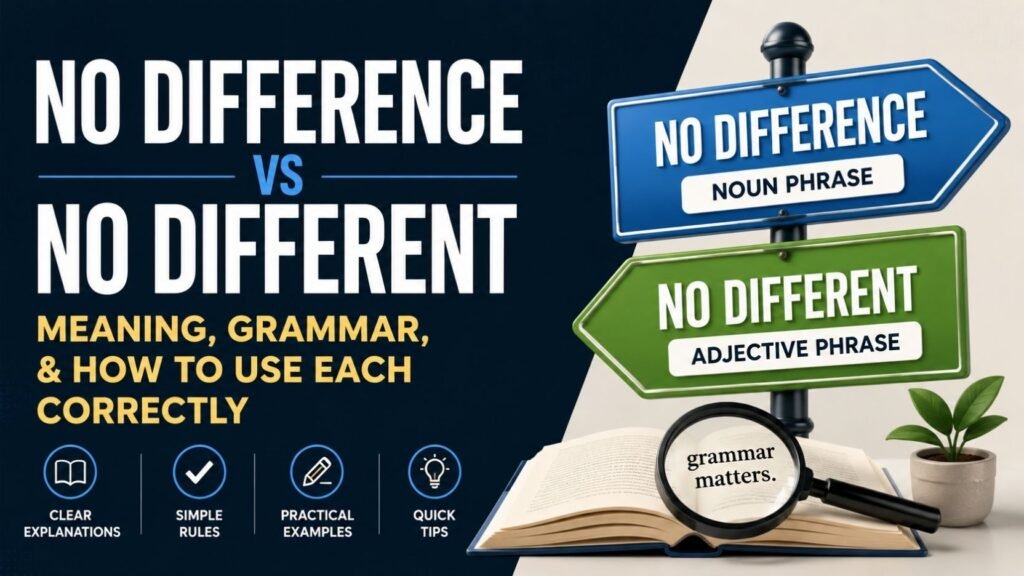
“No difference” and “no different” look almost identical, but they work in completely different ways. One is a noun phrase. The other is an adjective phrase. Mixing them up is one of the most common small grammar mistakes English speakers make, even native speakers.
If you have ever paused mid sentence wondering whether to say “there is no difference” or “it is no different,” you are not alone. This article breaks down the exact meaning of each phrase, the grammar rule behind them, and clear examples so you never have to guess again.
Understanding this distinction also helps with related expressions you hear often, like “it makes no difference,” “you’re no different,” and “no different than” versus “no different from.” Each of these follows the same core grammar logic, so once you understand the base rule, the rest becomes easy.
What Does No Difference Mean?
“No difference” means there is zero distinction between two or more things. It says that two items, situations, or people are essentially the same in some way.
“Difference” here is a noun. It refers to the quality or state of being unlike something else. When you place “no” in front of it, you are saying that quality does not exist between the things being compared.
Example:
- There is no difference between the two paint colors.
- I see no difference in the results.
In both examples, “difference” is functioning as a thing, an idea you can point to. You are commenting on the absence of that thing.
What Does No Different Mean?
“No different” means something is the same as something else, but here the word “different” is an adjective. It describes a noun directly, usually a person, situation, or object.
Example:
- This restaurant is no different from the one we visited last week.
- You’re no different than everyone else in this room.
Here, “different” is describing the subject of the sentence: the restaurant, or “you.” It is not naming a thing called “difference.” It is describing a quality that the subject either has or lacks.
No Difference Vs No Different: The Core Grammar Rule
The easiest way to remember the difference is this:
| Phrase | Part of Speech | What It Modifies | Typical Sentence Pattern |
| No difference | Noun phrase | Stands alone as a subject or object | There is no difference between A and B |
| No different | Adjective phrase | Describes a noun or pronoun | A is no different from B |
“Difference” needs a linking structure like “there is” or “I see” because it behaves like an object in the sentence. “Different” attaches directly to a subject through a linking verb, most often “is,” “are,” “was,” or “were.”
💡 Quick Tip: If you can replace the word with “distinction” and the sentence still makes sense, use “difference.” If you can replace it with “similar” or “identical” and the sentence still works, use “different.”
- There is no distinction between the two brands.
✅ (works, so “difference” is correct) - This brand is no similar from the other one.
❌ (does not work grammatically, confirming “different” needs a linking verb, not “there is”)
How No Difference Is Used in a Sentence
“No difference” almost always appears after an introductory phrase such as “there is,” “there was,” “I see,” “I notice,” or “it makes.”
Common patterns:
- There is no difference between X and Y.
- I see no difference in the outcome.
- It makes no difference to me.
- There was no difference in the test scores.
Notice that “difference” is treated as a countable idea, something you can observe, measure, or point to. This is why verbs like “see,” “notice,” and “make” pair naturally with it.
It Makes No Difference
This is one of the most frequent versions of the phrase. “It makes no difference” means the outcome or result stays the same no matter what choice is made. It is often used to express that a decision does not matter, either because both options are equal or because the speaker feels indifferent.
Example:
- Whether we leave now or in an hour, it makes no difference to the arrival time.
- It makes no difference to me which restaurant we choose.
This phrase can sound neutral (a factual statement about outcomes) or slightly emotional (a statement of indifference), depending on tone and context.
How No Different Is Used in a Sentence
“No different” pairs with a linking verb and is usually followed by “from,” “than,” or sometimes “to” in British English.
Common patterns:
- A is no different from B.
- You’re no different than the rest of us.
- This situation is no different to what happened last year.
Because “different” is an adjective, it directly modifies the subject. The sentence is making a judgment or observation about that subject’s nature, not describing an abstract idea.
Example:
- My experience was no different from yours.
- The new policy is no different than the old one.
No Different Than or No Different From: Which Is Correct?
Both “no different from” and “no different than” are widely used, but they are not identical in formal writing.
- No different from is generally considered the more traditional and grammatically preferred choice, especially in formal American English. “From” pairs naturally with “different” because you are marking a separation point between two things being compared.
- No different than is extremely common in everyday speech and is now widely accepted, particularly in American English, especially when followed by a clause rather than a single noun.
Example:
- This car is no different from that one. (comparing two nouns directly)
- The result was no different than what we expected. (comparing against a clause)
In British English, “no different to” is also commonly heard and accepted.
✅ Correct: The outcome is no different from what we predicted.
✅ Acceptable in most contexts: The outcome is no different than what we predicted.
⚠️ Less common but not wrong: The outcome is no different to what we predicted. (mainly British usage)
There is no strict rule that makes one version incorrect. Style guides simply tend to favor “from” in formal writing.
Side by Side Comparison With Examples
| Sentence Type | Correct Example | Why It Works |
| Using “no difference” | There is no difference between the two plans. | “Difference” is a noun, so it needs “there is” |
| Using “no different” | The two plans are no different. | “Different” is an adjective describing “plans” |
| Incorrect mix | The two plans have no different. ❌ | “Different” cannot follow “have” as a noun |
| Incorrect mix | This is no difference from that. ❌ | “Difference” cannot follow “is” like an adjective |
This table highlights the single biggest mistake people make: treating “different” like a noun or “difference” like an adjective. Once you see them side by side, the pattern becomes clear.
Common Mistakes With No Difference and No Different
Mistake 1: Using “difference” where an adjective is needed
❌ Incorrect: My opinion is no difference from yours.
✅ Correct: My opinion is no different from yours.
Here, the sentence needs an adjective to describe “opinion,” so “different” is correct.
Mistake 2: Using “different” where a noun is needed
❌ Incorrect: There is no different between the two.
✅ Correct: There is no difference between the two.
Here, “difference” is required because it follows “there is,” which needs a noun.
Mistake 3: Dropping the linking verb before “different”
❌ Incorrect: This situation no different from before.
✅ Correct: This situation is no different from before.
“Different” needs a linking verb such as “is,” “was,” or “seems” to connect it to the subject.
Mistake 4: Confusing “different than” with “differently than”
❌ Incorrect: He acted no different than expected. (when describing an action, not a state)
✅ Correct: He acted no differently than expected.
When describing how an action was performed, the adverb “differently” is often more accurate than the adjective “different.”
No Different Vs Not Different: Is There a Difference?
“No different” and “not different” can sometimes be used interchangeably, but they carry a slightly different tone.
- “No different” tends to sound more natural and idiomatic in everyday English. It often implies a direct comparison.
- “Not different” is grammatically correct but sounds more clinical or formal, and is used less often in casual speech.
Example:
- This year’s results are no different from last year’s. (natural, commonly used)
- This year’s results are not different from last year’s. (correct, but less common in speech)
Both are grammatically valid. “No different” is simply the more idiomatic choice in most everyday contexts.
Synonyms for No Different
| Word or Phrase | Meaning | Typical Usage |
| Identical | Exactly the same in every way | Used when things are truly indistinguishable |
| The same as | Equal or matching | Neutral, everyday comparison |
| Similar to | Alike but not exactly equal | Used when there are small variations |
| Indistinguishable from | Cannot be told apart | Used in more formal or technical writing |
These synonyms can replace “no different” depending on how strong or precise the comparison needs to be. “Identical” and “indistinguishable” are stronger claims than “no different,” which can sometimes allow for minor variation while still meaning “essentially the same.”
Synonyms for No Difference
| Word or Phrase | Meaning | Typical Usage |
| No distinction | No noticeable separation between two things | Formal or descriptive contexts |
| Equal | Having the same value or status | Comparisons involving measurement or value |
| Same result | Outcome does not change | Used when talking about consequences |
| Nothing to separate them | Informal way of saying two things are equal | Conversational tone |
Pronunciation
Both phrases are made of common English words, so pronunciation is straightforward, but stress placement matters for clarity.
- No difference: stress falls on the first syllable of “difference” (DIF-er-ence). The phrase is usually spoken smoothly, with “no” lightly stressed and “difference” carrying the main emphasis.
- No different: stress falls on the first syllable of “different” (DIF-er-ent). The rhythm is very similar to “no difference,” since both words share the same root and stress pattern.
Because “difference” and “different” come from the same root word, they are pronounced almost identically except for the final sound: “difference” ends in an “s” sound, while “different” ends in a “t” sound.
Origin Of Difference And Different
Both words trace back to the Latin word “differre,” meaning “to carry apart” or “to be unlike.” This Latin root entered English through Old French, eventually forming two separate paths:
- “Difference” developed as the noun form, describing the state or fact of being unlike something.
- “Different” developed as the adjective form, describing something that has that quality.
This shared origin explains why the two words look so similar today, even though they now serve different grammatical roles in a sentence.
Frequently Asked Questions
What does “no difference” mean?
“No difference” means there is no distinction between two or more things. It functions as a noun phrase and usually follows expressions like “there is” or “I see.”
What does “no different” mean?
“No different” means something is essentially the same as something else. It functions as an adjective phrase and follows a linking verb such as “is” or “was.”
Is “no different” a noun or an adjective?
“No different” uses “different” as an adjective. It describes a noun or pronoun rather than naming a thing.
Is “no difference” a noun or an adjective?
“No difference” uses “difference” as a noun. It names an idea or quality rather than describing something directly.
Which is correct: “no different from” or “no different than”?
Both are used in everyday English. “No different from” is generally preferred in formal writing, while “no different than” is common and accepted in conversational American English.
Can I say “there is no different”?
No. “There is” requires a noun, so the correct phrase is “there is no difference.”
Can I say “this is no difference”?
No. “This is” requires an adjective or noun that directly describes the subject, so the correct phrase is “this is no different.”
What is the difference between “no different” and “not different”?
Both are grammatically correct, but “no different” sounds more natural and is used more often in everyday speech. “Not different” is more formal and less common in casual conversation.
Does “it makes no difference” mean the same as “it is no different”?
They are closely related but not identical. “It makes no difference” usually refers to an outcome not changing based on a choice. “It is no different” usually compares one thing directly to another.
Is “no different” formal or informal?
“No different” is neutral and works in both formal and informal writing, as long as it is paired correctly with a linking verb and a comparison word like “from” or “than.”
Conclusion
The difference between “no difference” and “no different” comes down to one simple grammar rule: “difference” is a noun, and “different” is an adjective. “No difference” needs an introductory phrase like “there is” or “I see,” while “no different” needs a linking verb such as “is” or “was” to connect it to the subject being described. Once you recognize which role the sentence needs, the correct choice becomes automatic.
Keep this rule in mind the next time you write or speak: ask whether you are naming an idea or describing a subject. If you are naming an idea, use “no difference.” If you are describing a subject, use “no different.” With that one question, you will never confuse the two again.

Abdul Rehman Jutt is the author behind Grammar Wordz, with 4 years of experience researching and writing about English grammar, words, meanings, and language rules. Their goal is to make grammar simple, clear, and easy to understand through accurate and useful explanations.